
The second-shift millwright is scheduled to change out a gearbox on the number three conveyor. He climbs to the platform, sees the machine guard that has been zip-tied open since the last changeover, and tells his supervisor he is not doing the job until the guard is back on. The supervisor writes him up for refusing an assignment. Days later a letter arrives from OSHA’s whistleblower program.
There is a right to refuse dangerous work under the OSH Act, and it is narrower than its reputation. The evidence that most often matters in one of these cases is what the worker reported before refusing, and whether you can produce a record of it.
The default rule is that refusing an assignment is not protected
OSHA’s interpretive regulation on employee rights, 29 CFR 1977.12, opens at paragraph (a) by confirming that section 11(c) protects employees who exercise any right afforded by the Act. Paragraph (b)(1) then reaches the opposite of what most people assume about refusals. On the other hand, it says, review of the Act and its legislative history “discloses that, as a general matter, there is no right afforded by the Act which would entitle employees to walk off the job because of potential unsafe conditions at the workplace.” The reasoning follows in the same paragraph. Hazardous conditions which may be violative of the Act “will ordinarily be corrected by the employer, once brought to his attention,” and if corrections are not accomplished, or if there is a dispute about whether the hazard exists at all, the employee will normally have the opportunity to request an inspection under section 8(f) of the Act or to seek the assistance of other public agencies with responsibility in the field of safety and health. On that reading, disciplining someone for refusing normal job activities over an alleged hazard is not ordinarily a violation of section 11(c).
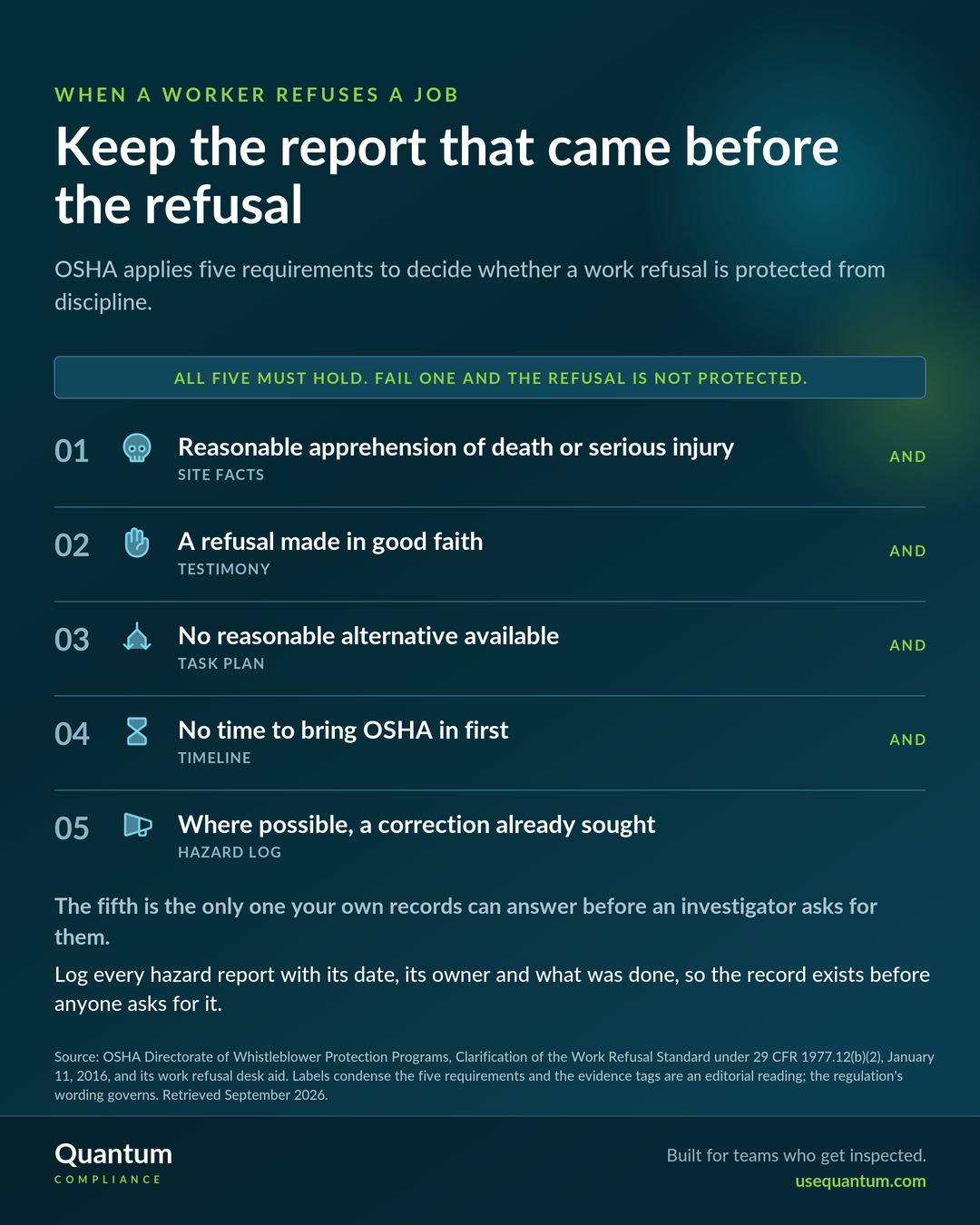
Paragraph (b)(2) then carves out the exception. Every clause in it is load-bearing. An employee who is “confronted with a choice between not performing assigned tasks or subjecting himself to serious injury or death arising from a hazardous condition at the workplace,” and who “with no reasonable alternative, refuses in good faith to expose himself to the dangerous condition,” is protected against later discrimination. The paragraph adds a reasonable-person test and a timing test, then closes on a sentence that tends to get overlooked: “In addition, in such circumstances, the employee, where possible, must also have sought from his employer, and been unable to obtain, a correction of the dangerous condition.”
The Whistleblower Investigations Manual breaks that paragraph into five requirements
In a January 2016 memorandum to regional administrators, the Directorate of Whistleblower Protection Programs set out how its own investigators are supposed to apply the paragraph, noting that the Whistleblower Investigations Manual at Chapter 2.V.A.7 breaks the language into five requirements. The memo is guidance to OSHA staff and not a rule binding on employers, which is what makes it useful: it shows what an investigator will look for if a refusal at your site becomes a complaint.
THE FIVE REQUIREMENTS, AND WHAT AN INVESTIGATOR ASKS
| Requirement under 1977.12(b)(2) | The question behind it |
|---|---|
| A reasonable apprehension of death or serious injury | Would a reasonable person facing the same conditions conclude there was real danger? The risk need not be imminent. |
| A good faith refusal | Did the worker genuinely believe the danger was real? |
| No reasonable alternative | Was there a different task the worker could have performed, or could the same task easily have been performed in a safer manner? |
| Insufficient time to eliminate the condition through regular statutory channels | Was there a period in which the worker reasonably could have contacted federal or state OSHA? |
| Where possible, the employee sought and was unable to obtain a correction of the dangerous condition | Was it reasonable to expect this worker to raise the concern with the employer, and did the worker request a correction? |
Source: OSHA, Clarification of the Work Refusal Standard under 29 CFR 1977.12(b)(2), January 11, 2016, including the attached work refusal desk aid. Retrieved September 2026.
The phrase “where possible” in the fifth requirement carries a reasonableness gate, and the question splits in two. Was it reasonable to expect this worker to raise the condition first, and did they. Someone who finds a guard missing at the moment the job starts may have had no opportunity to report anything. Where the same condition has been raised repeatedly over three weeks, your hazard reporting records are what answer both halves.
Two of the four trends the memo flags
The memo identifies four recurring problems in how work refusal cases are handled. Two of them describe the way employers tend to assess a refusal internally as well.
The first involves timing. The memo points out that the Supreme Court interpreted the insufficient-time criterion in Whirlpool Corp. v. Marshall, 445 U.S. 1, 10-11 (1980), to mean there was insufficient time to apprise OSHA of the danger, and then states the consequence plainly: “It is not an absolute requirement that a complainant call federal or state OSHA after being instructed to perform a dangerous task.” Complaints were being dismissed anyway on the ground that the worker had not called. The question investigators are told to ask is narrower, whether the complainant called OSHA and, if not, whether there was a period during which they reasonably could have.
The second trend is broader, and it is the reason earlier reports carry so much weight. A work refusal is one kind of protected activity among several. The memo instructs staff to administratively close a case on the basis of an unprotected work refusal only where both conditions hold, that the complainant is not alleging any additional protected activity and that the refusal fails the requirements of 1977.12(b)(2). It then observes that “in many cases, other forms of protected activity usually precede the actual refusal, such as the complainant raising a safety-related concern before refusing to perform a task.” A refusal that fails all five requirements can still leave that earlier report standing on its own.
22%
Approximate share of the cases discussed at the DWPP Review Forum and the Department of Labor Review Committee in FY 2014 that involved a possible misapplication of the work refusal regulation
Source: OSHA Directorate of Whistleblower Protection Programs, January 11, 2016. Scope is cases reviewed at those two bodies, not all Section 11(c) complaints. Retrieved September 2026.
The same memo records 165 complaints administratively closed in FY 2014 on the basis of an unprotected work refusal, 3.9 percent of the Section 11(c) complaints administratively closed that year, and 138 such closures in FY 2015, representing 3.3 percent. OSHA’s own reading of those figures is that the problems it identified implicate a large percentage of the whistleblower program’s work across the country.
What to do about it
A refusal is the last stop in a sequence that started somewhere upstream. The controls below are ordered so the ones that change conditions come before the ones that depend on training and paperwork.
Six controls, in order
A guard that has been zip-tied open since the last changeover is a maintenance item with an owner and a due date, and it stays one until somebody closes it.
If reporting means tracking down the supervisor who just handed out the assignment, conditions go unreported until someone is standing in front of one.
Date, location, a photo, and the description as it was given. Reconstructing that description three days later leaves you with a weaker record.
Then record what was done and when. A report that has sat unassigned for a month is the first thing an investigator will ask about.
Train supervisors that the first response to a refusal is an assessment of the condition. A write-up issued before anyone has looked at the machine is what turns a fixable guard into a federal complaint.
Two refusals on the same asset point at a problem with that asset, and the report history usually shows it first.
Step five is the one that most often converts a safety problem into a legal one. The condition and the conduct are separate questions, and they are best answered in that order.
How Q-Hazard Can Help
Q-Hazard handles steps two, three and four directly. Workers report a condition from the floor using the mobile app or by scanning a QR code at the point of work, attach photos or video, and set the severity, hazard type and contributing factors themselves. Real-time alerts and escalation workflows send the report to the location manager and EHS staff who can act on it. Corrective actions are assigned with due dates, documented and verified, and hazard resolution tracking keeps the status of each report visible as it moves toward closure.
For step six, hazard and corrective action data export from the list views, either the full list, the filtered view, or hand-picked rows, so a year of reports on one asset can be reviewed together. The platform will not tell you whether a particular refusal was protected. That call turns on the condition, the timing, the alternatives available in that moment, and the advice of your own counsel. What it gives you is a dated record rather than a recollection when someone asks what was reported and what was done about it. If you are working the upstream side of step one, structured scheduled checks live in Q-Inspection, and the wider platform is outlined on the Quantum EHS platform page.