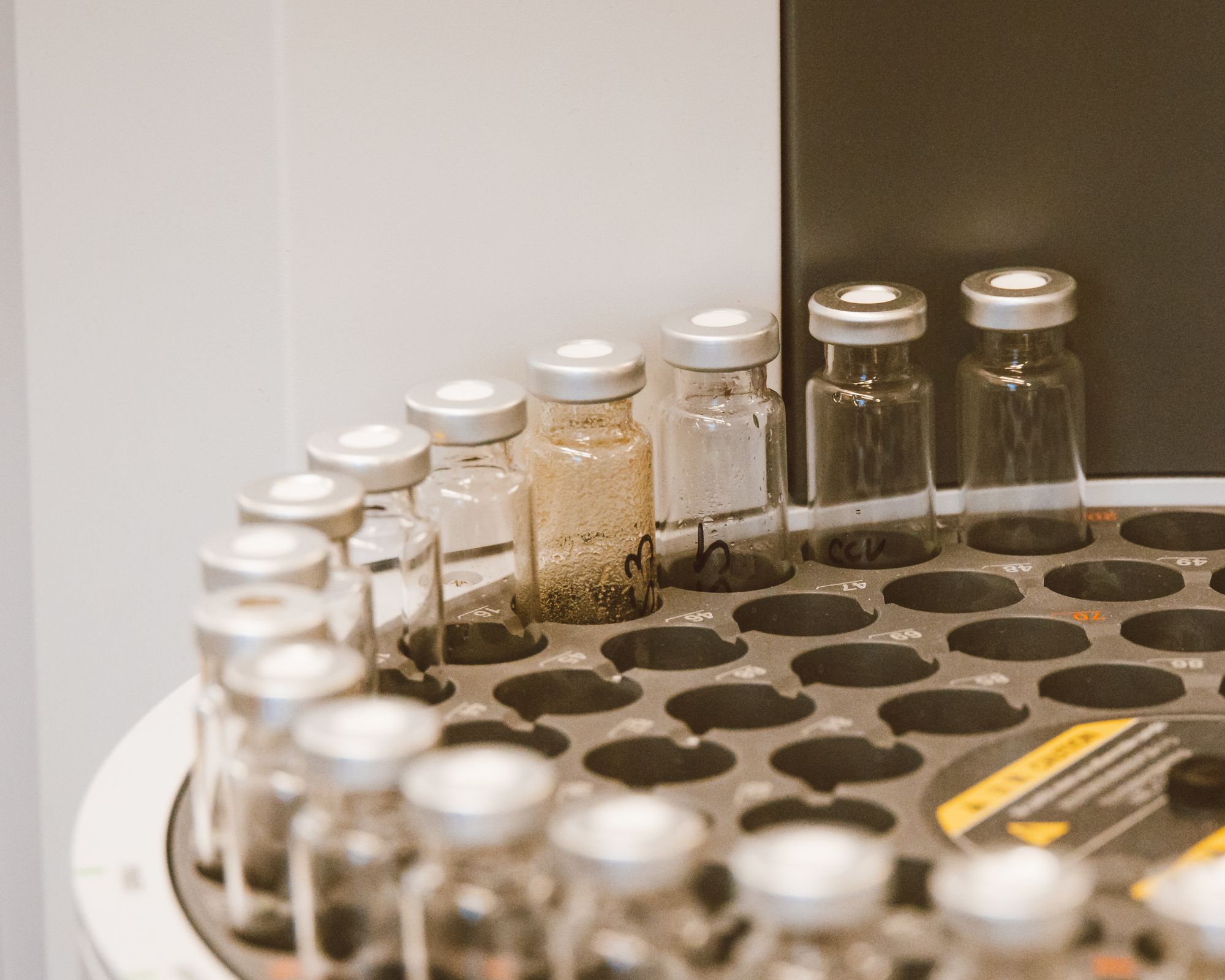
A utilities technician opens a boiler water test kit at the start of his shift, snaps a strip of 2 ml reagent ampoules out of the tray, drops them into the drawer of his test cart, and breaks the kit box down for recycling. Two weeks later you find those ampoules during a walk-through. Each one carries a product name and very little else. The pictograms, hazard statements and first aid instructions were printed on the box, and the box is gone.
Under the 2024 update to OSHA’s Hazard Communication Standard, those ampoules may have shipped exactly as the rule allows. Paragraph (f)(12) gives chemical manufacturers, importers and distributors formal relief for very small containers, on the condition that the complete label travels on the immediate outer package. Once the chemical reaches your site, your own duties under (f)(9) and (f)(6) govern what happens to that carton.
3 ml
At or below this capacity, where a supplier can demonstrate that a full label is not feasible and that any label would interfere with normal use, the container may carry only the product identifier
What Paragraph (f)(12) Allows Suppliers to Do
The small container provisions apply only where the supplier “can demonstrate that it is not feasible to use pull-out labels, fold-back labels, or tags containing the full label information.” Size alone does not trigger the relief. A 50 ml bottle that could carry a pull-out label, fold-back label or tag is still expected to carry the full label.
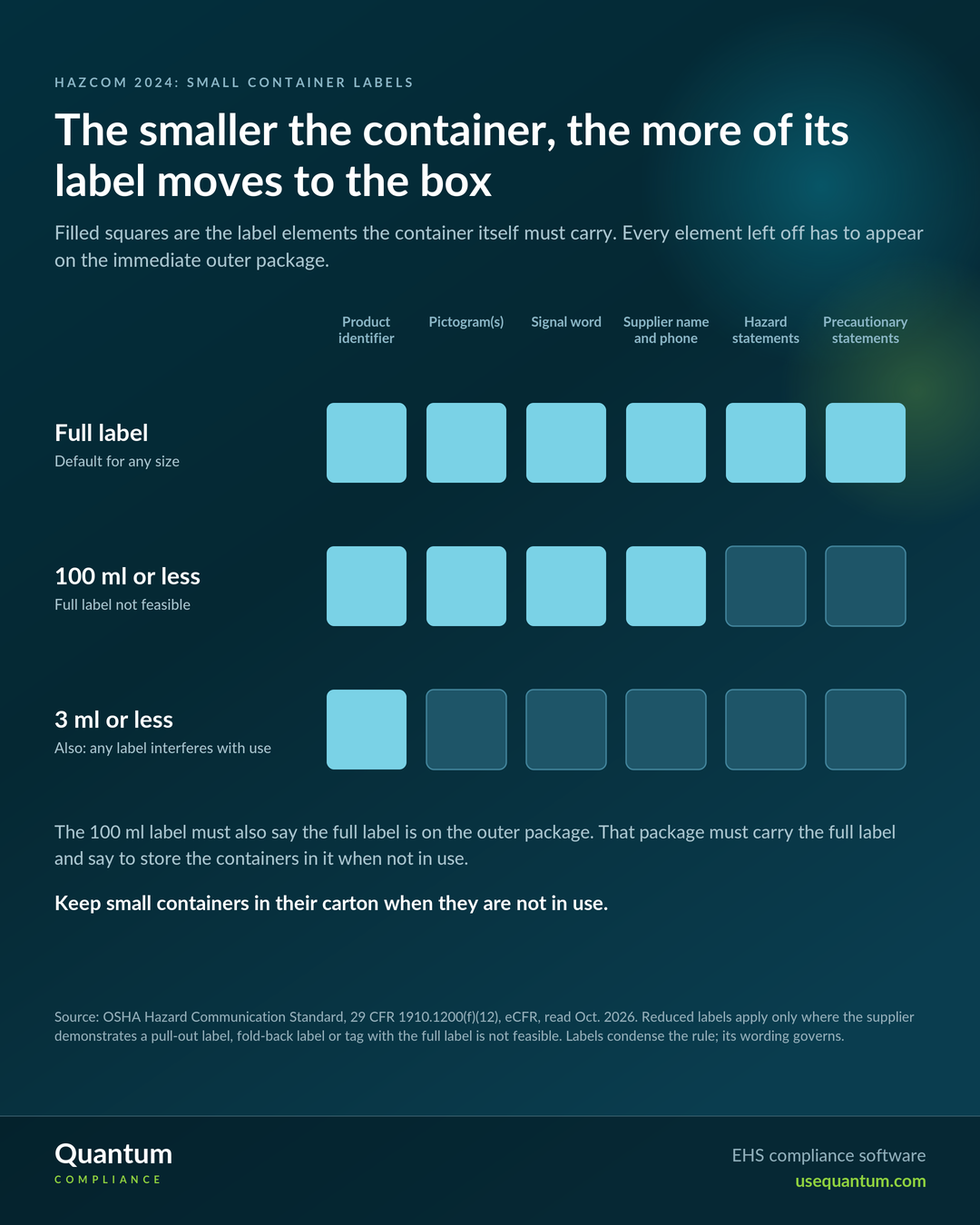
Once that feasibility condition is met, the rule sets two tiers. A container of 100 ml capacity or less must carry, at a minimum, the product identifier, pictogram(s), signal word, the manufacturer’s name and phone number, and a statement that the full label information is on the immediate outer package. A container of 3 ml or less can go further. If the supplier can also demonstrate that any label interferes with the normal use of the container, no label is required, and the container only has to bear the product identifier. Both conditions must hold for that second tier, so a 2 ml vial that could take a small label without getting in the way belongs in the 100 ml tier.
For every container in either tier, the immediate outer package must carry the complete (f)(1) label for each hazardous chemical inside, along with a statement that the small containers “must be stored in the immediate outer package bearing the complete label when not in use.”
What Must Appear Where Under 1910.1200(f)(12)
| Container | Minimum on the container | On the immediate outer package |
|---|---|---|
| Larger than 100 ml, or any size where a pull-out label, fold-back label or tag is feasible | Full (f)(1) label | Not addressed by (f)(12) |
| 100 ml or less, full label not feasible | Product identifier, pictogram(s), signal word, manufacturer name and phone number, statement that the full label is on the outer package | Full (f)(1) label for each hazardous chemical, plus a statement to store the small containers in the package when not in use |
| 3 ml or less, full label not feasible and any label interferes with normal use | Product identifier | Same as above |
Where Your Obligations as the Employer Begin
Two employer provisions decide what happens after delivery. The first, (f)(9), says the employer “shall not remove or deface existing labels on incoming containers of hazardous chemicals, unless the container is immediately marked with the required information,” and (f)(12)(iv)(A) points back to that duty for the outer package label specifically. Breaking down the kit box removes the only complete label those ampoules had.
Under (f)(6), subject to the exceptions in (f)(7) and (f)(8), each container of hazardous chemicals in the workplace must be labeled, tagged or marked with either the information in (f)(1)(i) through (v), or the product identifier plus words, pictures or symbols that give at least general information about the hazards and, together with other information immediately available to employees under your HazCom program, provide specific hazard information. A 100 ml tier label with a pictogram and signal word likely carries the kind of general hazard information (f)(6)(ii) describes. At 3 ml, a product identifier alone gives no hazard information, so once that container leaves its package the worker is relying entirely on whatever else your program puts in front of them.
Laboratories, as the standard defines them, are covered more narrowly. For them, (b)(3) sets out a short list of duties, and workplace labeling is not on it. The first item on that list requires employers to “ensure that labels on incoming containers of hazardous chemicals are not removed or defaced,” so in a lab the outer package label still has to survive.
Small containers your own people fill are a separate case. When a technician decants a stock solution into dropper bottles, those bottles fall under ordinary workplace labeling. The portable container exemption in (f)(8) covers only containers “intended only for the immediate use of the employee who performs the transfer.”
When These Labels Reach Your Shelves
The revised standard took effect July 19, 2024, with staggered compliance dates. Suppliers evaluating substances had to comply with the modified provisions by May 19, 2026, and suppliers evaluating mixtures have until November 19, 2027. During the transition either the revised standard or the prior version may be followed, so labels on your shelves may follow either one. OSHA’s final rule preamble explains that it had already allowed limited small container labels through letters of interpretation and its compliance directive, provided complete label information appeared on the outside packaging. The 2024 rule wrote that accommodation into the standard. Under paragraph (j), employers also have until November 20, 2026 to update alternative workplace labeling, the written program and training for newly identified hazards in substances, and until May 19, 2028 for mixtures. OSHA’s HCS questions and answers lay out the same schedule.
What to Do About Small Containers on Your Site
Boxes often get thrown out because the storage layout has no place for them. Fix the layout before you write the rule.
Steps to Keep Small Container Hazard Information With the Chemical
Size cart drawers and shelf bins so the carton fits. If storing the box is the easy path, people take it.
Whoever unpacks orders looks for the “full label on outer package” statement and sends those cartons to storage intact.
Keep small containers in their outer package when not in use, as the supplier statement directs. Any container your staff fill gets a workplace label that meets (f)(6) unless the (f)(8) exemption applies.
Small labels leave out most of the hazard text, so make the safety data sheet reachable from where the container is used.
Training under (h)(3)(iv) already has to explain labels received on shipped containers. Add what the outer package statement means.
Loose ampoules and vials with no carton nearby are the sign that steps one and two are not holding.
Safety data sheets must already be “readily accessible during each work shift to employees when they are in their work area(s)” under (g)(8), and a container that carries only a product name sends the worker straight to that sheet. An SDS a worker can open by scanning a label is the practical version of that requirement on a test cart or a maintenance cart.
How Q-Chem Can Help
Q-Chem supports the labeling half of step three, and step four. Its GHS secondary label printing builds workplace labels from SDS data already extracted into structured fields, and every label carries the product identifier, pictogram, signal word and manufacturer information, with hazard and precautionary statements added where the label size leaves room. Each label also prints a QR code that opens the full safety data sheet on any phone with no login, which is most useful on exactly the small labels where text has to be cut. On the SDS side, import tools now detect chemical components even when a manufacturer lists them outside the usual section.
Carton storage and the receiving routine in steps one and two are facilities and process decisions that stay with your team. To see how Quantum Chemical Management fits your site, contact sales@usequantum.com.