
On the morning of September 15, a safety manager at a regional distribution center pulls up OSHA’s preliminary Top 10 list for fiscal year 2026 looking for anything new, and finds very little. Her site runs a dozen forklifts, her maintenance crew locks out conveyor drives every week, the paint booth crew wears half-face respirators, and the coatings they spray arrive with safety data sheets. At least four of the ten standards on the list apply to her floor, five if you count the guarding on those conveyors.
The same ten standards appeared on the FY 2025 list, and Fall Protection held the top spot for the 16th consecutive fiscal year. Half of those standards also spell out an inspection the employer has to perform and how often it has to happen. When those inspections run on schedule and defects get acted on, many of the conditions behind these citations get caught before a compliance officer finds them.
What OSHA Announced for FY 2026
Prent Cline, acting deputy director of OSHA’s Directorate of Enforcement Programs, presented the list at the 2026 NSC Safety Congress & Expo in Indianapolis. According to Safety+Health magazine’s report on the session, the data comes from the OSHA Information System for October 1, 2025, through August 31, 2026, and it is preliminary. Safety+Health says updated data will appear in its December issue, so read the counts below as an eleven-month snapshot.
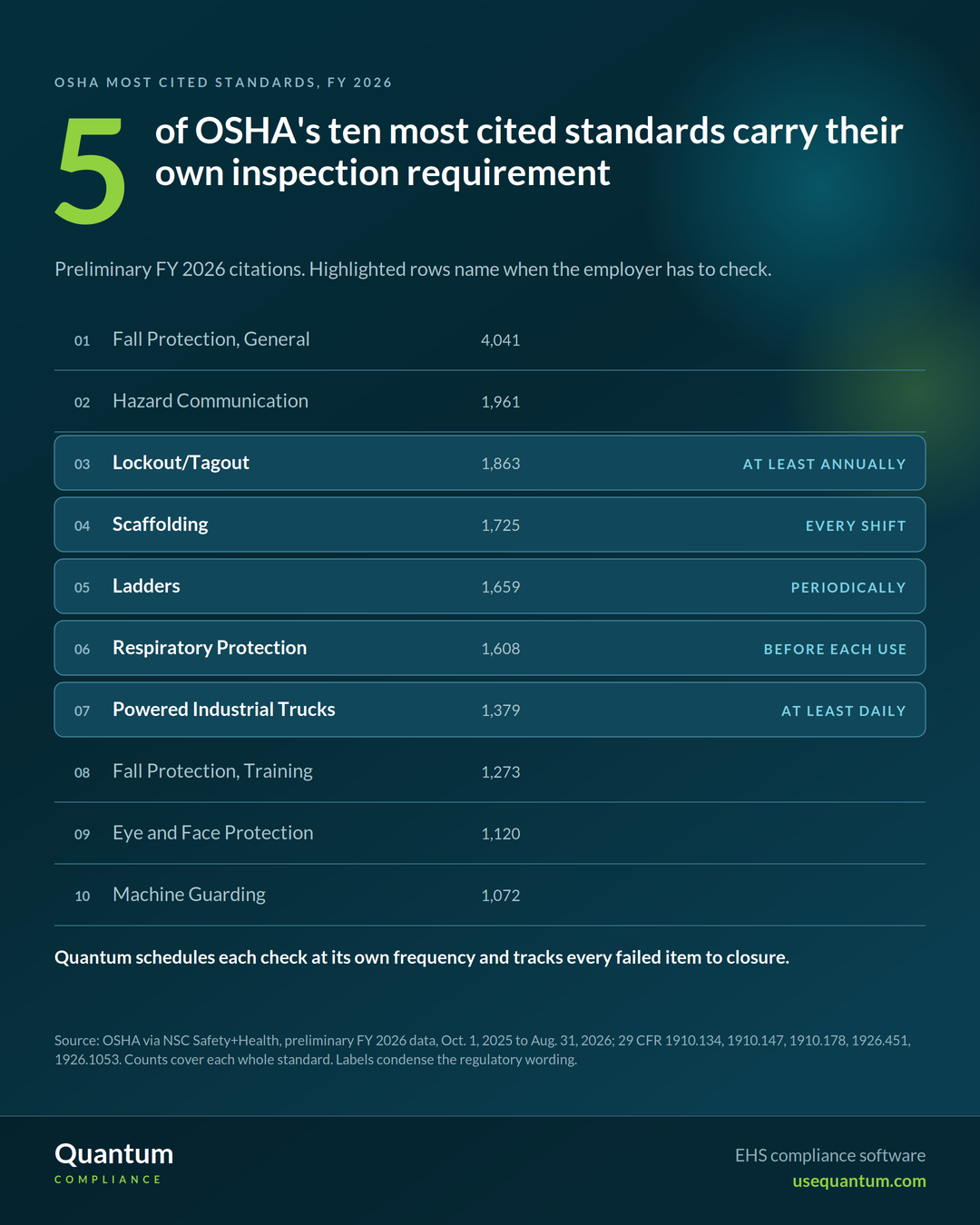
OSHA’s Most Frequently Cited Standards, FY 2026 (Preliminary)
Violations cited October 1, 2025 through August 31, 2026. Standards marked ● include a recurring inspection requirement discussed below.
Source: Safety+Health (NSC), OSHA Top 10 for FY 2026, preliminary data
Each count covers every subsection of a standard. The 1,863 Lockout/Tagout violations, for example, can include missing procedures alongside missed periodic inspections, so the chart shows where citations cluster across a whole standard.
Why the Same Standards Keep Coming Back
“Fall protection violations are often a failure to manage the job,” Cline said during the presentation, and the framing applies well beyond falls. A missing guardrail or a cracked ladder rail usually means the job was planned without the control, or the equipment degraded and nothing in the process was set up to notice.
A list that repeats year after year suggests the systems producing these conditions have stayed much the same. Retraining the worker who was standing on the defective ladder when the compliance officer walked in feels like action. The process that let the ladder stay in service is still there the next morning.
Five Standards on the List Include a Built-In Inspection Cycle
Five of the ten standards on the FY 2026 list carry their own inspection requirement in the regulatory text. Frequency and documentation rules differ from one standard to the next, so a single annual audit calendar can miss most of them.
Inspection Requirements Inside the FY 2026 Top 10
| Standard | What the text requires | Written record? |
|---|---|---|
| Scaffolding, 1926.451(f)(3) | Competent person inspects for visible defects before each work shift and after any occurrence that could affect structural integrity | Not specified in this paragraph |
| Ladders, 1926.1053(b)(15) | Competent person inspects for visible defects on a periodic basis and after any occurrence that could affect safe use | Not specified in this paragraph |
| Powered Industrial Trucks, 1910.178(q)(7) | Examined before being placed in service, at least daily, and after each shift when used round the clock | Not required, per an OSHA interpretation letter |
| Respiratory Protection, 1910.134(h)(3) | Routine-use respirators before each use and during cleaning; emergency-use respirators at least monthly, per the manufacturer’s recommendations, and function-checked before and after each use; escape-only units before being carried into the workplace | Required for emergency-use respirators |
| Lockout/Tagout, 1910.147(c)(6) | Periodic inspection of each energy control procedure at least annually, by an authorized employee other than the ones using it | Required: certification naming the equipment, date, employees included, and inspector |
Source: OSHA, 29 CFR 1910 and 1926 regulatory text. Scaffolding and Ladders are construction standards under Part 1926.
A record is how you show an inspection happened, even when the rule does not demand one. OSHA has said forklift examinations do not have to be documented, and 1910.178(q)(7) still says a truck with a condition affecting its safety shall not be placed in service. A site with no trace of a daily check has a hard time proving it met that second requirement.
These inspections lean on the rest of the program more than a regulation-by-regulation reading suggests. Ladder and scaffold checks include an “after any occurrence” trigger, and that only works if someone reports the occurrence. A forklift check is only as good as what happens to the truck afterward; under 1910.178(p)(1), a defective truck is taken out of service until restored to safe operating condition.
What to Do Before Next Year’s List
Steps to Turn Inspection Requirements Into Working Controls
Fixed platforms and guardrails in place of portable ladders on recurring tasks, and permanent isolation points on equipment that gets serviced often, remove exposure before any inspection is needed.
Shift-start checks for scaffolds, at least daily checks for trucks (after each shift if they run round the clock), before-use checks for respirators, and an annual cycle for each energy control procedure, each assigned to a named person.
Tag and remove defective ladders and trucks on the spot, with a physical place to put them and someone authorized to return them to service.
A finding that lives only in a note gets lost. Assign the repair, track it, and verify it before closing.
Look at which items fail repeatedly and fix the upstream cause, whether that is how equipment gets bought or how the job gets planned, before scheduling refresher training.
Training sits last because it is the weakest control in the hierarchy, and a training fix applied to a design or maintenance problem will keep producing the same finding.
For the distribution center in the opening example, that works out to a short, specific list. Forklifts get examined at least daily, and she chooses to do it at the start of every shift they run, with a tag and a parking spot for any truck that fails. The paint booth crew checks respirators before each use. Once a year, every conveyor lockout procedure gets its periodic inspection from an authorized employee other than those who use that procedure, and the certification goes on file. Her stepladders are not covered by the construction ladder standard on the list, but the general industry rule at 1910.23(b)(9) is more specific, requiring an inspection before initial use in each work shift. All of it fits inside the program she already runs once the schedule exists and the results have somewhere to go.
How Q-Inspection Can Help
Quantum’s Inspection & Audit module handles steps two and four directly. You can build custom checklists by task type, schedule them at the frequency each standard requires, and have inspectors complete them on a phone at the scaffold or the charging station. Some platforms now let frontline workers open a form by scanning a QR code and entering only an employee ID, with no app download or password, and Quantum supports that for inspections. When an item fails, a corrective action is assigned automatically and tracked through verification and closure, and the completed records stay available for an audit or a compliance officer’s visit.
The module schedules each check and keeps a failed item open until someone fixes it. Deciding whether a scaffold is sound, and physically pulling a truck out of service, stay with the competent person and supervisors on the floor, which is why steps one and three are yours to build. To see how it fits alongside the rest of your program, explore the Quantum EHS platform or contact sales@usequantum.com.