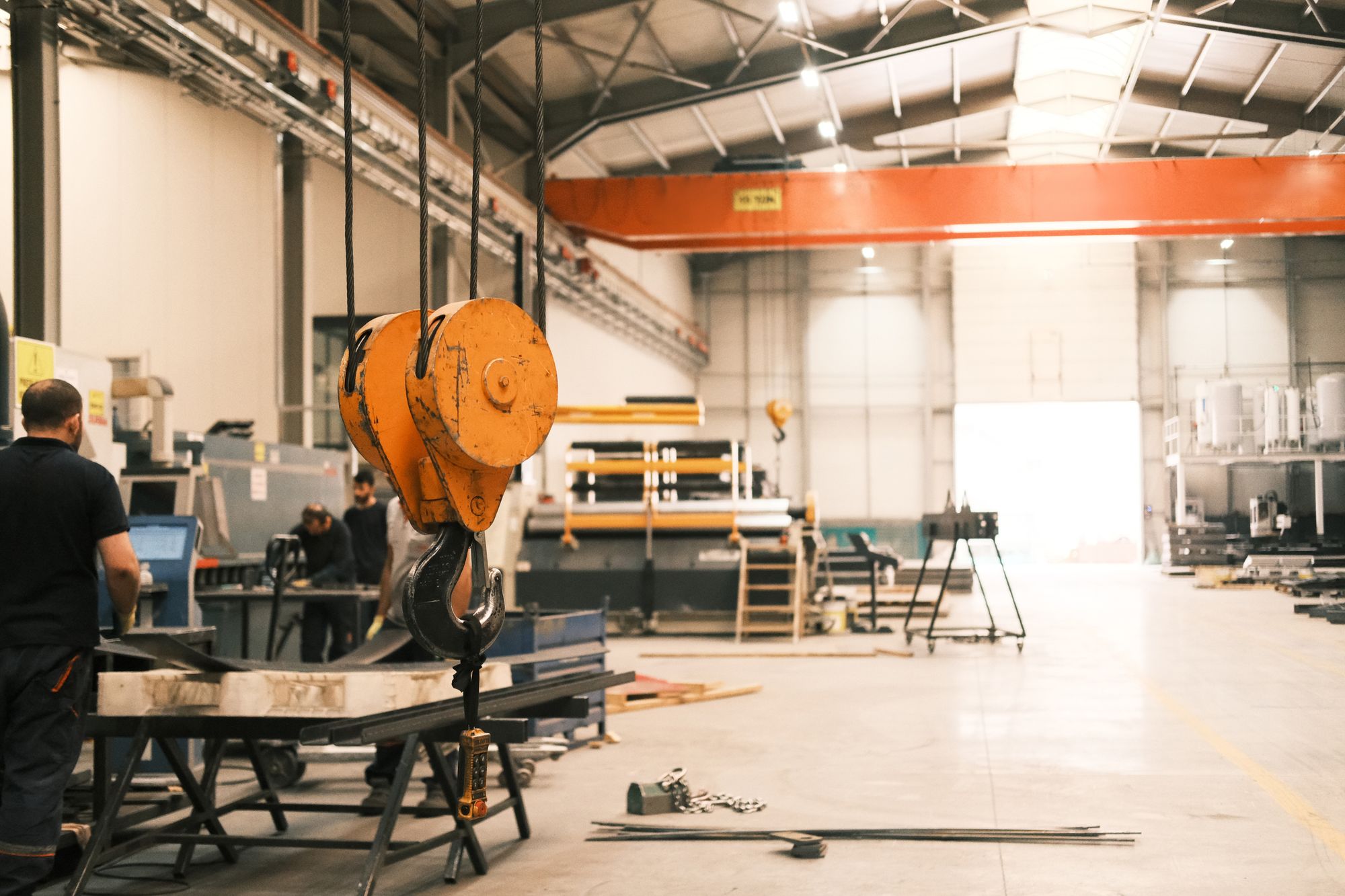
Second shift is pulling a gearbox off a line conveyor. The lead grabs a synthetic web sling from the hook by the bay door, chokes it around the housing, and signals the hoist. With the load a foot off the floor, he notices the edge of the sling is cut almost a third of the way through where it bent over the gearbox flange. They set it down without incident. Afterward, nobody can say when that sling was last looked at, or who was supposed to look at it.
That sling had probably been on that hook for months. It shared the hook with three good ones, there was no bin to drop a damaged sling into, and no one on second shift had been named to check rigging before use. The lead did what the setup let him do. This post walks through what OSHA actually requires for sling inspection and how to build a daily routine that holds up on every shift.
What OSHA 1910.184 Requires
The general industry sling standard, 29 CFR 1910.184, covers slings used with other material handling equipment to hoist material. It names five sling types: alloy steel chain, wire rope, metal mesh, natural or synthetic fiber rope of conventional three strand construction, and synthetic web made of nylon, polyester, or polypropylene.
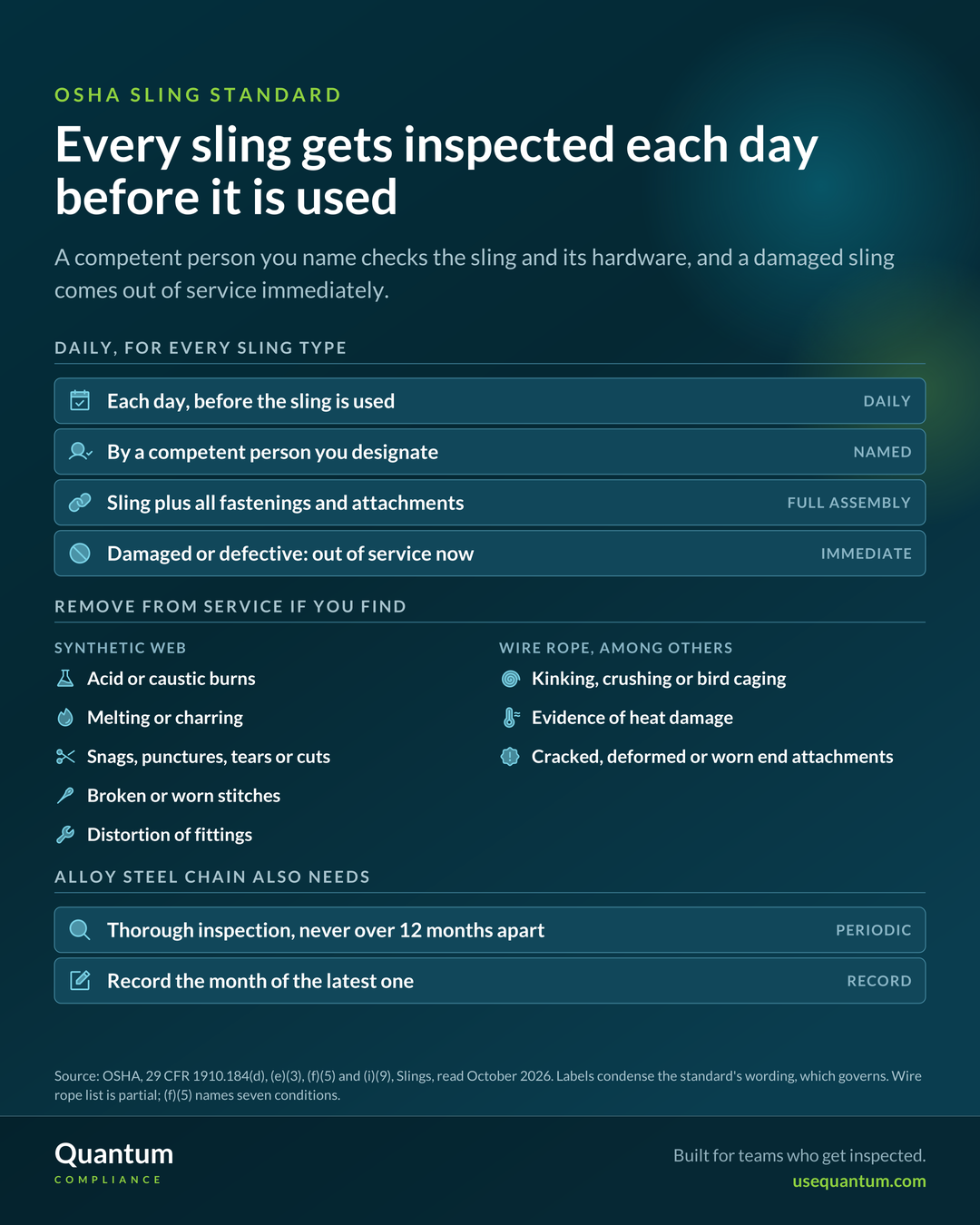
Paragraph (d) is the inspection requirement, and it applies to all of them. Each day before being used, the sling and all fastenings and attachments must be inspected for damage or defects by a competent person designated by the employer. Additional inspections are required during use where service conditions warrant, and damaged or defective slings must be immediately removed from service. Construction sites fall under 29 CFR 1926.251, where paragraph (a)(6) uses the same wording.
The employer has to name the person. A shift where everyone assumes the rigger checks and the rigger assumes the lead checks has nobody designated at all.
Beyond the daily check, the standard adds requirements for specific sling types.
What 1910.184 Adds Beyond the Daily Inspection
| Sling type | Identification | Periodic inspection and record |
|---|---|---|
| Alloy steel chain | Permanently affixed durable identification stating size, grade, rated capacity, and reach, per (e)(1) | Thorough periodic inspection by a competent person at intervals set by use and service conditions, never more than 12 months apart, with a record of the most recent month each sling was inspected, per (e)(3) |
| Synthetic web | Marked or coded to show rated capacities for each type of hitch and type of web material, per (i)(1) | No separate periodic inspection paragraph; the daily inspection in (d) applies |
| Wire rope | No identification paragraph comparable to (e)(1) or (i)(1) | Daily inspection in (d), plus the removal criteria in (f)(5) |
Source: eCFR, 29 CFR 1910.184, Slings. Metal mesh and fiber rope slings have their own paragraphs in the same section.
The daily inspection paragraph says nothing about a written record. The section’s other record requirements cover the most recent thorough inspection month for each alloy steel chain sling, plus proof test certificates and repair records for certain sling types. Keep a daily record anyway, since a daily check that leaves no trace is hard to prove and harder to manage.
12 months
Longest interval OSHA allows between thorough inspections of an alloy steel chain sling in use
Source: 29 CFR 1910.184(e)(3)(i)
The standard sets the actual interval by how often the sling is used, how severe the service conditions are, the nature of the lifts, and experience with slings in similar service, with 12 months as the outer limit. A chain sling used every shift in a foundry should be on a much shorter cycle than one that comes out twice a year.
Removal Criteria Your Inspector Needs in Hand
A competent person can only reject a sling against criteria they know. For wire rope, paragraph (f)(5) lists seven conditions that require immediate removal, including ten randomly distributed broken wires in one rope lay or five broken wires in one strand in one rope lay, kinking or bird caging, evidence of heat damage, corrosion, and hooks opened more than 15 percent of the normal throat opening or twisted more than 10 degrees. For synthetic web, paragraph (i)(9) lists five: acid or caustic burns; melting or charring of the sling surface; snags, punctures, tears or cuts; broken or worn stitches; and distortion of fittings.
Paragraph (c)(1) adds a broader rule: slings that are damaged or defective shall not be used. An inspector who finds damage outside the listed conditions still takes the sling out of service. Put the type-specific lists on the inspection form and train to the broader rule.
How to Set Up a Daily Sling Inspection
Start with the physical setup, because a well-trained inspector working from a rack that makes damaged slings easy to reuse will still lose. Then put the people and the checklist in place, and finish with records you actually review.
Steps to Build a Daily Sling Inspection
Give each one an asset number and confirm it carries the identification or marking 1910.184 requires for its type.
A locked, clearly marked container next to the storage point, so a failed sling has somewhere to go other than back on the hook.
Paragraph (c)(7) requires slings to be padded or protected from the sharp edges of their loads. Pads stored in another building rarely make it to the lift.
Name them in writing, including nights and weekends, and train them on the removal criteria for each sling type you own.
One form per sling type, with the removal criteria written out and a photo of what a reject looks like.
Log the daily check, schedule chain sling thorough inspections, and look at every rejected sling monthly to find out what keeps damaging them.
The monthly reject review shows what keeps damaging your slings. If most rejected web slings come back with cut edges, the fix usually sits in step three. When slings keep failing in one bay, look at the loads and lift plans for that bay before you reorder stock.
Training the designated inspectors is its own job, and the people you name in step four should have a documented record of it. A safety training platform can assign that course and keep each person’s completion history.
How Q-Inspection Can Help
Quantum’s Inspection & Audit module supports steps five and six. You can build a custom form for each sling type, add reference photos to the question descriptions so the inspector sees what a cut edge or bird caging looks like, and schedule the daily check so it shows up for the right person on each shift. Inspectors complete it on a phone, with photo capture, and frontline staff can open the form by scanning a QR code on the rack and entering only their employee ID, with no app download or password. When a sling fails, the module assigns a corrective action automatically and tracks it through to closure, and every completed inspection stays in an audit-ready history you can review for the monthly reject pattern.
The software does not decide whether a sling passes. That remains the competent person’s judgment, and the reject bin and edge protection are decisions you make on the floor. For a closer look at scheduled audits and inspections, see our safety audit software page or contact sales@usequantum.com.