
A maintenance planner pulls the risk assessment for the number three packaging line, because a guard has to come off for a bearing change. The sheet is signed, complete and scored. It also describes a line that has been rebuilt around it over two years. The infeed conveyor was rerouted in the spring. A pneumatic pusher was swapped for a servo unit that moves faster and holds position when the air pressure drops.
That is an assessment that was true once and has no mechanism for staying true. It is easy for a risk assessment to become a document that gets produced, filed, and then only reopened after somebody is hurt. What keeps an assessment honest is a review clock and a list of triggers, and the standards give you very little help building either one.
Where OSHA sets a clock, and where it does not
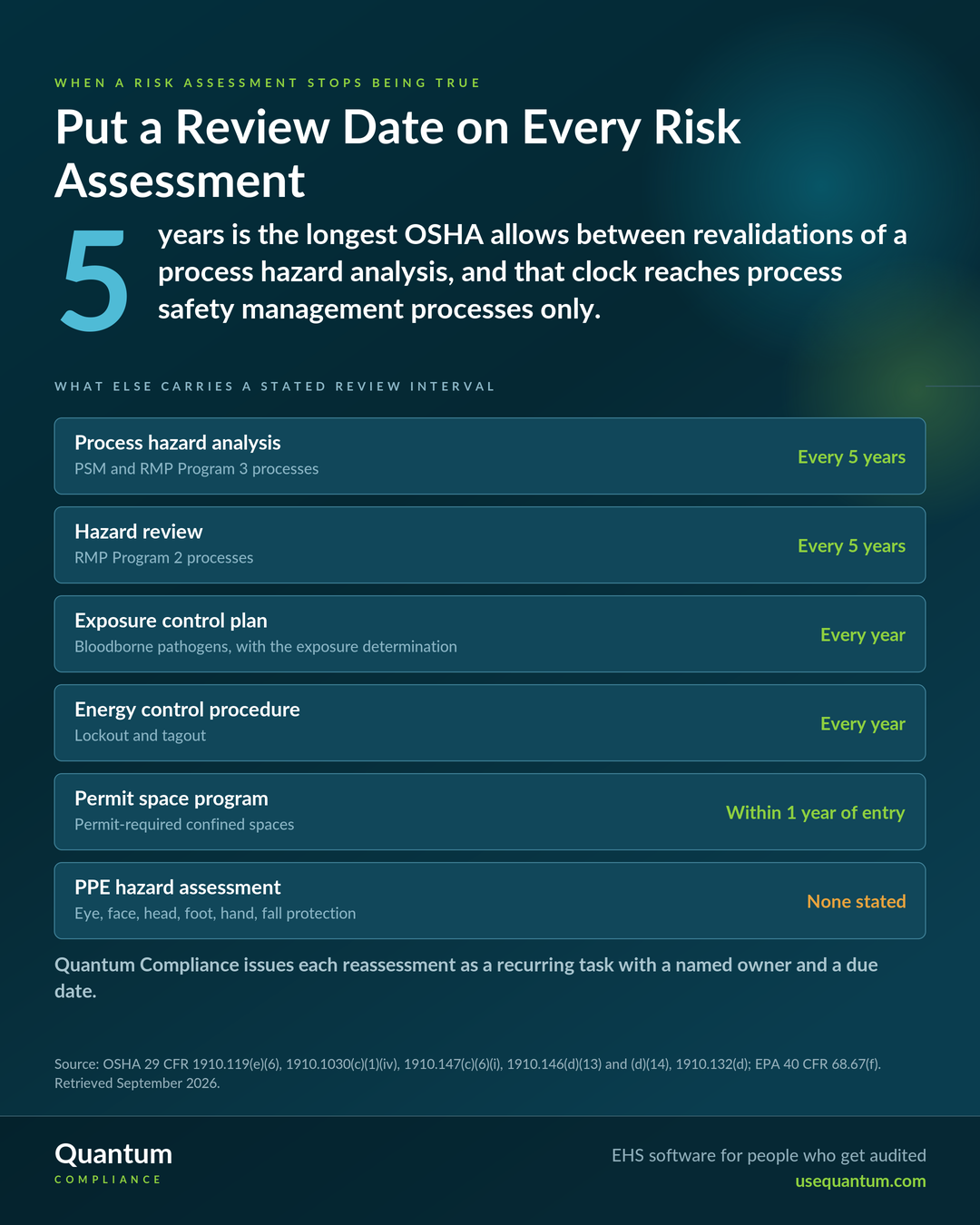
Across the general industry standards, the clearest requirement to go back and revalidate a hazard analysis on a fixed schedule lives in process safety management. 29 CFR 1910.119(e)(6) requires that at least every five years after the initial process hazard analysis is completed, the analysis is updated and revalidated by a team meeting the requirements of paragraph (e)(4), to assure that the analysis is consistent with the current process. Paragraph (e)(7) then requires the employer to keep those analyses, every update or revalidation, and the documented resolution of the recommendations that came out of them, for the life of the process.
Five years
The maximum interval between process hazard analysis revalidations, for PSM-covered processes only
Source: 29 CFR 1910.119(e)(6), retrieved September 2026
Process safety management reaches a process involving a chemical at or above a threshold quantity listed in appendix A. It also reaches a process holding 10,000 pounds or more of a Category 1 flammable gas or a flammable liquid with a flashpoint below 100 degrees Fahrenheit on site in one location, and that second trigger alone carries two carve-outs: hydrocarbon fuels used solely for workplace consumption as a fuel, provided they are not part of a process containing another covered highly hazardous chemical, and flammable liquids stored in atmospheric tanks or transferred that are kept below their normal boiling point without benefit of chilling or refrigeration. The section does not apply to retail facilities, oil or gas well drilling or servicing, or normally unoccupied remote facilities.
EPA carries the same five-year clock at 40 CFR 68.67(f), but only for Program 3 processes under its Risk Management Program rule. Program 2 processes get a lighter hazard review under 40 CFR 68.50, updated every five years and whenever a major change occurs, and Program 1 processes get neither.
What the rest of the rulebook asks for
The standards do ask for review elsewhere, on different clocks. Most of those requirements attach to a program, and the hazard assessment inside it is only carried along. Bloodborne pathogens is the exception: the exposure determination it requires is itself an element of the plan that must be reviewed annually.
SELECTED REVIEW INTERVALS WRITTEN INTO THE STANDARDS
| Citation | What gets reviewed | Stated interval |
|---|---|---|
| 29 CFR 1910.119(e)(6) | Process hazard analysis, PSM-covered processes | At least every five years |
| 40 CFR 68.67(f) | Process hazard analysis, RMP Program 3 processes | At least every five years |
| 40 CFR 68.50(d) | Hazard review, RMP Program 2 processes | At least once every five years |
| 29 CFR 1910.1030(c)(1)(iv) | Exposure control plan, including the exposure determination | At least annually |
| 29 CFR 1910.147(c)(6)(i) | Energy control procedure, lockout and tagout | At least annually |
| 29 CFR 1910.146(d)(14) | Permit-required confined space program | Within 1 year after each entry |
| 29 CFR 1910.132(d)(1) | PPE hazard assessment | None stated |
Source: Electronic Code of Federal Regulations, 29 CFR 1910 and 40 CFR 68, retrieved September 2026. Intervals as written in the cited paragraphs; each standard carries its own scope.
29 CFR 1910.132(d)(1), the last row, requires an employer to assess the workplace to determine whether hazards are present, or are likely to be present, that necessitate personal protective equipment, and paragraph (d)(2) requires that assessment to be certified in writing. Neither paragraph names an interval or a trigger. Read paragraph (g) first: paragraphs (d) and (f) apply only to eye and face, head, foot, hand and personal fall protection under 1910.133, 1910.135, 1910.136, 1910.138 and 1910.140, and do not apply to 1910.134 or 1910.137.
OSHA already wrote your trigger list
The confined space standard is where OSHA writes this out most plainly. 29 CFR 1910.146(d)(13) requires the employer to review entry operations when there is reason to believe the measures taken under the permit space program may not protect employees, and to revise the program to correct deficiencies before subsequent entries are authorized. The note that follows gives examples of circumstances requiring that review: any unauthorized entry of a permit space, the detection of a permit space hazard not covered by the permit, the detection of a condition prohibited by the permit, the occurrence of an injury or near-miss during entry, a change in the use or configuration of a permit space, and employee complaints about the effectiveness of the program. OSHA introduces those as examples, so the list is open by its own terms, and a program treating those six as complete has understated the duty.
Strip out the confined space vocabulary and most of that list applies to any assessment you hold. A hazard turns up that the assessment never named, a condition it prohibited turns out to be routine practice, somebody gets hurt or nearly does, or the equipment changes. OSHA’s list carries one more that rarely makes it into a site’s own: a worker says the controls do not work. None of those arrive on an annual schedule, which is why a review date cannot be the only mechanism.
The argument you will have is about change
PSM also carries the management of change requirement, the closest the standards come to defining when a hazard analysis has gone stale. Paragraph (l)(1) requires written procedures to manage changes, other than replacements in kind, to process chemicals, technology, equipment and procedures, and changes to facilities that affect a covered process. Paragraph (l)(2) names five considerations the procedure must address before any change: the technical basis, the impact on safety and health, modifications to operating procedures, the necessary time period, and the authorization requirements.
The phrase carrying the weight there is replacement in kind, which the standard defines as a replacement that satisfies the design specification. The servo pusher in the opening is the case that tests it, because it moves faster and behaves differently on loss of air. If you borrow this idea outside PSM, the definition belongs in your own written procedure, settled in advance of the first argument about it.
Putting a clock on it
Steps to keep a risk assessment current
An interval you chose, recorded on the assessment itself, and issued as a task with a due date.
Start from the circumstances in 1910.146(d)(13) and add the ones your plant actually produces: new equipment, a chemical substitution, a change in shift pattern or crew size, a contractor scope change, a near-miss on the task.
Decide once who makes that call and on what basis, so it is not settled by whoever is standing there at two in the morning.
Record the level the control was expected to reach, then record what a later assessment actually found. The gap between those two numbers is what tells you whether the control worked.
Every score change, its date and the action behind it, on the same record, so nobody has to reconstruct why a hazard was downgraded.
The first three are design decisions that stop assessments drifting. Measurement laid on a program with no review clock only tells you how far behind you already are.
How Q-Risk Can Help
Quantum’s Risk Assessment module is built on the assumption that an assessment is a recurring task rather than a filed document. A risk point, which can be a machine, a location, a task or a workflow, holds its hazard sources, control measures and scores, and a risk assessment plan puts them on a one-time or recurring cadence, issuing the reassessment to a named person or to a whole department. That is step one. When a reassessment lands in a high-risk band, the task will not close without a corrective action. The creator records the risk level the action is expected to produce. A later reassessment records the level actually reached. That is step four. Risk point history keeps the timeline of assessments, corrective actions and score changes on the record itself for step five, and a major risk control list shows what sits at high risk across the site.
Steps two and three stay with you. Deciding that a conveyor reroute is significant enough to reopen an assessment, or that a servo pusher no longer satisfies the original design specification, is a judgement call the platform leaves to you. Once the call is made, the reassessment exists as a task with an owner and a date. You can see how scoring and scheduling work on the risk assessment software page, and how recurring field checks are scheduled and tracked to closure in inspection and audit.