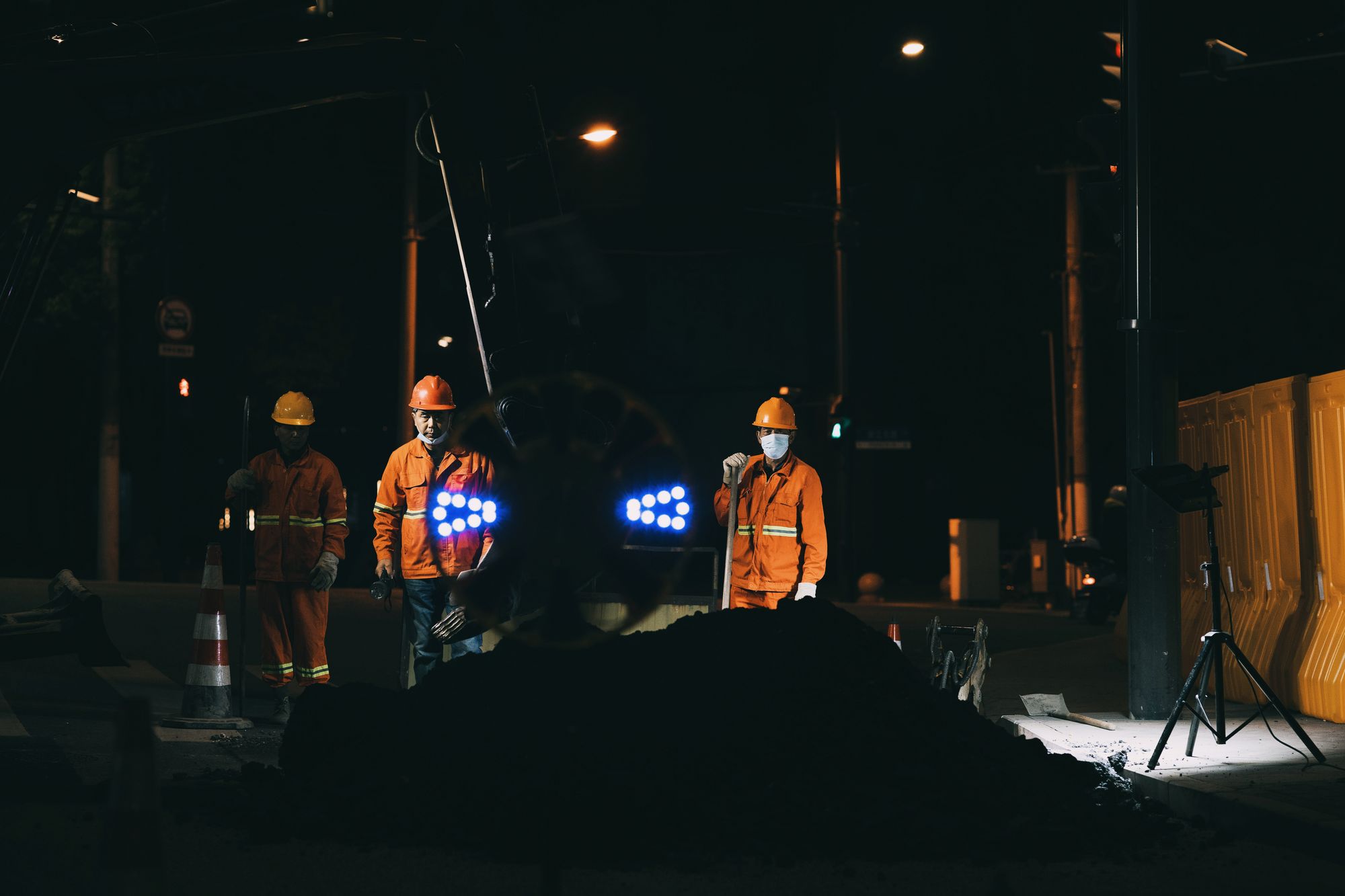
It is 4:40 in the morning at a packaging plant, the fourth consecutive night of a twelve-hour rotation. An operator on the fill line sees a jam, reaches past the guard to clear it, and catches two fingers between the pusher and the rail. He has run that line for nine years without an injury. In the interview afterward he cannot describe deciding to reach in.
The report closes with a cause of “failure to follow lockout procedure.” The corrective action is a refresher session and a documented conversation. Six weeks later, on the fourth night of another rotation, a different operator does close to the same thing.
The second event is not bad luck. Nobody became careless at 4:40 in the morning. A person was doing precision work at the hour when human alertness bottoms out, at the end of four short daytime sleeps in a row, on a schedule designed months earlier by people balancing coverage against overtime cost. That schedule was a decision with safety consequences, and in most organizations it is never assessed as a hazard, because fatigue almost never gets written down as one.
Fatigue Is a Working Condition
Unlike most workplace exposures, fatigue has no single source. NIOSH describes it as arising from scheduling practices such as night shifts and extended hours, from demanding tasks, from extreme temperatures and from stress. A worker’s age, health and home responsibilities contribute too.
That mixture is exactly why fatigue gets pushed onto the individual. Because some contributors sit outside the workplace, it becomes easy to treat the whole thing as a personal problem and hand out a sleep hygiene pamphlet. But look at which levers are pulled by whom. Shift length, rotation direction, rest between shifts, staffing, workload and overtime distribution are all employer decisions. The worker controls the smallest share of the variables and absorbs all of the consequence.
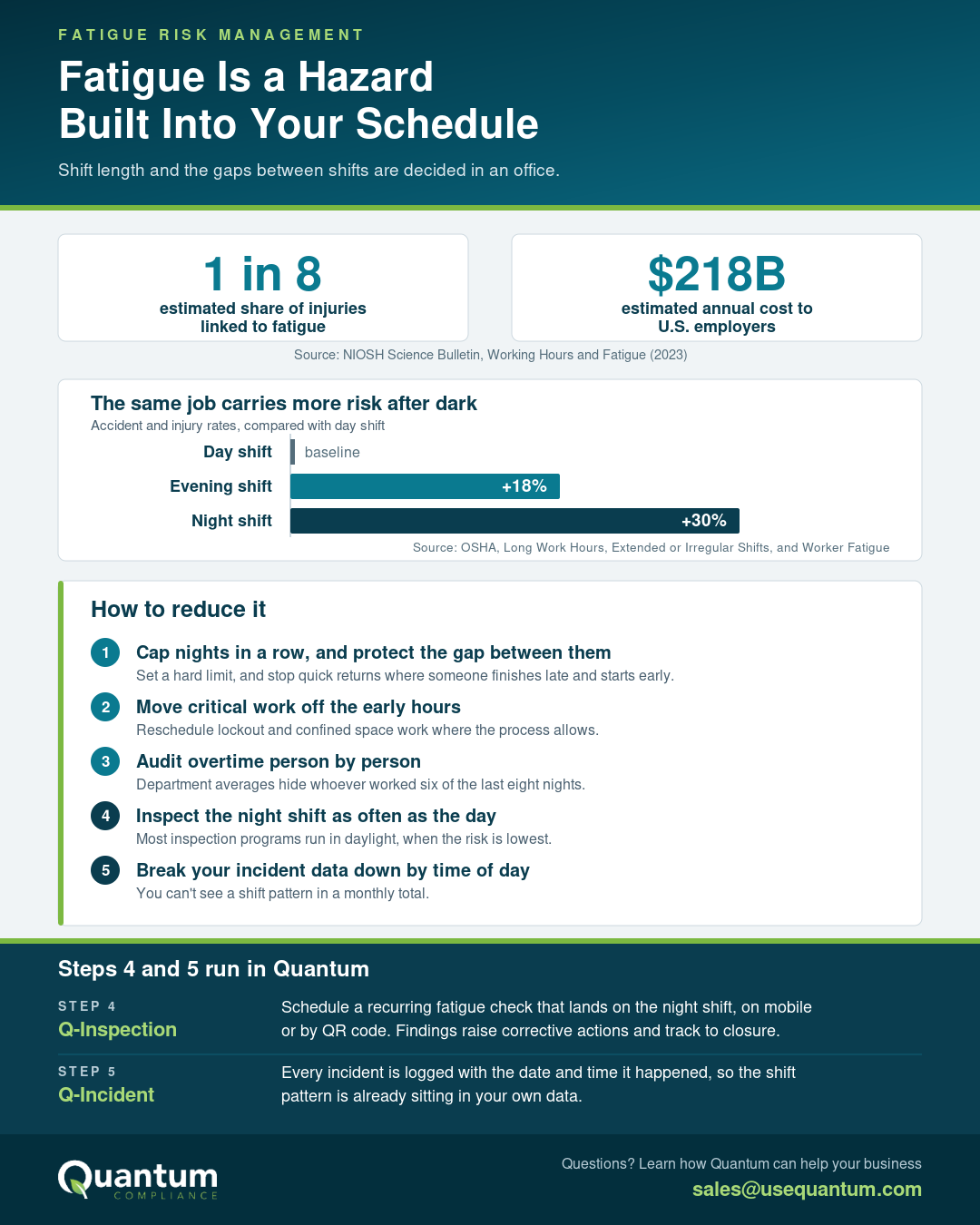
1 in 8
Researchers estimate that close to one in eight workplace injuries may relate to fatigue
NIOSH also notes that more than one in five fatal vehicle crashes may involve a drowsy driver. The drive home after a night shift is a consequence of the schedule even though it happens off site.
Shift Design Belongs in the Risk Assessment
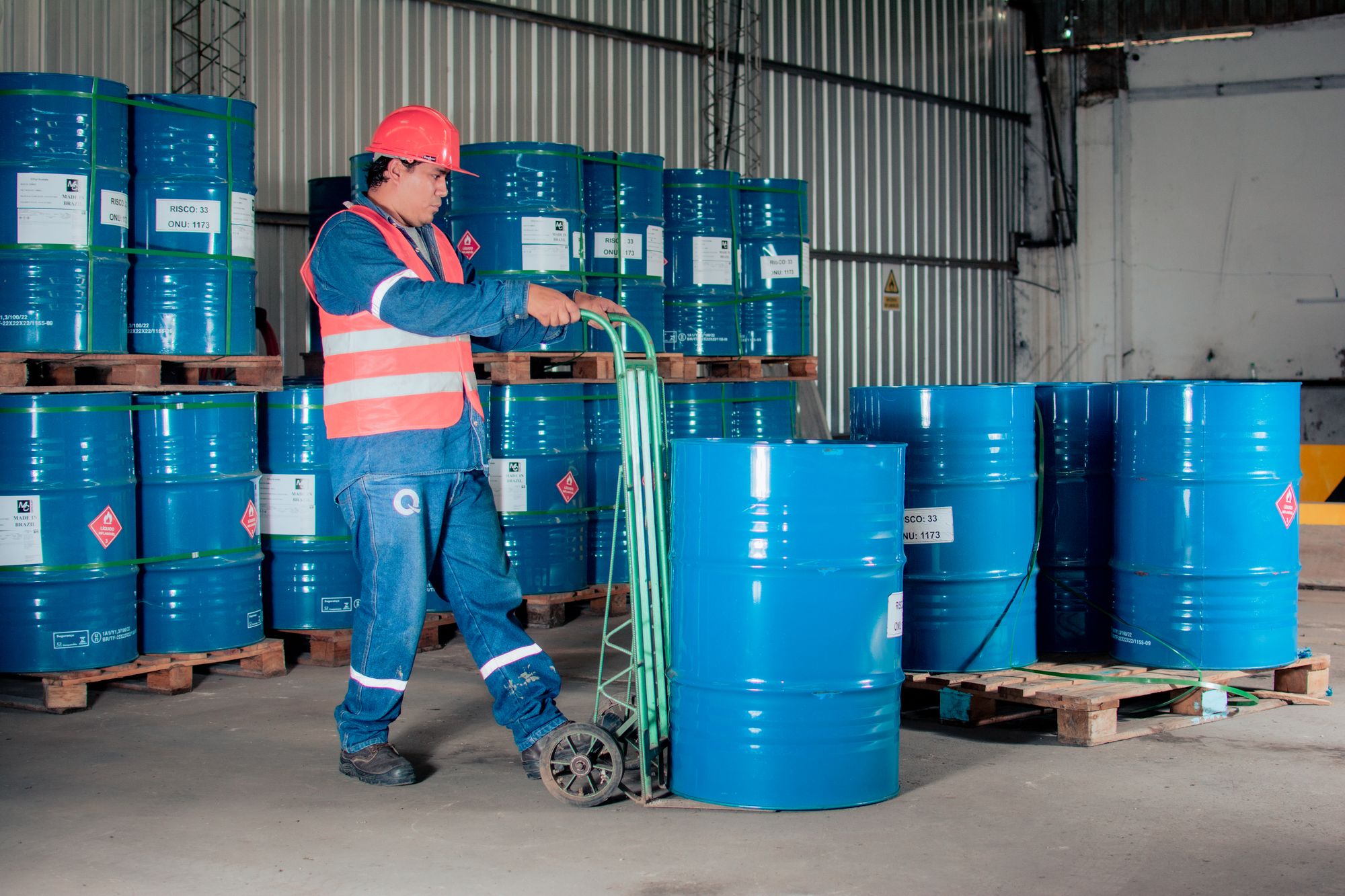
You would not introduce a solvent without reviewing the safety data sheet and the ventilation. Yet shift patterns get changed to cover a staffing gap, and the change moves through operations without ever reaching a risk assessment.
What the Schedule Does to Risk
| Schedule feature | Associated change in risk |
|---|---|
| Evening shift, compared with day shift | Accident and injury rates 18% greater |
| Night shift, compared with day shift | Accident and injury rates 30% greater |
| Working 12 hours per day | 37% increased risk of injury |
| Each extended shift added in a month, among medical residents | 16.2% higher monthly risk of a motor vehicle crash on the commute home |
Source: OSHA, Long Work Hours, Extended or Irregular Shifts, and Worker Fatigue: Hazards
The identical task carries measurably more risk at 3 a.m. than at ten in the morning, with the same worker, equipment and procedure. If any other control produced a 30% swing in injury rates, you would have a policy about it.
Why Fatigue Never Reaches Your Hazard Log
Ask an EHS manager how many fatigue hazards were reported last quarter and the answer is usually zero. The reporting system was never built for this hazard.
Saying “I am too tired to do this safely right now” asks a worker to volunteer something that sounds like a personal failing. The practical obstacles stack on top of the social ones: on a night shift there is often no supervisor on the floor, no computer logged in, and no realistic window to stop and fill in a form.
What shows up instead
Fatigue arrives disguised as other findings: incidents whose stated cause is human error, near-misses concentrated in the final two hours of a shift, absence that spikes the day after a rotation flips. If your investigations keep landing on attention and compliance, the honest next question is what condition made attention hard.
Treating the Schedule as an Assessable Hazard
The point of fatigue risk management is to move the control upstream, out of the worker’s willpower and into the design of the work.
Start with an honest inventory. Pull the actual schedules, not the policy: consecutive nights worked, shift length, rest between shifts, rotation direction, and overtime by named individual. Averages hide the person who worked six of the last eight nights.
Then bring shift design into the risk assessment alongside machine and chemical hazards, and score by when the task happens, not only what it is. A confined space entry at 3 a.m. on the fourth consecutive night is not the same job as the identical entry at 9 a.m. on a Tuesday. Where the process allows, move the highest-consequence work out of the circadian low, limit consecutive nights, and close the quick-return gaps where someone finishes late and starts early.
Then look at your inspection coverage, because it usually mirrors the office day. If the scheduled walks happen between nine and five, the shift carrying the most risk is the one getting checked least. Put recurring inspections on nights and weekends, assign them to people who are actually on site, and build the form around the task rather than reusing the generic daytime checklist.
Give people a way to flag fatigue in the moment, on the floor, without a conversation about it. Then verify by breaking your incident and near-miss data down by hour of shift, and check whether the late-shift cluster moved after you changed the pattern. A monthly total will hide it. NIOSH notes that most sleep-focused programs do not account for the many sources of fatigue. Training alone is the weakest control here, the same conclusion the hierarchy of controls reaches everywhere else.
Where the Rules Stop and Your Judgment Starts
For most industries there is no federal cap on how long a shift may run. The hour limits that exist come from other agencies covering specific sectors: the FAA for flight crews, the FMCSA for commercial drivers, the FRA for railroad employees, the NRC for nuclear facility workers, plus provisions for VA nurses and several state laws on mandatory overtime for nurses.
If your operation is not on that list, no regulator will hand you a number. That does not make the exposure disappear; it means the judgment belongs to you, and your own documentation is the only evidence you exercised it.
How Q-Inspection and Q-Incident Can Help
Two of those controls are ones software actually runs. The first is inspection coverage. Q-Inspection, the inspection and audit module in the Quantum EHS Management System, schedules recurring checks against a form you define for the task, and staff complete them on a phone or by scanning a QR code at the point of work. The constraint on inspecting a night shift is rarely willingness; it is that nobody with a clipboard is on site at 3 a.m. A scheduled task assigned to whoever is working that shift closes the gap, and any finding raises a corrective action with an owner, a due date and a verification step. See how the safety audit software handles recurring inspections.
The second is measurement. Q-Incident records the date and time of every event alongside the cause analysis and the OSHA recordability flags, so the question of when in the shift your incidents happen is answerable from your own records. You run that comparison yourself, since the modules do not exchange data, but the timestamps are there. Details on the incident management software.