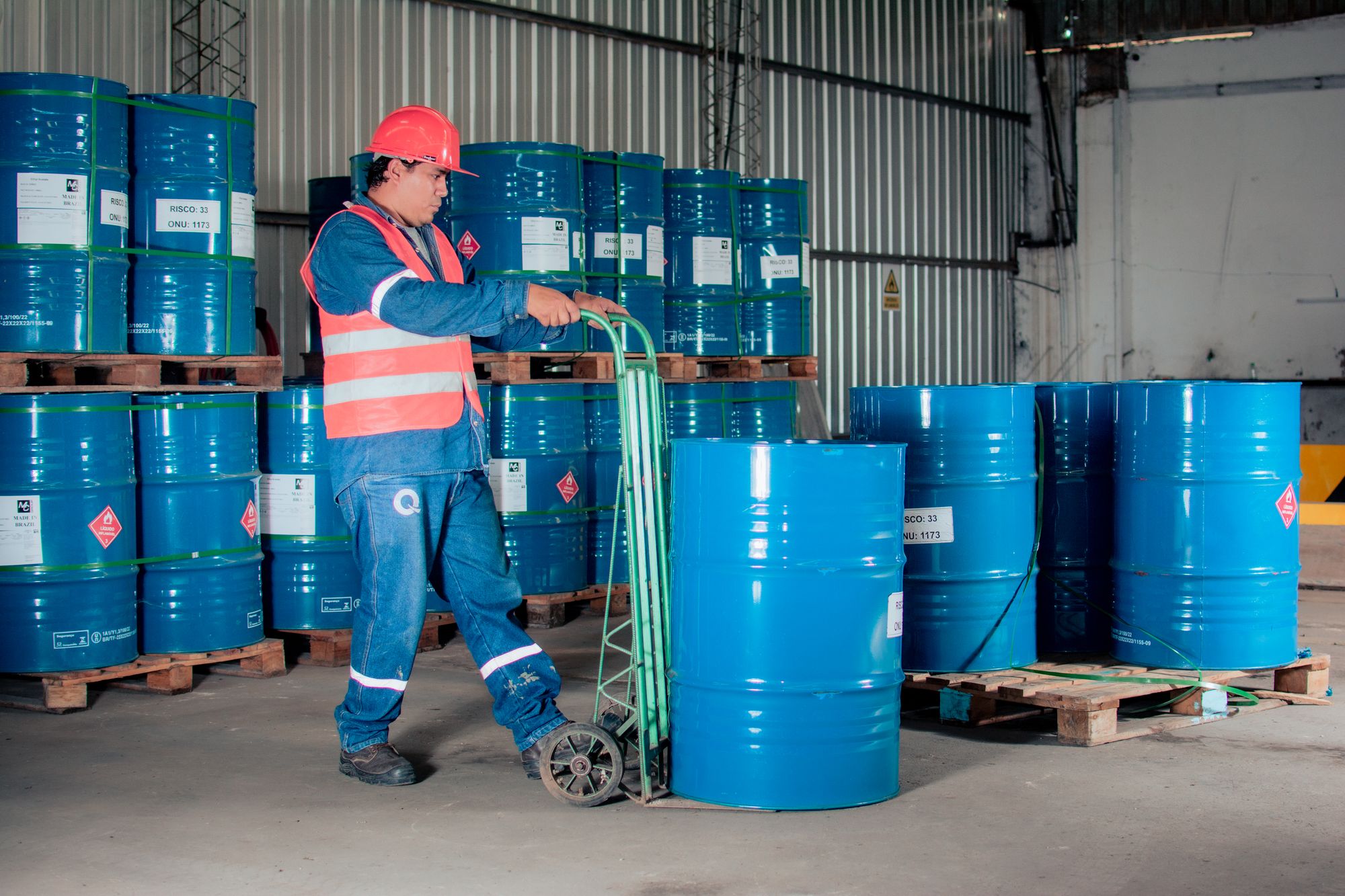
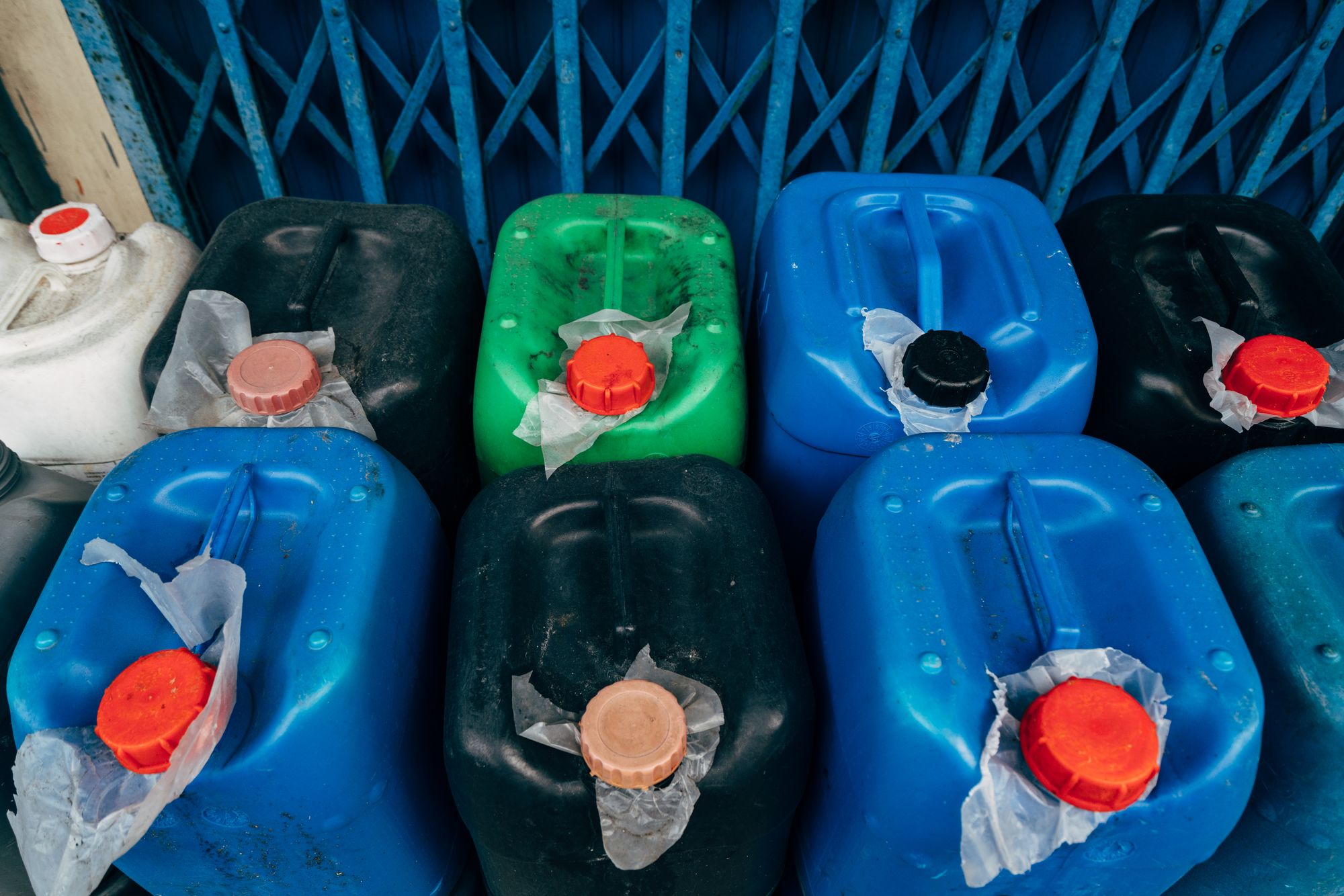
The parts washer in your maintenance shop runs on mineral spirits that arrive in a 55-gallon drum. A technician decants a quart into a squeeze bottle, cleans a gearbox, sets the bottle back on the bench and clocks out. Second shift finds it sitting there. Nobody can say for certain what is in it, and the one person who could is asleep at home.
That bottle is where secondary container labeling stops being a paperwork exercise. OSHA’s Hazard Communication Standard does exempt some portable containers from labeling, and a lot of chemical safety programs lean on it harder than the text supports. The exemption carries two conditions, and that bottle is on the wrong side of one of them.
What a workplace label has to carry
Paragraph 1910.1200(f)(6) is the rule. Except where (f)(7) and (f)(8) apply, every container of hazardous chemicals in the workplace has to be labeled, tagged or marked, and the employer picks one of two ways.
TWO WAYS TO LABEL A WORKPLACE CONTAINER
| Option | What the container must carry |
|---|---|
| (f)(6)(i) Shipping label elements |
The information specified in (f)(1)(i) through (v): product identifier, signal word, hazard statements, pictograms, precautionary statements. The cross-reference stops at (v), so the manufacturer name, address and telephone number required on shipped containers are not required here. |
| (f)(6)(ii) Alternative workplace label |
Product identifier, plus words, pictures, symbols or any combination of them giving at least general information about the hazards. This option only satisfies the standard in conjunction with other information immediately available to employees under your hazard communication program. |
Two scope limits sit upstream of this. Paragraph (b)(3) reaches laboratories through a short list of requirements that does not include (f)(6), so lab secondary containers fall under the Laboratory standard at 1910.1450 instead. Paragraph (b)(4) does the same for operations where employees only handle sealed containers that are not opened in normal use, citing marine cargo handling, warehousing and retail sales as examples.
Most sites choose the second option. It really is lighter, and it carries a condition the first one does not.
The portable container exemption has two conditions, not one
Paragraph (f)(8) reads that the employer is not required to label portable containers into which hazardous chemicals are transferred from labeled containers, and which are intended only for the immediate use of the employee who performs the transfer. Two conditions sit in that sentence, and the second one does the real work. The paragraph carries one unrelated carve-out as well, for drugs a pharmacy dispenses to a health care provider for direct administration to a patient.
“Immediate use” is a defined term. The standard defines it in paragraph (c) as meaning the chemical will be under the control of and used only by the person who transfers it from a labeled container, and only within the work shift in which it is transferred. So the exemption reaches a narrow set of facts: the chemical stays with whoever poured it and is used up before their shift ends. A container that sits overnight falls outside the exemption, and so does one a second worker picks up, even mid-shift.
The first condition gets less attention. The transfer has to come out of a labeled container, so if the drum in the corner lost its label two years ago, the exemption never engages at all. That drum is separately a (f)(6) problem of its own.
The lighter labeling option is the one you have to defend
OSHA confirmed in a 2017 letter of interpretation that paragraph (f)(6)(ii) does not require workplace labeling to include the manufacturer’s name and address, precautionary statements, or hazard statements. A bottle with an embossed chemical name and a couple of hazard pictograms can satisfy the rule.
The same letter quotes CPL 02-02-079, OSHA’s inspection directive for the standard. An employer relying on an alternative labeling system rather than labels carrying complete health effects information bears the burden, in any enforcement action alleging inadequate labeling, of establishing that it achieved a level of employee awareness that “equals or exceeds” what full labels would have produced. So the trade is a shorter label in exchange for having to demonstrate, if challenged, that the rest of your program closed the gap the short label left.
And the gap has to be filled somewhere reachable. Where an employer uses safety data sheets as that additional information, the letter is explicit that they must be immediately available to all employees in their work area throughout each shift. The example OSHA gives of what does not count is a sheet locked in an office.
HAZARD COMMUNICATION CITATIONS ACROSS MANUFACTURING
29 CFR 1910.1200 citations issued by Federal OSHA, all establishment sizes, October 2024 through September 2025
Those totals cover every subsection of the standard, not labeling alone, so read them as a measure of inspector attention rather than a count of label findings. They also cover Federal OSHA only, leaving out the state plan jurisdictions.
The paragraphs that catch programs out
Paragraph (f)(7) allows signs, placards, process sheets, batch tickets, operating procedures and similar written materials instead of labels on individual containers. The scope limit is easy to miss: it applies to individual stationary process containers. A fixed reactor or day tank falls inside it, labelable or not. A pallet of drums under a posted placard is a different thing, and that is a common misread. The written material also has to identify which containers it covers, convey what (f)(6) would have required on a label, and stay readily accessible in the work area throughout each shift.
Strip a label off an incoming drum and paragraph (f)(9) gives you no grace period. It prohibits removing or defacing existing labels on incoming containers unless the container is immediately marked with the required information. Everything hangs on “immediately.” A drum that arrives, gets stripped, and waits for someone to walk a label printer over has already put you out of compliance.
Legibility and language get their own paragraph. Under (f)(10) workplace labels have to be legible, in English, and either prominently displayed on the container or readily available in the work area throughout each shift. Employers with workers who speak other languages may add that language, and English is required regardless.
What to do about it
Closing the secondary container gap
Point-of-use dispensing, right-sized purchase containers and closed transfer systems eliminate the unlabeled bottle at the source, which is the only control that holds when nobody is watching.
Pre-printed or on-demand labels at the dispensing point make labeling faster than not labeling. A label printer in a locked office produces unlabeled bottles.
Then test each one against both conditions, including what happens at shift change. Anything that outlives a shift or changes hands needs a label.
If it is the alternative label, name the backup information and confirm a worker in that area can reach it on every shift, including nights and during a network outage.
Workers aren’t usually told the exemption has a shift boundary in it. Walk the shop at the end of a shift, not the start, and count what is sitting out.
The order is deliberate. The first two steps change the physical setup so the compliant path is the easy one. Training and auditing come last because a worker who has to walk across the building for a label will keep making the same decision your program keeps citing them for, and the system is what put the bottle on the bench.
How Chemical Management Can Help
Steps two and four are where Quantum’s Chemical Management module does concrete work. Hazard data lives in structured fields, so GHS secondary container labels print on demand for any chemical in your inventory, hazardous or not, on calibrated stock that lines up with the sheet in the printer tray. US workplace labels carry the product identifier, pictogram, signal word and manufacturer information by default, with hazard and precautionary statements added wherever size allows, which puts more on the container than (f)(6)(ii) asks for. Where those statements will not fit, what you get is an (f)(6)(ii) label rather than a full (f)(6)(i) one. Every label also carries a code a worker can scan with a phone to open the full safety data sheet, and the whole library can be exported as an offline searchable bundle for the shift when the network is down.
What it does not do is decide whether a given transfer qualifies for the exemption. That is a judgment about who will use the container and when, and it belongs to the people on the floor. It will not reduce the number of transfers either, which is step one and the most valuable item on the list. What it removes is the excuse that labeling a bottle takes too long.