At 6:05 on a Monday morning, an operator at a regional distribution center walks around truck 14, finds a slow hydraulic drip under the mast, and marks the leak on the pre-shift sheet. The sheet goes onto the clipboard hanging by the battery charger, the way it has for years. Truck 14 runs the rest of first shift, gets handed to the afternoon crew, and is still moving pallets at four in the afternoon. The paperwork had nowhere to go next, so the truck kept working.
That gap between a recorded defect and a truck actually taken out of service is a familiar one in warehousing. The check happened on schedule and the defect went onto the record, and the part that never ran was the step that pulls the machine out of the aisle. That step is where the standard puts its weight.
What 29 CFR 1910.178 Requires After a Defect Is Found
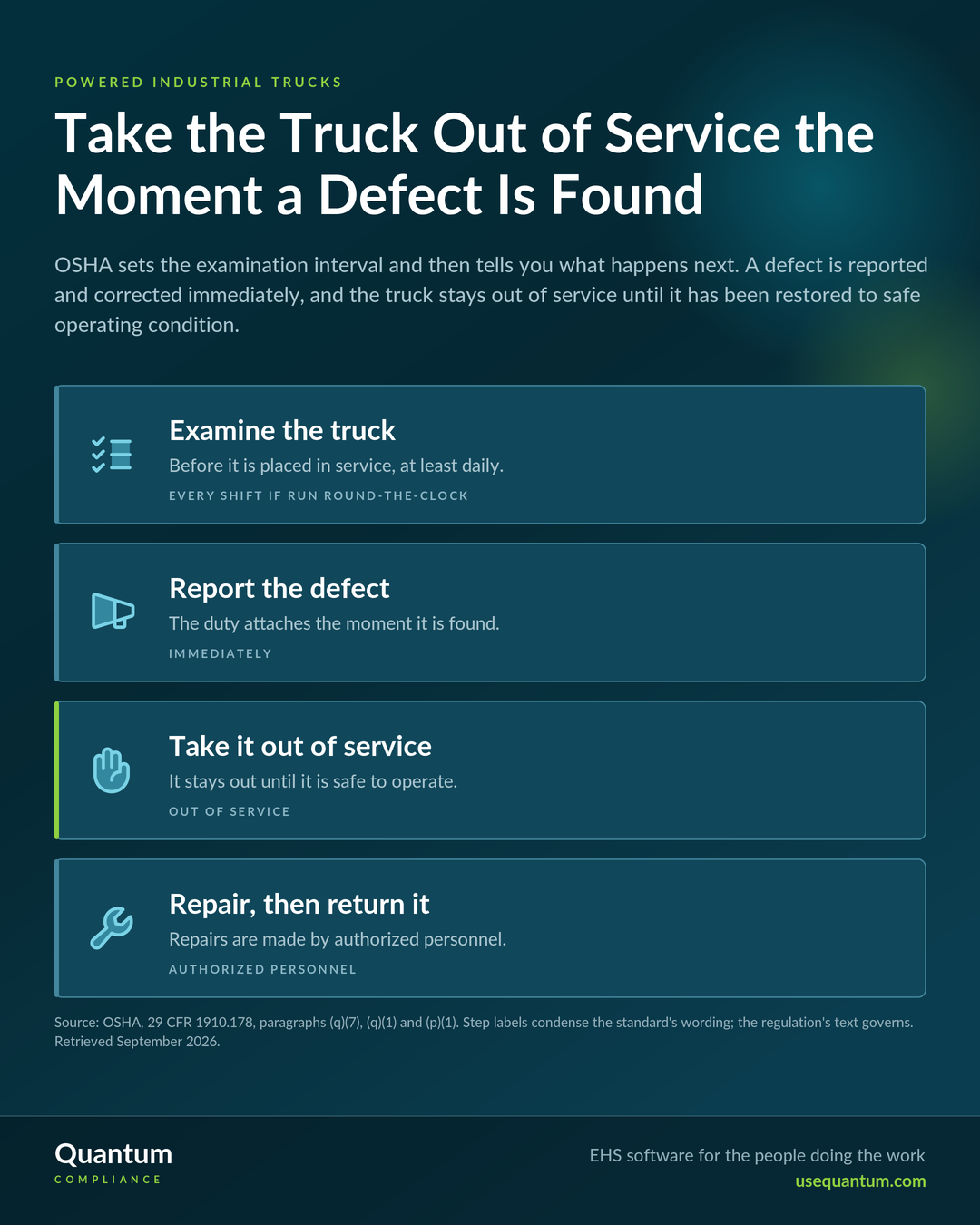
Forklift inspection requirements are easy to read as a frequency rule and nothing more. Paragraph 1910.178(q)(7) sets that frequency: industrial trucks “shall be examined before being placed in service, and shall not be placed in service if the examination shows any condition adversely affecting the safety of the vehicle,” and “Such examination shall be made at least daily.” Where trucks run on a round-the-clock basis, they are to be examined after each shift.
Paragraph (q)(7) then closes with a flat instruction that is easy to read past: “Defects when found shall be immediately reported and corrected.” The language sets no grace period and no allowance for finishing the shift first. What counts as a defect is left undefined in the section, so that judgement sits with the employer, but the response once one is found does not.
Two other paragraphs make the consequence explicit. Under 1910.178(p)(1), if at any time a truck is found to be in need of repair, defective, or in any way unsafe, it “shall be taken out of service until it has been restored to safe operating condition.” Under 1910.178(q)(1), any truck not in safe operating condition “shall be removed from service,” and all repairs are to be made by authorized personnel. Fuel system leaks get their own sentence at (p)(4): no truck is to be operated with one until the leak has been corrected.
Check the scope against your fleet before you map this onto it. Section 1910.178 covers fork trucks, tractors, platform lift trucks, motorized hand trucks and other specialized industrial trucks powered by electric motors or internal combustion engines. It does not reach compressed air or nonflammable compressed gas-operated trucks, farm vehicles, or vehicles intended primarily for earth moving or over-the-road hauling. If your yard runs equipment in those categories, 1910.178 is not your authority for it.
WHAT THE STANDARD REQUIRES AT EACH POINT
| Paragraph | Duty in the text |
|---|---|
| 1910.178(q)(7) | Examine before placing in service, at least daily; after each shift where trucks are used on a round-the-clock basis. Defects when found shall be immediately reported and corrected. |
| 1910.178(p)(1) | A truck found in need of repair, defective, or in any way unsafe shall be taken out of service until restored to safe operating condition. |
| 1910.178(q)(1) | Any truck not in safe operating condition shall be removed from service. All repairs shall be made by authorized personnel. |
| 1910.178(p)(4) | No truck shall be operated with a leak in the fuel system until the leak has been corrected. |
Source: OSHA, 29 CFR 1910.178, Powered industrial trucks. Section 1910.178 does not apply to compressed air or nonflammable compressed gas-operated trucks, farm vehicles, or vehicles intended primarily for earth moving or over-the-road hauling.
Inspectors Are Already Looking Here
Powered industrial trucks is a heavily cited category in warehousing. In federal fiscal year 2025, 1910.178 drew more federal OSHA citations in the warehousing and storage sector than any other standard, by a wide margin over hazard communication in second place.
MOST CITED STANDARDS, WAREHOUSING AND STORAGE
Federal OSHA citations, NAICS 493, establishments of all sizes, October 2024 through September 2025
Source: OSHA, Frequently Cited OSHA Standards, NAICS 493. Retrieved September 2026.
Read those totals carefully before you quote them internally. Each count covers every subsection of the standard, so the 228 figure includes training, operator certification, refresher evaluation and load handling alongside the inspection and removal-from-service paragraphs. The figures also cover federal OSHA jurisdiction only, so states running their own approved plans sit outside the total. Treat the ranking as a map of where inspector attention lands in this sector. Paragraph-level exposure is a separate question.
Where the Loop Usually Breaks
Walk the process backwards from the citation and the gap usually sits in the same place. The inspection is designed as a record, not as a trigger. An operator fills in a form, the form goes somewhere, and the only thing that moves a defective truck out of the aisle is somebody noticing the form and choosing to act on it. On a busy shift with a short fleet, that choice gets deferred, and deferring it is rational for everyone except the company.
The second break is quieter. When defect reports live on paper, nobody can see how many times truck 14 has been written up for that same hydraulic leak. Each report reads as a one-off. A repeat defect on a single truck is a strong signal that a repair was never actually completed, and it stays invisible unless the reports accumulate somewhere you can sort them.
What to Do About It
Fix the system before you retrain anyone. The controls below start with design, then verification, then measurement.
Closing the Loop on a Forklift Defect
Daily is the floor, and every truck owes an examination before it is placed in service. A fleet running on a round-the-clock basis owes one after each shift, so that schedule has to be built around the shift changes.
The answer on the form should carry the assignment with it. When a human has to read the form and then decide to raise a work order, the control depends on attention at the worst possible moment.
That can be key control, a lock on the charger, or a tag the operator cannot remove. Taking a truck out of service is a physical act performed on the floor, and it needs to happen at the point the defect is found.
The standard requires repairs to be made by authorized personnel and leaves it to you to define who those people are. Name them on the record and add a verification step, so closure requires somebody to confirm the truck is safe before the ticket is shut.
Pull your findings together by asset and look for the same defect appearing twice on one machine. Sorting the same findings by operator turns a maintenance signal into a performance conversation, which is how honest reporting dries up.
On step two, some platforms now let a frontline worker reach the inspection form by scanning a QR code and entering an employee ID, with no app to install and no password to remember. Every submission is attributed to the correct employee automatically, which removes one of the practical reasons pre-shift checks end up on shared paper.
How Q-Inspection Can Help
Q-Inspection is built for the recurring field check and the corrective action that follows it. Forms can be defined by site, role or task type and run as scheduled or ad hoc inspections from a phone or a browser. On the task record, findings carry risk level, description and attachments, and a reviewer cannot submit an inspection while a finding still has no corrective action attached to it. That gate is the practical answer to step two, and the verification and closure workflow behind it is step four: a corrective action moves through assignment to verification rather than ageing out of view.
Two things the platform does not do. Deciding whether a drip is a condition “adversely affecting the safety of the vehicle” is a judgement the inspector makes on the floor, and step three stays physical, since locking out a defective truck is an act somebody performs on the machine itself. Step five is partly covered: the analytics dashboards surface issue frequencies and trends and the inspection matrix views by facility and role, so a per-truck rollup is something you would build out of the historical records rather than something waiting for you on a screen. What a system on the Quantum EHS platform does reliably is make sure the finding never sits on a clipboard waiting for somebody to notice it.