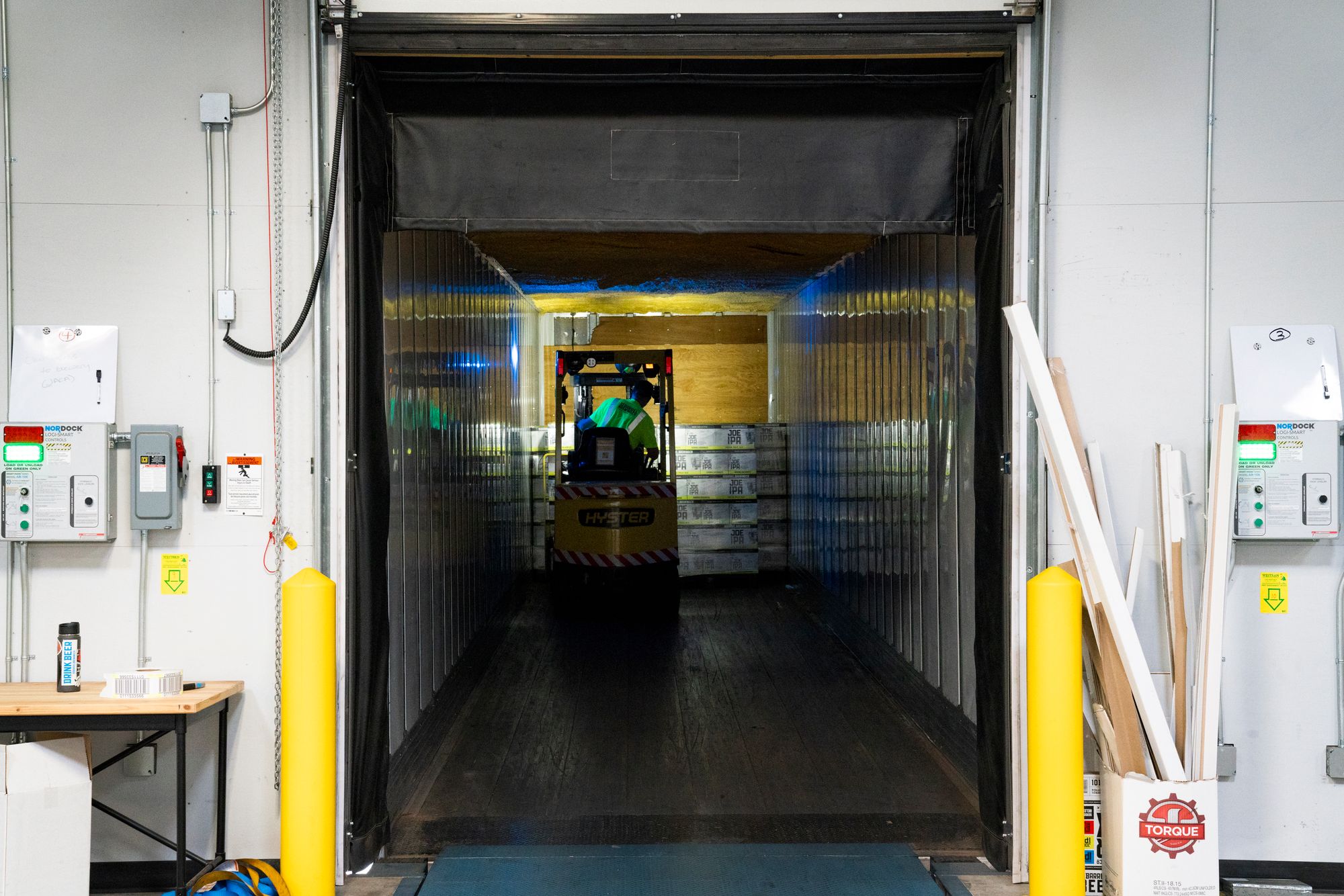
A distribution yard put in a painted walkway and a line of concrete barriers after a driver nearly backed over a picker two winters ago. The paint has worn down to a ghost. The barriers came out during a repaving job last spring and got stacked behind the maintenance shed, where they still sit. Everyone who works that yard knows to look twice before crossing. Nobody has written a work order in fourteen months.
If a compliance officer walks through, the outcome turns less on whether a standard covers how trucks and people share an open yard than on what your own file says about what you already knew.
The four things OSHA has to establish
Section 5(a)(1) of the OSH Act requires every employer to furnish a workplace “free from recognized hazards that are causing or are likely to cause death or serious physical harm.” OSHA’s Field Operations Manual, Chapter 4 is where it turns into a test. In general, the manual says, Review Commission and court precedent have established the following elements as necessary to prove a violation of the general duty clause, and each one has to hold:
- The employer failed to keep the workplace free of a hazard to which employees of that employer were exposed
- The hazard was recognized
- The hazard was causing or was likely to cause death or serious physical harm
- There was a feasible and useful method to correct the hazard
Elements one, three and four are questions about the physical world: what was there, who was exposed, how bad it could get, and whether a fix existed. Element two is a question about your filing cabinet, and it is the one this article is about.
Recognition gets decided by your own paperwork
The manual allows three routes to recognition. Employer recognition and industry recognition come first, and only where neither of those can be established does it permit what it calls common-sense recognition, which it limits to special circumstances and flagrant cases. The employer route catches sites off guard, because most of the material on it is either written by the employer or already in the employer’s own files.
Employer awareness of a hazard, the manual says, “can also be demonstrated by a review of company memorandums, safety work rules that specifically identify a hazard, operations manuals, standard operating procedures, and collective bargaining agreements.” Prior events count too: the manual names prior accidents and incidents, “near misses” (close calls) known to the employer, injury and illness reports, or workers’ compensation data. Employee complaints and safety committee reports to supervisory personnel can establish it as well, although the evidence should show those complaints “were not merely infrequent, off-hand comments.”
WHAT COUNTS AS EMPLOYER RECOGNITION
| Evidence | What the manual says about it |
|---|---|
| Statements by management | Written or oral, made during or before the inspection |
| Your own documents | Memorandums, safety work rules that specifically identify a hazard, operations manuals, SOPs, collective bargaining agreements |
| Your own event history | Prior accidents and incidents, near misses known to the employer, injury and illness reports, workers’ compensation data |
| Worker voice | Complaints, grievances and safety committee reports, provided they were not merely infrequent, off-hand comments |
| Inspection history | Prior Federal OSHA or State Plan inspections involving the same hazard |
| A fix you let lapse | Your own corrective action, where it was not adequately continued or maintained, or did not afford effective protection |
Source: OSHA Field Operations Manual, Chapter 4, Section III.B.6, which states that recognition “must be supported by the following evidence and adequate documentation in the file.”
The last row is the one that reaches the yard above. The manual’s wording is exact: “An employer’s own corrective actions may serve as the basis for establishing employer recognition of the hazard, if the employer did not adequately continue or maintain the corrective action or if the corrective action did not afford effective protection to the employees.”
The barriers and the paint were the corrective action, and installing them was the moment the organization went on record about what could happen in that lane. Letting them decay did not remove the record. It extended it.
Some sites read this backwards and conclude that documenting less is safer. Recognition is only one of four elements, and the other three still have to be proven, so the paperwork doesn’t produce a citation by itself. What it produces is a clock. Once a hazard is written down, the organization owns a decision about it, and that decision gets remade every week the record stays open.
Where general duty citations actually land
In the twelve months ending September 2025, Federal OSHA issued 692 citations under 5A0001, the general duty paragraph, across 664 inspections, carrying $5,900,579 in penalties at current amounts. Manufacturing and construction together account for roughly half.
FEDERAL GENERAL DUTY CITATIONS BY SECTOR
Standard 5A0001, OSH Act General Duty Paragraph. Citations issued October 2024 through September 2025, all establishment sizes. Federal OSHA only, so State Plan jurisdictions are excluded. Total for all industries: 692. Retrieved September 4, 2026; OSHA reports penalties at current rather than initial amounts, so figures move.
Manufacturing and transportation combine the NAICS ranges OSHA reports separately. Source: OSHA, Industry Profile for OSHA Standard 5A0001
Two limits on the clause
The manual restricts the general duty clause to gaps. It “shall be used only where there is no standard that applies to the particular hazard and in situations where a recognized hazard is created in whole or in part by workplace conditions or practices that are not covered by a standard.” Where a specific standard reaches the condition, that standard is what gets cited.
There is one exception, and it runs straight back to the subject of this article. The manual’s heading says 5(a)(1) shall normally not be used to impose a stricter requirement than an OSHA standard imposes. When an existing standard is inadequate to protect worker safety and health, the manual says a 5(a)(1) citation can still be considered, but only if all four elements are satisfied “AND there must be actual employer knowledge that the standard was inadequate to protect employees from death or serious physical harm.” Knowing more than the standard requires is itself a form of recognition.
The second limit runs the other direction. Only hazards presenting serious physical harm or death can be cited under the clause, including willful or repeated violations that would otherwise qualify as serious, and the manual states that other-than-serious citations shall not be issued for general duty violations. Every general duty citation therefore carries a finding that the condition could kill or seriously injure someone, that your own people were exposed to it, that you knew, and that a fix was available.
What to do with a hazard you have already recognized
Recognition and abatement have to live on the same record, so a hazard can’t be written down without also acquiring an owner and a named control with dates on both.
Closing the loop on a recognized hazard
A hazard entry that ends at the description is an open recognition with nothing attached to it. Require a stated control measure before the record can be saved.
Elimination, substitution and engineering controls hold on their own. Administrative rules and PPE depend on a person remembering, every shift, forever.
The gap between writing a hazard down and naming who fixes it is the gap an inspector will ask about.
Closure only proves the control was installed; a recurring reassessment is what tells you it survived the repaving crew and two supervisor handovers.
A yard lane scored P4S4 before the barriers and P2S4 after them is a defensible statement about how much the exposure actually changed. “We handled it” is not.
Step four is the one the manual singles out. A control that was installed and then quietly withdrawn hands an inspector the recognition element without an argument, because it arrives with a paper trail showing that somebody understood the risk well enough to spend money on it.
How Q-Risk Can Help
Q-Risk is built around the record this article is about. A risk point holds its hazard sources, each carrying control measures entered across all five levels of the hierarchy of controls plus a likelihood and severity score on a configurable matrix, so steps one, two and five land on one record. When a reassessment falls into a high-risk band, the task can’t complete until a corrective action exists, which covers step three. Scheduled reassessment on a recurring cadence covers step four, and the risk point history shows the timeline of assessments, corrective actions and risk-level changes since the record was created. A Major Risk Control List gives you every hazard currently sitting at high risk across all risk points.
Deciding that something is a recognized hazard stays with the people who walk the site. No software makes that call, and none of this reaches a hazard nobody wrote down. Each module also keeps its own records: a near miss logged in Q-Incident stays in Q-Incident until somebody opens the risk point. If you want to see how the modules sit together on one EHS platform, or want to walk through your own register, reach us at sales@usequantum.com.