
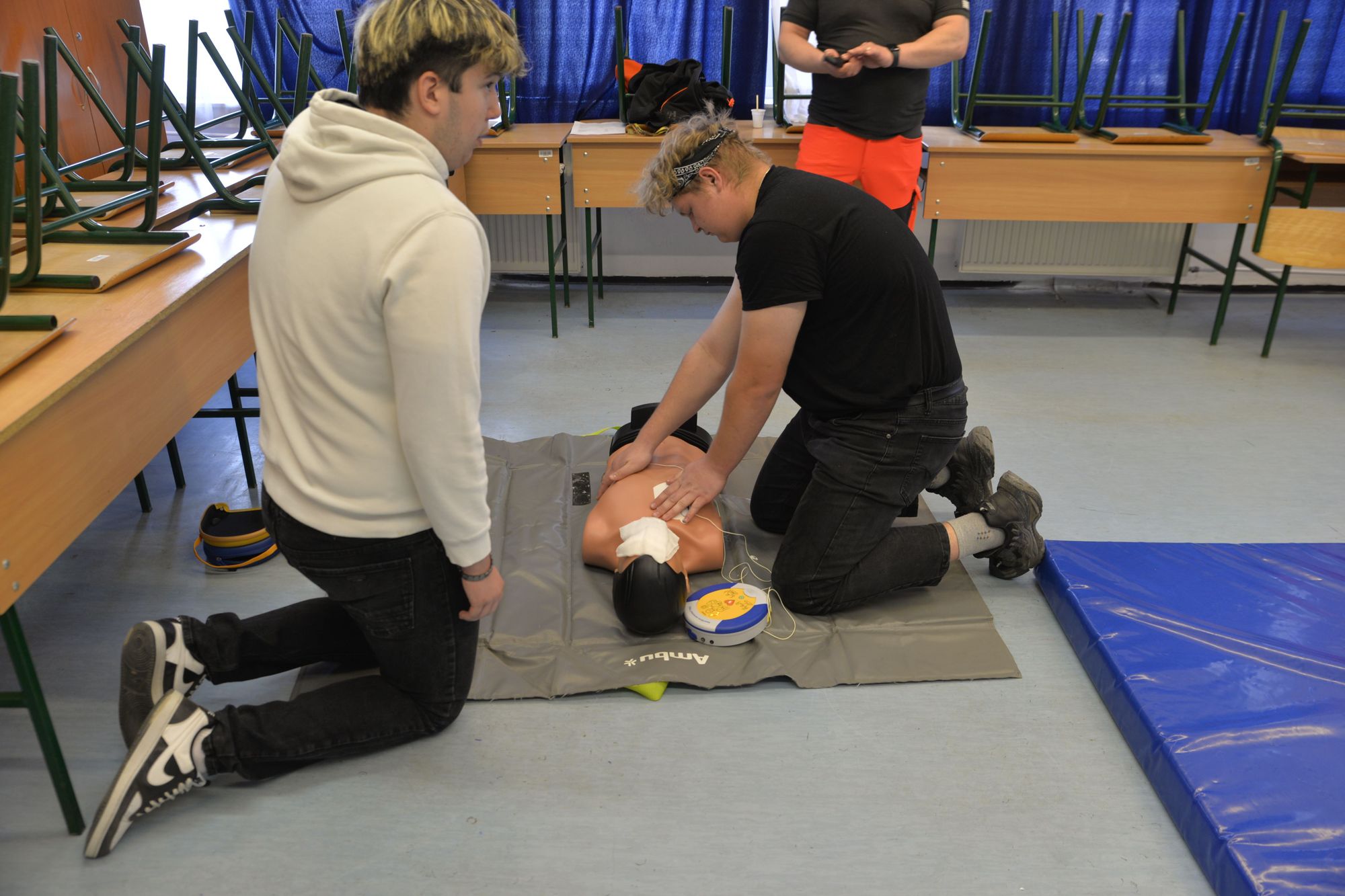
A press operator catches his forearm on a burr at twenty to ten on a Tuesday. There is blood on the guard rail and on the floor mat. A maintenance tech from two bays over pulls the kit off the wall, puts on the gloves that came with it, and wraps the arm while somebody pages the nurse. Twenty minutes later the line is running again, and the only paperwork question anyone asks is whether the cut goes on the OSHA 300 log.
Nobody asks about the maintenance tech. He joined the emergency response roster when he volunteered three years ago, and nobody has looked at the list since. He has been covered by 29 CFR 1910.1030 from that day, because contact with blood is reasonably anticipated in the duty he signed up for. If your plant defers hepatitis B vaccination for volunteer responders under OSHA’s collateral duty policy and he has not been vaccinated, the full series now has to be made available to him within 24 hours.
Who counts as exposed
The standard applies to all occupational exposure to blood or other potentially infectious materials (OPIM). OSHA defines occupational exposure as reasonably anticipated skin, eye, mucous membrane, or parenteral contact with blood or other potentially infectious materials that may result from the performance of an employee’s duties. The test looks forward, at what someone doing the job should reasonably expect, and in a plant it can catch people whose job titles say nothing about blood: the volunteer responder team, the shift leads who carry the AED key, whoever cleans up after a laceration.
In the twelve months to September 2025, federal OSHA cited this standard 16 times in NAICS 33 manufacturing and cited hazard communication 654 times in the same sector. Those 16 bloodborne pathogens citations came from four inspections.
BLOODBORNE PATHOGENS CITATIONS IN MANUFACTURING
Federal OSHA citations of 29 CFR 1910.1030, all establishment sizes, issued October 2024 through September 2025
Source: OSHA, Frequently Cited OSHA Standards. Retrieved September 2026.
Those counts cover every subsection of 1910.1030, including paragraphs unrelated to training, and Federal OSHA figures exclude the states that run their own OSHA-approved plans. Eleven inspections across the three subsectors is too small a base for a trend. By our arithmetic they averaged a little over two and a half citations each.
Four clocks on every responder
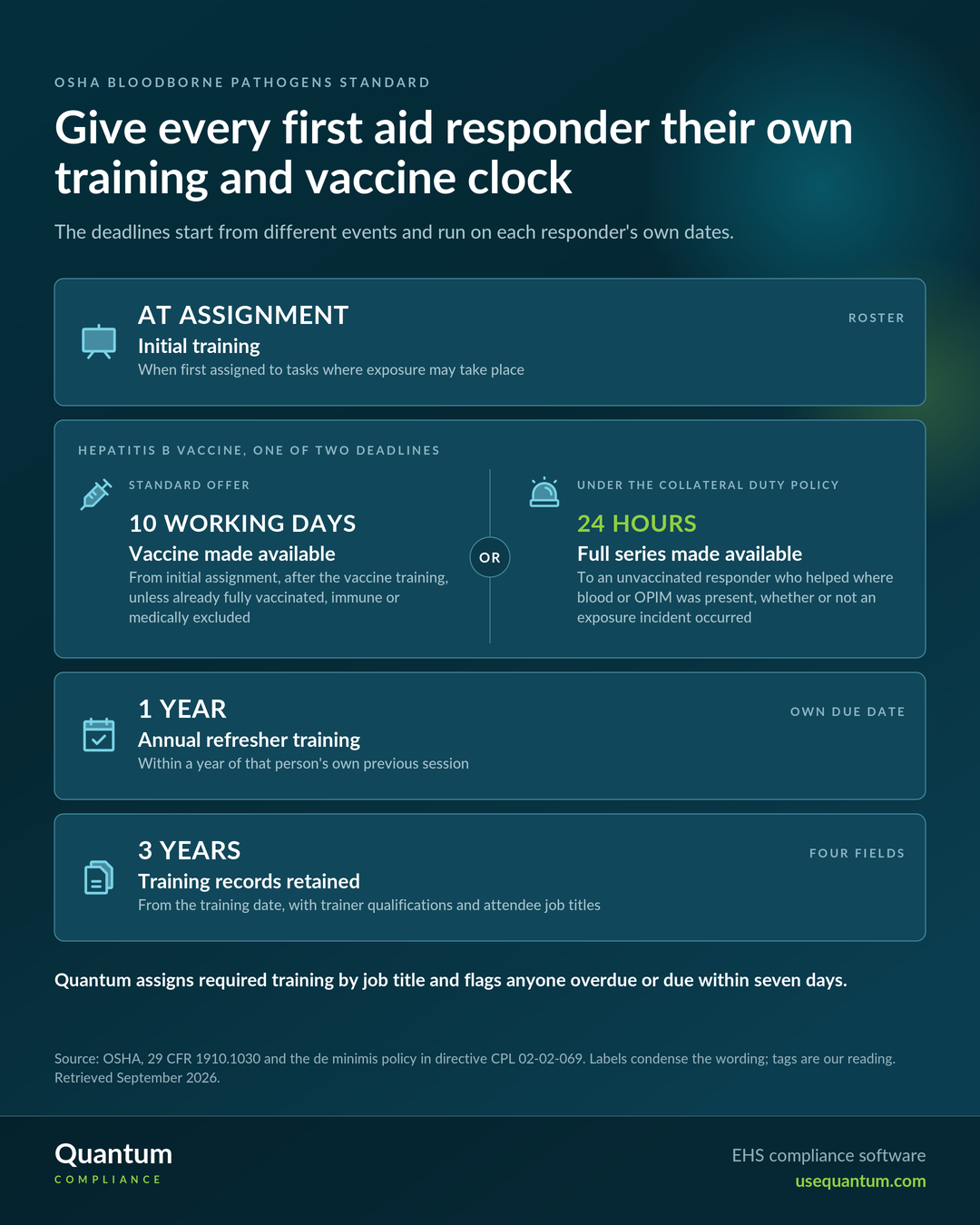
Bloodborne pathogens training requirements are measured per person, and a single annual session can still meet them if nobody falls through it. Training is due at the time of initial assignment to tasks where occupational exposure may take place and at least annually after that, and paragraph (g)(2)(iv) adds that annual training for all employees shall be provided within one year of their previous training.
Picture a plant that trains everyone each March. A responder added to the roster in July gets his initial session in July. If the next March session passes him over because he was trained so recently, his second session comes the March after that, twenty months after his first and eight months past his deadline.
Unless your plant relies on the collateral duty policy described below, hepatitis B vaccination starts from the same moment on a clock of its own. Paragraph (f)(2)(i) requires the vaccine to be made available after the employee has received the vaccine portion of the training and within 10 working days of initial assignment, unless the employee has already completed the series, antibody testing shows immunity, or the vaccine is medically contraindicated. The offer has to follow that training. When an employee declines, the standard requires a signed statement in the wording of its appendix A.
Training records carry a fourth deadline. They must show the dates of the sessions, the contents or a summary, the names and qualifications of the persons conducting the training, and the names and job titles of all attendees, and they are kept for three years from the date the training occurred. Plants that defer vaccination swap the ten-day offer for a different clock.
The collateral duty policy is a trade, not a waiver
A plant that has not offered pre-exposure vaccination to its volunteer responders, past the ten-working-day window and outside the three (f)(2)(i) exceptions, is either relying on an enforcement policy in OSHA’s compliance directive CPL 02-02-069 or open to citation. OSHA describes that policy as de minimis: employers will not be issued a citation for not offering the pre-exposure hepatitis B vaccine series if specific conditions are met. The obligation stays in the standard, and the rest of 1910.1030 still applies to these employees in full, including training, the exposure control plan, PPE and post-exposure follow-up.
The directive sets three conditions, and the third carries four required provisions of its own.
WHAT THE COLLATERAL DUTY POLICY REQUIRES
| Condition | What it requires |
|---|---|
| (a) Primary job | The provider’s primary job assignment is not the rendering of first aid or other medical assistance |
| (b) Collateral duty only | First aid is rendered only as a collateral duty, responding solely to injuries resulting from workplace incidents, generally at the location where the incident occurred |
| (c) The plan | The exposure control plan specifically addresses the provision of the hepatitis B vaccine to all unvaccinated first aid providers who assist where blood or OPIM is present, whether or not an exposure incident occurred, and post-exposure evaluation, prophylaxis and follow-up for anyone who has an exposure incident. It must also include the four provisions below. |
| (c)(1) Shift-end report | Every first aid incident involving blood or OPIM is reported to the employer before the end of that work shift, naming every provider who assisted whether or not PPE was used, with a description of the incident, the time, the date and whether an exposure incident occurred |
| (c)(2) Incident list | A report listing all such incidents is readily available on request to all employees and to the Assistant Secretary |
| (c)(3) Responder training | The bloodborne pathogens training for designated first aiders covers the specifics of the reporting procedure |
| (c)(4) 24-hour offer | The full hepatitis B series is made available as soon as possible, and no later than 24 hours, to any unvaccinated provider who assisted where blood or OPIM was present, whether or not an exposure incident occurred |
Source: OSHA letters of interpretation of November 1, 2000 and May 16, 2011, reproducing directive CPL 02-02-069. Retrieved September 2026.
A note attached to the policy keeps two familiar groups out of it. The policy does not reach designated providers who render assistance on a regular basis, for example at a first aid station, clinic, dispensary or other location where injured employees routinely go for assistance, and it does not reach healthcare, emergency, or public safety personnel who are expected to render first aid in the course of their work. Those employees must be offered the vaccine prior to exposure. A plant with a staffed first aid room already has one group outside the policy, and security officers expected to respond to injuries may be a second.
What to do about it
Steps to Put Bloodborne Pathogens Training on a Defensible Clock
Write the job titles and individuals with occupational exposure into the Exposure Control Plan, and state in writing whether you rely on the collateral duty policy.
If you rely on the policy, the reporting procedure and the employee-accessible incident list have to exist already, and responder training has to teach the procedure.
Hepatitis B content first, then the offer within ten working days of initial assignment, unless the employee is already fully vaccinated, immune or medically excluded. File a signed appendix A statement whenever someone declines.
Within one year of that person’s previous training, including people added to the roster mid-year.
New or modified tasks that affect exposure require additional training, which may be limited to the new exposures created.
Dates, contents or a summary, names and qualifications of the persons conducting the training, and names and job titles of everyone who attended. Keep them three years.
Steps one to three are decisions for whoever owns the Exposure Control Plan. Steps four and six repeat for every person every year, and step five comes back whenever a task changes.
How Q-Training Can Help
Quantum’s Training and Certificate Management module handles assignment, renewal and completion records. Required training is set once by job title, role, or group, so a new hire in a covered job is assigned the right courses automatically, with a due date and a notification. Renewal then runs from each person’s own completion date, so the next annual due date lands one year after that person’s last session, which is the (g)(2)(iv) interval, mid-year additions included. The compliance dashboard shows who is overdue and who comes due in the next seven days, with one-click follow-up to the employee or the supervisor. Instructor-led training runs as a live session with attendance recorded afterward, and every completion lands in that person’s training history with its date. Job titles come from the shared employee list that every module on the Quantum EHS platform reads, so they are maintained in one place.
Three parts stay with people. Deciding who has occupational exposure is a judgment your Exposure Control Plan makes, and so is noticing that a task has changed enough to need new training. Hepatitis B vaccination status and post-exposure evaluation results belong in the employee medical record, which 1910.1030 requires to be kept confidential, so they sit outside a training module.