

Your welder comes back from urgent care on Tuesday morning with a note. Rotator cuff strain, no overhead work for two weeks, cleared for everything else. He wants to work, his supervisor wants him on the floor, and there is enough bench work to keep him busy through the end of the month. The note gets filed, the case gets marked first aid and returned to duty, and nothing goes on the OSHA 300 Log.
The note also started a clock. If overhead welding is something he does at least once in a normal week, that case became a recordable restricted work case the moment the restriction took effect, and a day count began running the next morning.
What actually makes a case restricted work
29 CFR 1904.7(b)(4)(i) gives two routes into the category, both of them conditioned on the injury or illness being work-related in the first place. Either you keep the employee from performing one or more of the routine functions of the job, or from working the full workday that was otherwise scheduled; or a physician or other licensed health care professional recommends that the employee not do one of those things. Either route on its own is enough. When two providers disagree, paragraph (b)(4)(viii) lets you record the case based on whichever recommendation you judge the most authoritative.
The load-bearing phrase is “routine functions,” and paragraph (b)(4)(ii) defines it narrowly: work activities the employee regularly performs at least once per week. A task somebody touches twice a year falls outside that definition. A task he does every Monday sits inside it, even when the restriction sounds minor and the worker never complains about it.
Under (b)(4)(iii), a restriction imposed only for the day the injury occurred is not recordable as restricted work. Under (b)(4)(vi), a worker who performs all of his routine functions and works his full shift but produces less than he did before has not been restricted, because output is not what the paragraph measures. Two things are: the routine function list, and the full scheduled shift. That second half matters more than it looks, because (b)(4)(v) records a partial day worked as a day of job transfer or restriction on any day except the day of the injury.
“Light duty for a week” is not something anyone can evaluate against either test. Paragraph (b)(4)(vii) offers a way through rather than a requirement: you may go back to the provider and ask whether the employee can do all of his routine job functions, and whether he can work all of his normally assigned shift. Two yes answers and the case does not have to be recorded as a restricted work case, though it can still be recordable under 1904.7(a) on medical treatment beyond first aid, loss of consciousness, or any of the other general criteria. One no and it is restricted work. If you cannot get the answers from the provider who wrote the note, the rule closes the door for you and says to record the case as restricted work.
Under (b)(4)(viii), when a provider recommends a restriction that meets OSHA’s definition and the employee performs all of his routine functions anyway, the case is still recorded as restricted work. The recordkeeping consequence survives the workaround, and somebody should be asking why the restriction was not followed.
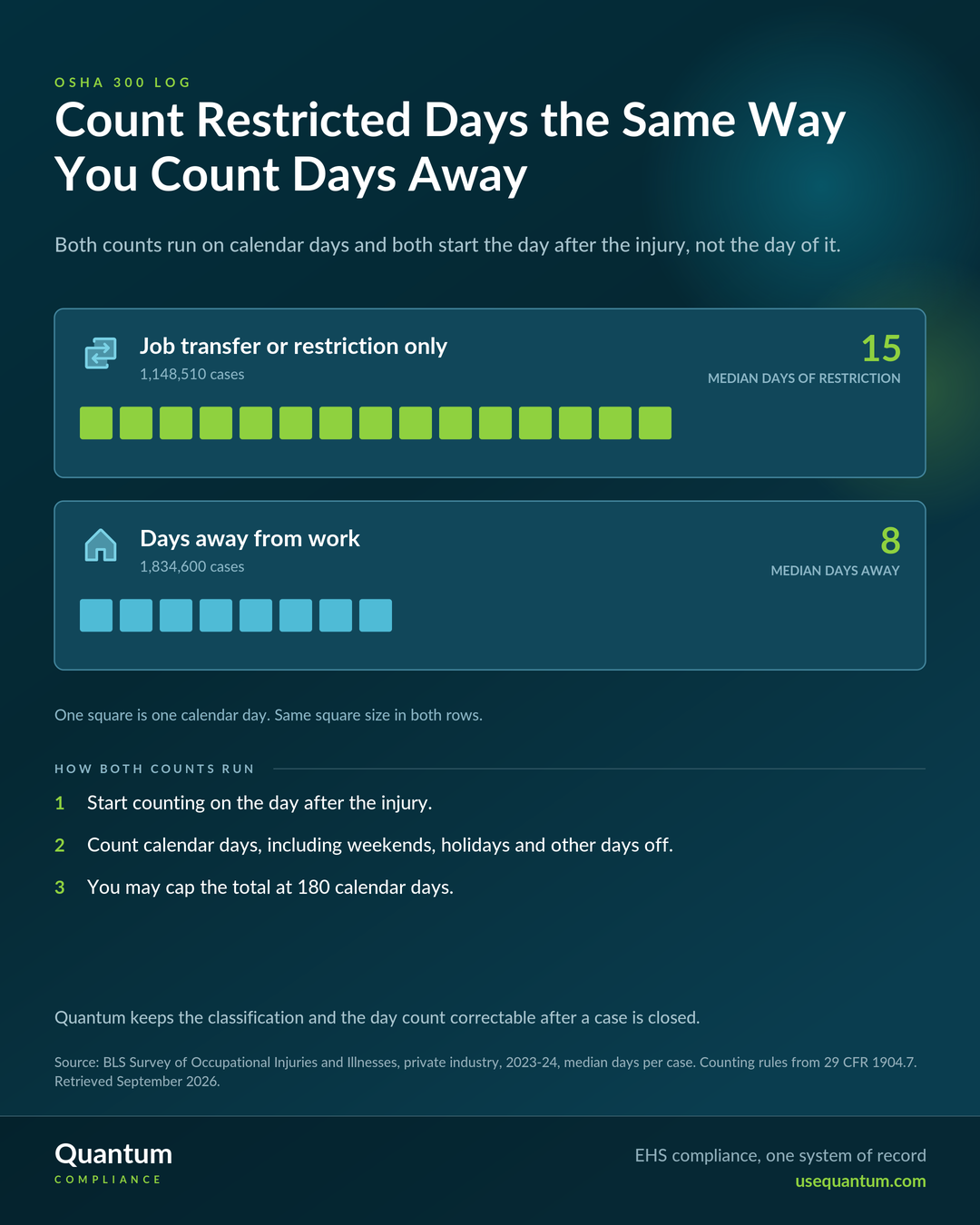
The day count runs on calendar days
MEDIAN DAYS PER CASE, PRIVATE INDUSTRY
BLS Survey of Occupational Injuries and Illnesses, 2023-24 combined. Cases involving only days of job transfer or restriction: 1,148,510. Cases involving days away from work: 1,834,600.
The two medians measure different quantities: days of job transfer or restriction in the first row, days away from work in the second. Source: U.S. Bureau of Labor Statistics, Employer-Reported Workplace Injuries and Illnesses, Table 2. Retrieved September 2026.
Across private industry in 2023 and 2024, cases involving only job transfer or restriction ran a median of 15 days of restriction. Days-away cases ran a median of 8 days away. Whatever else restricted duty is, it is not a short entry on the log.
Paragraph (b)(4)(xi) says you count days of job transfer or restriction the same way you count days away from work, using 1904.7(b)(3)(i) through (viii). Counting begins the day after the injury, not the day of it, and the unit is calendar days. Weekend days, holidays, vacation days or any other days off are all included whenever the injury is what would have kept the employee from working on them. The total may be capped at 180 calendar days.
Paragraph (b)(3)(viii) handles the employee who leaves mid-count, and it splits two ways that are worth reading carefully. If the departure has nothing to do with the injury, such as a retirement or a better job somewhere else, you may stop counting. If the injury is the reason the employee left, the opposite applies: you must estimate the total days away or days of restriction and enter that count on the log.
The one real difference from a days-away case sits at the end of (b)(4)(xi). If you permanently assign the worker to a job that has been modified or permanently changed so that the restricted functions are gone, you may stop the count on the day that change becomes permanent. Even then, you must count at least one day.
Which box gets the check
ONE CHECK BOX PER CASE
| What the case involved | Box checked | Days entered |
|---|---|---|
| Restriction or job transfer only | Job transfer or restriction | Restricted or transferred days |
| Days away from work | Days away from work | Calendar days away |
| Restriction reaches the 180-day cap, then becomes days away | Days away from work (column H), with the earlier check removed | 180 in the restriction column, and OSHA suggests 1 in the days away column |
Source: OSHA, Recordkeeping FAQ 7-18. Column lettering from the OSHA 300 Log form. Retrieved September 2026.
The 300 Log takes one classification per case, and that classification reflects the most severe outcome the case produced. OSHA’s own guidance on the 180-day cap is explicit about what happens when a case gets worse: the check initially placed in the job transfer or restriction box is removed and a check goes in column H, because days away from work is the more severe outcome. The day counts are a separate question from the check box, which is why a single case can carry a restricted day count and a days-away entry while only one box is checked.
What to do about it
Steps to Classify Restricted Work Correctly
For each job, list the activities the employee performs at least once a week, and note the normally scheduled shift length. That list is what turns a doctor’s note into a recordkeeping decision.
A provider looking at overhead welding, repeated 40-pound lifts, confined space entry and a ten-hour shift can write a restriction you are able to evaluate. A job title on its own gives them nothing to work with.
Ask the two questions in 1904.7(b)(4)(vii) and write down the answers with the date and the name of who gave them. If the provider cannot be reached, record the case as restricted work.
Weekends, holidays and other days off are included. Enter an estimate while the case is open, and cap the total at 180 calendar days if you choose to.
A restricted case that turns into days away moves to the days away box. An estimated day count gets replaced with the real one once the employee is back on full duty.
The first three steps decide whether the other two are even possible, and all three are conversations. One with your occupational health provider, one with the supervisors who know what a normal week on that job looks like, and one with yourself about how much of that has ever been written down.
How Q-Incident Can Help
Quantum’s Incident Management module covers step five and holds the record that step four produces. Each injured-person record on an incident carries a recordable flag, and setting it opens the OSHA 300 and 301 question set on that record along with the lost-days fields, so a case classified as restricted work is documented as restricted work, in the record, rather than in a supervisor’s email. Administrators can edit those injury case records after the case has been closed, which is exactly what step five needs when a restriction turns into days away six weeks later. The OSHA 300, 300A and 301 forms export from the same data.
The platform will not decide for you whether a restriction touches a routine function. It does not hold your per-job list of weekly activities, it does not know your scheduled shift lengths, and it does not talk to your clinic. Steps one through three stay with the EHS manager and the people who do the work. What the platform changes is whether the judgment you made in September is still legible, and still correctable, in March. For how incident records sit alongside the rest of your safety data, the Quantum EHS platform is the wider view.