
A forklift clips the leg of a pallet rack in aisle seven on a Tuesday afternoon. Nothing falls. Nobody is hurt. The operator backs off, finishes the pick, and the shift supervisor writes two lines in the daily log because that is what the daily log is for. By Thursday nobody is thinking about it.
Pull up that operator’s training record and it looks fine. Certified fourteen months ago, evaluation on file, next refresher scheduled for the spring. Green across the board. And the record is wrong, because OSHA stopped counting from the calendar the moment that mast touched steel.
What the forklift standard actually requires
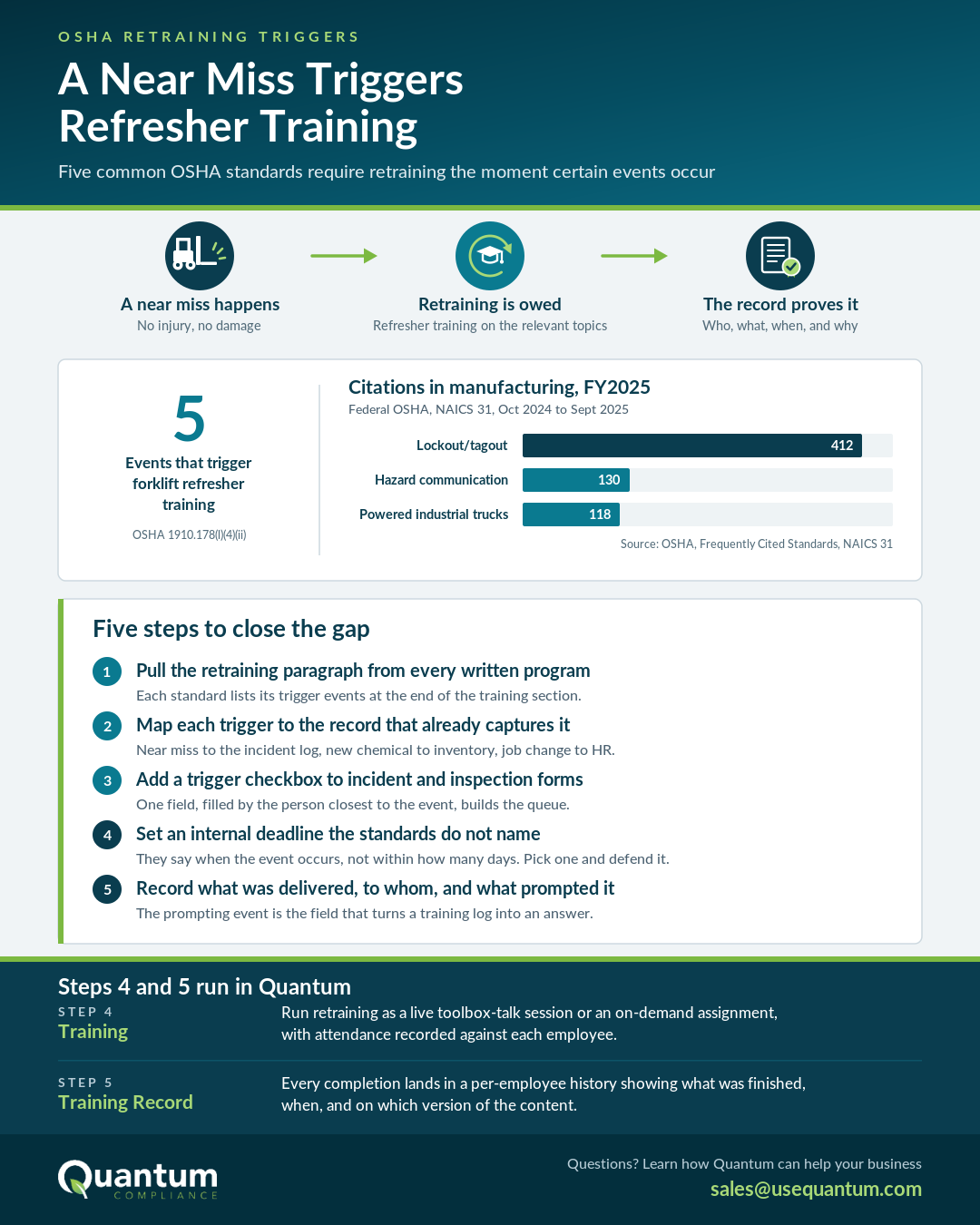
Powered industrial truck training under 29 CFR 1910.178(l) has two clocks running at the same time. One is the three-year evaluation in paragraph (l)(4)(iii), which is the part everyone tracks. The other is paragraph (l)(4)(ii), which lists five events that require refresher training in relevant topics regardless of where the operator sits in the three-year cycle. Those events include being observed operating unsafely, being involved in an accident, and being involved in a near-miss incident.
Read that list carefully, because a near miss with no injury, no damage and no recordable outcome still trips it. The trigger is the event itself.
This pattern is not unique to forklifts. Several of the standards EHS teams manage most closely carry the same structure: a baseline training requirement everyone schedules, plus a set of event-driven triggers that fire whenever the workplace changes underneath the training.
EVENT-DRIVEN RETRAINING TRIGGERS IN COMMON OSHA STANDARDS
| Standard | What triggers retraining |
|---|---|
| Powered industrial trucks 1910.178(l)(4)(ii) |
Unsafe operation observed, accident or near miss, failed evaluation, assignment to a different type of truck, or a workplace condition change affecting safe operation |
| Lockout/tagout 1910.147(c)(7)(iii) |
Change in job assignment, change in machines, equipment or processes presenting a new hazard, change in energy control procedures, or a periodic inspection revealing gaps in an employee’s knowledge or use of the procedures |
| Hazard communication 1910.1200(h)(1) |
A new chemical hazard employees have not previously been trained about is introduced into their work area |
| Respiratory protection 1910.134(k)(5) |
Annually, plus workplace or respirator type changes rendering previous training obsolete, evidence the employee has not retained the required skill, or any other situation where retraining appears necessary for safe respirator use |
| Personal protective equipment 1910.132(f)(3) Applies to eye, face, head, foot, hand and personal fall protection PPE. Respirators and electrical protective equipment are covered by their own standards. |
Workplace changes or PPE type changes rendering previous training obsolete, or inadequacies in an employee’s knowledge or use of assigned PPE. The standard presents these as examples, not a closed list. |
Source: OSHA, 29 CFR Part 1910
Two things about the wording are worth noticing. First, several of these triggers are about the employer having reason to believe an employee’s knowledge has slipped, which means a supervisor’s observation is enough to start the obligation. Second, the scope of the retraining is often narrower than people assume. The forklift standard asks for refresher training in relevant topics, so a focused session on what actually went wrong is defensible and much faster to deliver than repeating the initial course.
Why the annual calendar cannot catch these
An annual training matrix is a scheduling tool. It answers one question: who is due, and when. That question has a fixed answer set months in advance. The predictability is what makes an annual matrix easy to run, and it is also why the matrix has nothing to say about anything that happens between two scheduled dates.
Event-driven triggers work the other way around. They are fired by things that land in other systems entirely. The near miss goes into your incident record, the energy control procedure revision into a document library, the new solvent into a chemical inventory that generates a safety data sheet. Job reassignments sit with HR, where nobody is thinking about lockout/tagout at all. Every one of those is a retraining trigger under some standard, and none of them will ever write themselves onto a training calendar.
The result is a program that is genuinely well run and still exposed. When an inspector asks why an operator who was in a near miss two months ago has no refresher on file, “he was not due yet” is not a defense. The citation history suggests this gap is common. Across federal OSHA inspections of manufacturing establishments in fiscal year 2025, the standards carrying these event-driven triggers were cited heavily.
CITATIONS IN MANUFACTURING, FY2025
Federal OSHA citations issued October 2024 through September 2025, NAICS 31, all establishment sizes. Each of these standards carries an event-driven retraining trigger.
Those totals cover every subsection, so read them as a map of where inspectors spend their time rather than a count of missed refreshers. On all five standards an inspector will ask whether training happened, and then whether it happened again when the standard required it.
Building a retraining trigger list
The fix is a short document and a wiring job. It takes an afternoon to draft and it closes an exposure that a calendar cannot reach.
Steps to build a retraining trigger list
Walk your written programs and pull the retraining paragraph out of each one. Most sit at the end of the training section and read as a short list of conditions.
A near miss trigger points at your incident log. A new hazard trigger points at chemical inventory. Name the specific system for each one so the trigger has somewhere to come from.
Most of these standards say retraining is required when the event occurs without naming a number of days. Pick a window your organization can defend, write it into the program, and apply it consistently.
A single operator after a near miss needs a focused session on the relevant topics. A procedure change affecting a whole crew is a toolbox talk. A job reassignment is the full curriculum.
The training record should show what was delivered, to whom, on what date, and what event prompted it. That last field is what turns a training log into an answer.
Step two is where most of the work is, and it is an organizational problem before it is a software problem. The near miss and the training record usually live with different people. Until someone owns the handoff, the trigger does not fire, and the operator who clipped the rack keeps showing green.
A practical way to make the handoff real is to add one field to the forms you already use. On the incident and near miss form, ask whether the event involved equipment or a procedure covered by a training standard. On the inspection form, ask the same about findings. One checkbox, filled in by the person closest to the event, gives the training owner a queue to work from. When someone leaves that box unchecked on an event that clearly qualified, treat it as a sign that the form or the briefing needs work.
Build in one more source: treat your own inspection findings as triggers. Lockout/tagout says so outright. If a periodic inspection reveals gaps in how an employee applies the energy control procedure, the standard treats that finding as a retraining obligation in its own right.
How Training and Certificate Management Can Help
Quantum’s Training and Certificate Management module handles steps four and five. Live instructor-led sessions can be scheduled and run as a meeting, which is the right shape for a toolbox talk delivered days after a triggering event, with attendance recorded against each employee afterward. On-demand assignments cover the cases where a full course is warranted. Either way the completion lands in a per-employee training history showing what was finished, when, and on which version of the content.
Identifying the trigger stays a human judgment call, and no module watches your incident log and assigns training on its own. What the platform removes is the part that usually fails after the fact: proving the retraining happened. A supervisor or an auditor can scan an employee’s QR code and see their current training record with no login, and the compliance dashboard flags who is overdue so a triggered assignment does not quietly age out alongside the annual ones.