
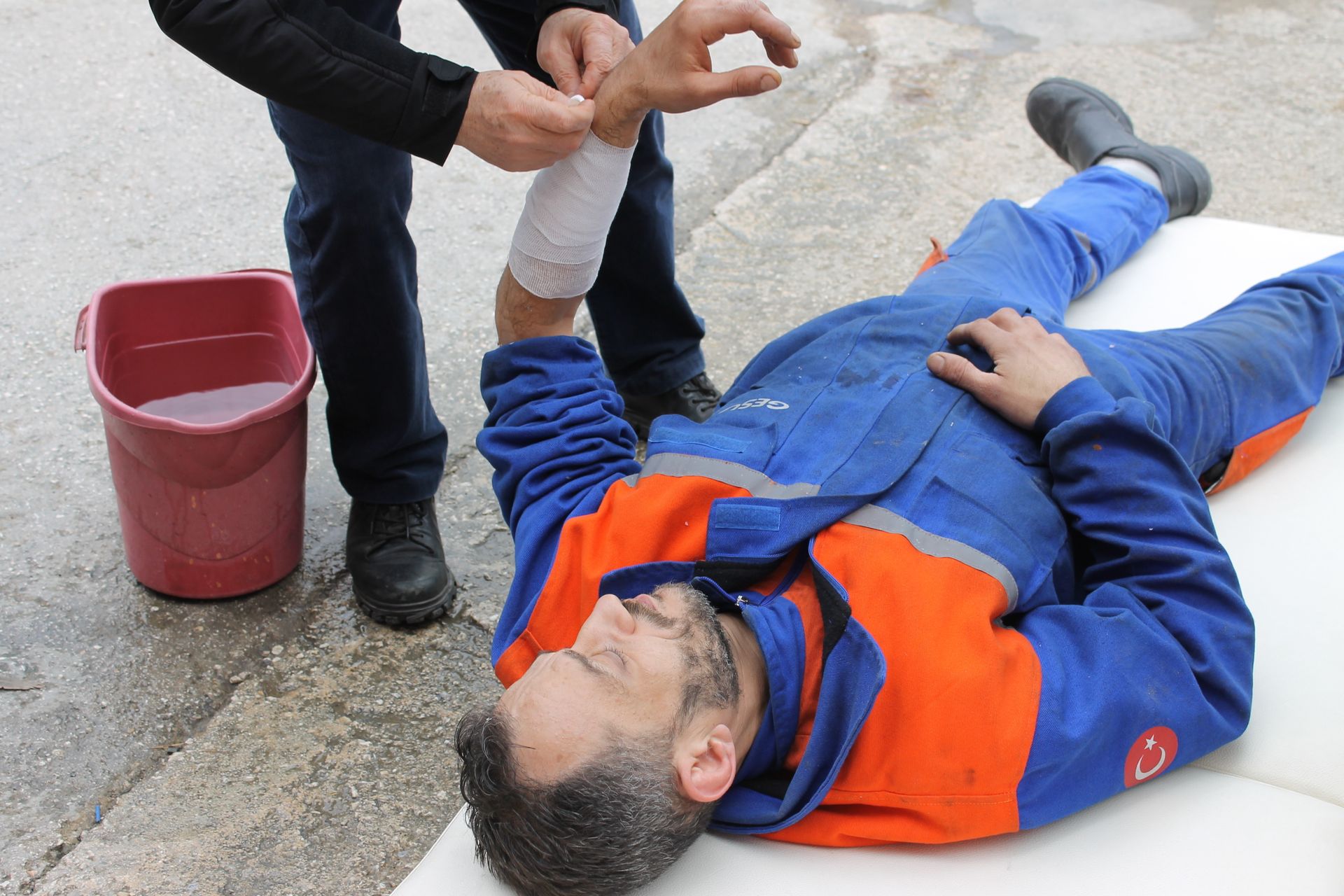
Two workers, same shift, nearly identical lacerations from the same conveyor guard. The first sees the onsite nurse, gets the wound cleaned and closed with butterfly strips, and returns to the line. The second gets two sutures at the clinic and is back the next morning with no restrictions. If you put both on your OSHA 300 log, you overreported. If you left both off, you are carrying an unrecorded recordable, and it will surface at the worst possible moment: during an inspection, an insurance audit, or your 300A certification in February.
Recordability looks simple until you have to make the call at 4:45 on a Friday with partial information. This guide walks through the five-step decision process from 29 CFR 1904, with special attention to the distinction that causes most errors: first aid versus medical treatment.
Why This Decision Matters More Than It Seems
Every entry on your log feeds your TRIR and DART rates, which follow your company into insurance renewals and contractor prequalification. Overrecording quietly inflates those rates for years. Underrecording is a citation waiting to happen, and OSHA treats recordkeeping violations seriously precisely because the log is how everyone else verifies your safety performance.
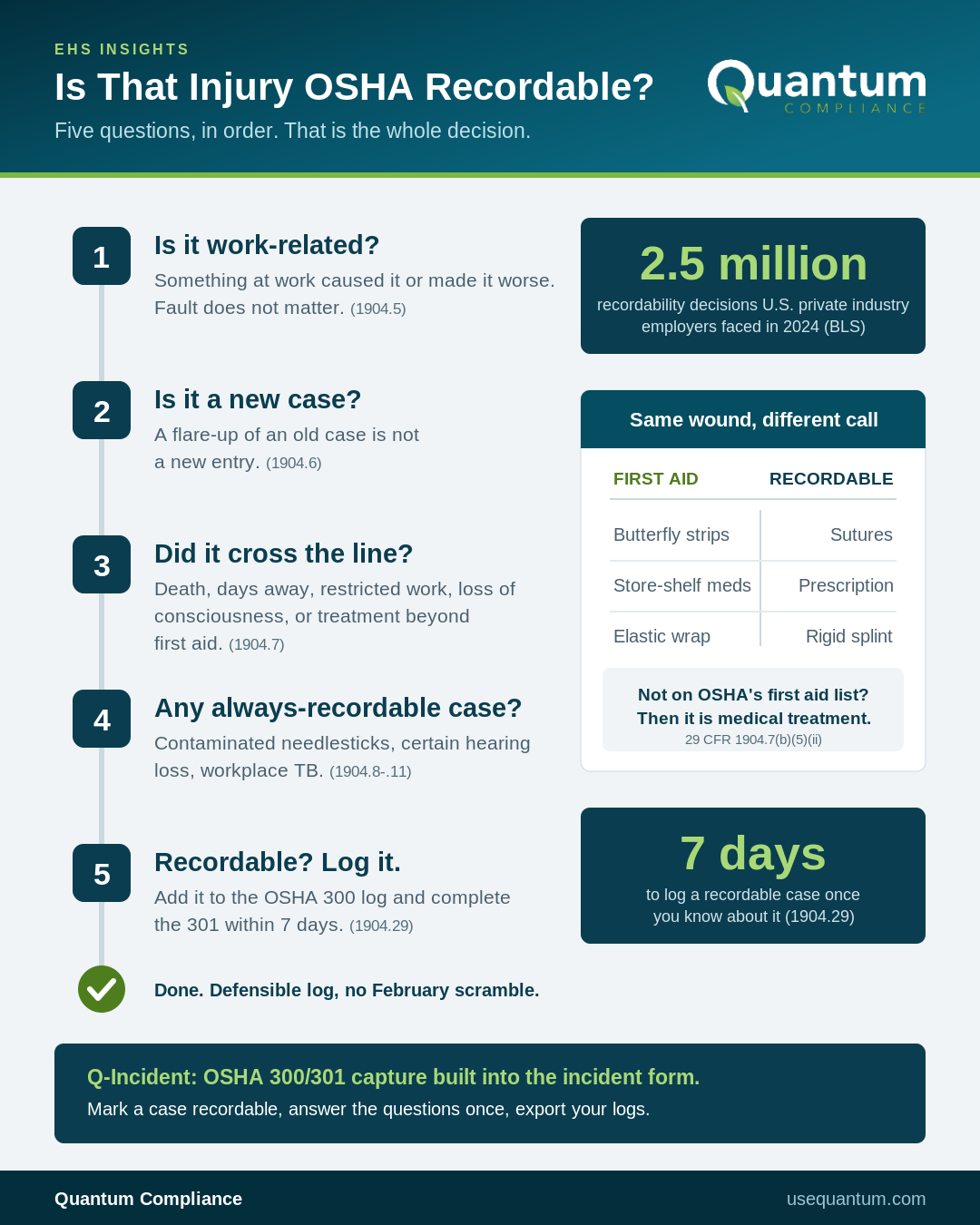
2.5 million
Nonfatal workplace injuries and illnesses reported by private industry employers in 2024. Every one required a recordability decision.
Source: U.S. Bureau of Labor Statistics
Step 1: Establish Work-Relatedness
Under 1904.5, an injury or illness is presumed work-related if an event or exposure in the work environment caused or contributed to it, or significantly aggravated a pre-existing condition. The presumption is broad, and the exceptions are narrow: symptoms that merely surface at work, personal tasks outside assigned hours, personal grooming, and a handful of others.
One caution from the field: if the discussion drifts toward whether the worker should have been doing the task that way, you are asking a blame question, not a work-relatedness question. The regulation does not care whose fault it was. Neither should this step.
Step 2: Confirm It Is a New Case
A case is new under 1904.6 if the employee has not previously had a recordable injury or illness of the same type affecting the same body part, or had fully recovered and a new workplace event triggered the condition again. A flare-up of an old case without a new event is not a new entry; it may update the original one.
Step 3: Apply the General Recording Criteria
A work-related new case is recordable under 1904.7 if it results in any of the following: death, days away from work, restricted work or job transfer, medical treatment beyond first aid, loss of consciousness, or a significant injury or illness diagnosed by a licensed health care professional (a fractured or cracked bone or tooth, a punctured eardrum, cancer, or chronic irreversible disease).
The tripwire is medical treatment beyond first aid. OSHA solved the ambiguity by making the first aid list exhaustive: if a treatment is not on the list in 1904.7(b)(5)(ii), it is medical treatment. That produces some counterintuitive pairs.
First Aid vs. Medical Treatment: Where Cases Flip to Recordable
| First aid (not recordable by itself) | Medical treatment (recordable) |
|---|---|
| Butterfly bandages or Steri-Strips | Sutures, staples, or surgical glue |
| Nonprescription medication at nonprescription strength | Any prescription medication, or OTC medication at prescription strength |
| Elastic wraps and other non-rigid support | Rigid splints, casts, or other devices that immobilize |
| Cleaning, flushing, or soaking a surface wound | Wound debridement |
| Draining a blister, drilling a nail, eye patches, simple splinter removal | Physical therapy or chiropractic treatment |
| Tetanus immunization | Other immunizations, such as hepatitis B or rabies vaccine |
Source: OSHA, 29 CFR 1904.7(b)(5)(ii)
Two clarifications that resolve most edge cases. First, it is the treatment that counts, not the provider or the location. A clinic visit that ends in first aid only is not recordable, and first aid administered by a physician is still first aid. Second, a visit for observation, diagnostic testing, or X-rays does not by itself make a case recordable, even though it feels significant in the moment. One narrow exception on splints: a rigid device used only to immobilize someone during transport to treatment still counts as first aid under 1904.7(b)(5)(ii)(G).
Step 4: Check the Special Criteria
A few case types skip the general criteria entirely. A needlestick or cut from a sharp contaminated with another person’s blood or other potentially infectious material is always recordable under 1904.8. Medical removal under an OSHA standard is recordable under 1904.9. Occupational hearing loss is recordable when an audiogram shows a standard threshold shift of 10 dB or more and total hearing level reaches 25 dB above audiometric zero (1904.10). A tuberculosis infection following a known workplace exposure is recordable under 1904.11.
Step 5: Record Within 7 Days and Keep the Log Current
Once you have the information that a recordable case occurred, 1904.29 gives you seven calendar days to enter it on the 300 log and complete the 301 incident report. The 300A summary must be certified and posted from February 1 through April 30, and records are kept for five years after the year they cover, with the 300 log updated as cases change.
Here is the systems-thinking point that matters most: late or missing entries are rarely procrastination. In most organizations the recordkeeper never got the report in time, because reporting required a login, an app, or a form the injured worker could not find. Fix the intake path and the seven-day clock stops being a threat. Some platforms now let a frontline worker report an injury by scanning a QR code and entering only an employee ID, no app download and no password, with the submission attributed to the correct employee automatically. It also helps to train supervisors on the first aid list so treatment decisions in the first hour do not accidentally decide recordability for you.
How Q-Incident Can Help
Q-Incident is built around the workflow this article describes. When an investigator marks an injured person’s record as recordable, the form opens the OSHA 300 and 301 questions for that specific case, so log data is captured at the moment the decision is made instead of being reconstructed months later. OSHA 300, 300A, and 301 forms export directly from your incident data when it is time to certify and post.
Intake friction is handled at the front of the process too: workers can report an incident from the floor via QR code without a login, which means the seven-day clock starts when the injury happens, not when the paperwork finally surfaces. Learn more about Q-Incident incident management software.