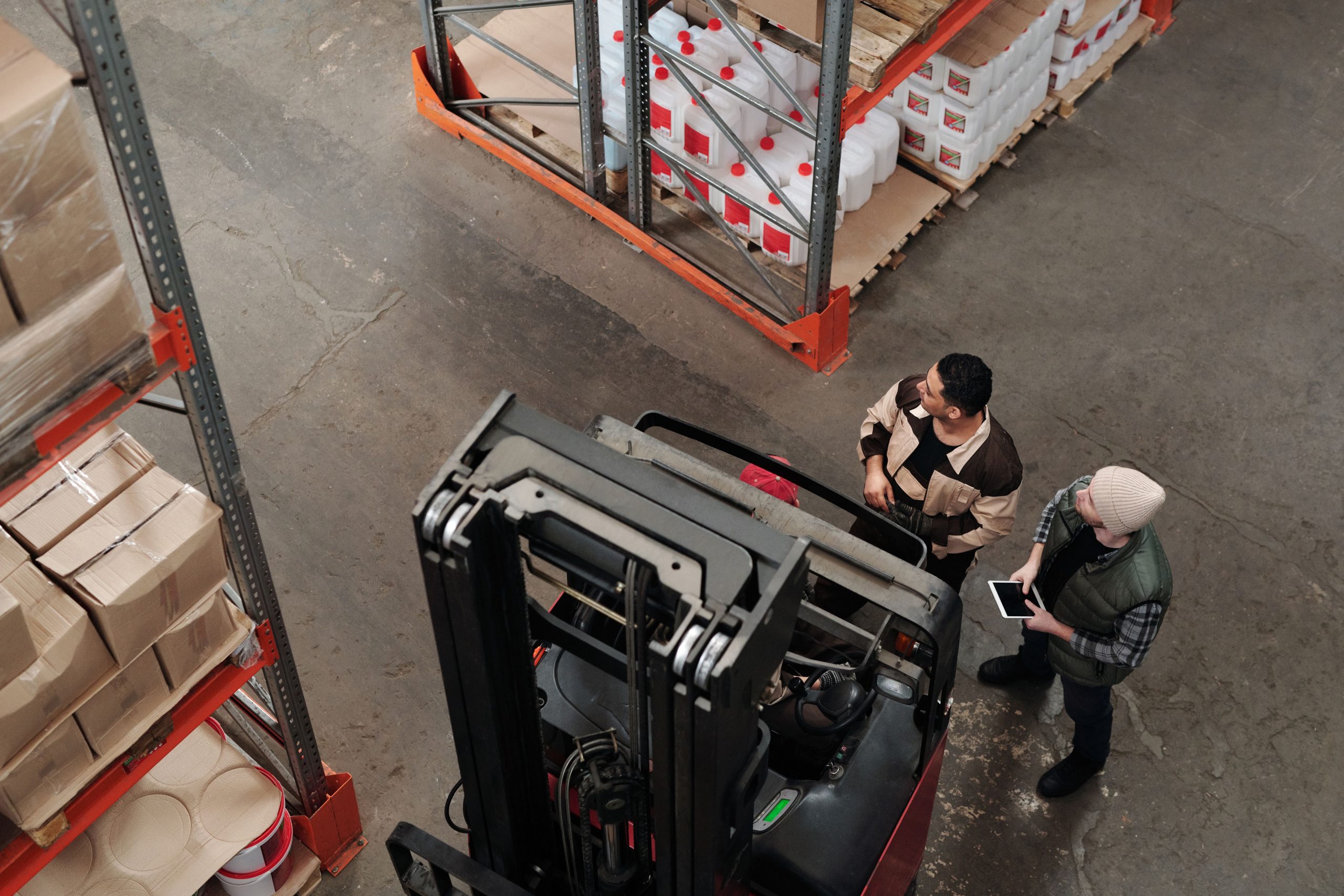
A forklift operator swings a loaded pallet around a blind corner in aisle 12 and comes within a few feet of pinning a picker against a rack. No contact. No injury. The picker reports it to the shift supervisor, who logs it in the safety software as a near-miss with no injury and moves on to the next item on the clipboard. That same week, another employee gets a paper cut sorting mail and grabs a bandage from the first aid kit. Both events get filed as level-one, no-lost-time entries. On paper, they carry identical weight.
In reality, one of those two employees was a few feet and a fraction of a second away from a fatality. The other was never going to be anything more than a paper cut. Most incident tracking systems cannot tell the difference, because they are built to rate what happened, not what could have happened. That gap is one of the more consequential blind spots in workplace safety today, and it is not the fault of the supervisor who logged the report correctly according to the tools available.
The Number That’s Improving Doesn’t Measure the Risk That Matters Most
In 2024, the incidence rate of total recordable cases (TRC) in private industry fell to 2.3 cases per 100 full-time equivalent workers, the lowest rate the Bureau of Labor Statistics has recorded since this data series began in 2003. Fatal work injuries also declined that year, to 5,070, a rate of 3.3 per 100,000 full-time equivalent workers, down from 3.5 in 2023. Both numbers moving in the right direction looks like unambiguous progress, and in aggregate, it is.
But the two numbers are not measuring the same risk, and they are not driven by the same hazards. Look at what actually shows up in each dataset.
Leading Causes of Nonfatal Recordable Injuries (DART Cases), 2023-2024
| Event or Exposure | DART Cases |
|---|---|
| Overexertion, repetitive motion, and bodily conditions | 946,290 |
| Contact incidents | 860,050 |
| Falls, slips, and trips | 721,720 |
| Exposure to harmful substances or environments | 224,450 |
| Transportation incidents | 121,330 |
Source: U.S. Bureau of Labor Statistics, Employer-Reported Workplace Injuries and Illnesses, 2023-2024
Leading Causes of Fatal Work Injuries, 2024
| Event | Fatalities | Share of Total |
|---|---|---|
| Transportation incidents | 1,937 | 38.2% |
| Falls, slips, and trips | 844 | 16.6% |
| Violent acts | 733 | 14.5% |
| Exposure to harmful substances or environments | 687 | 13.6% |
Source: U.S. Bureau of Labor Statistics, Census of Fatal Occupational Injuries Summary, 2024
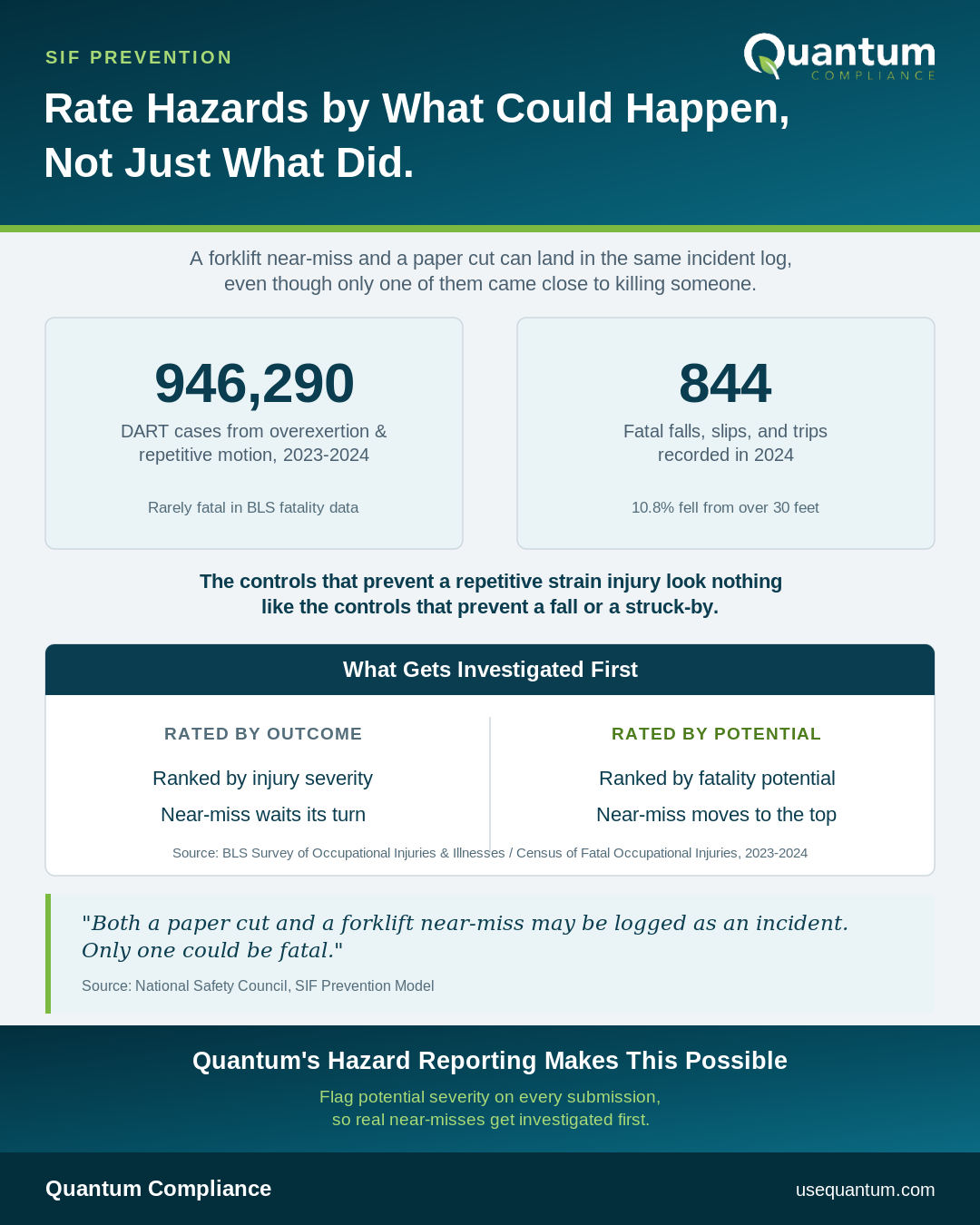
Notice that falls, slips, and trips appear on both lists. That is not a contradiction, it is the point. What separates a twisted ankle from a fatality in that category is rarely the initial hazard. It is the height, the surface, and the energy involved. Of the fatal falls recorded in 2024, 10.8 percent were falls from a height over 30 feet. The category label does not tell you which outcome you are looking at. A safety program that gets very good at reducing overexertion injuries, the single largest driver of its recordable rate, can still be doing almost nothing to reduce its fatality risk, because the controls that prevent a repetitive strain injury look nothing like the controls that prevent a worker from being struck by a vehicle or falling from height.
What “SIF Potential” Actually Means
The National Safety Council has a name for this distinction: the difference between an incident’s actual severity and its potential severity. As NSC’s Serious Incident and Fatality (SIF) Prevention Model puts it, both a paper cut and a near-miss involving a forklift may get logged as an incident, but only one of them could have been fatal. NSC calls a near-miss or lower-severity event that could have resulted in serious harm a “potential SIF,” and treats it as a leading indicator worth investigating on its own terms, not a non-event to file away because no one was hurt.
That reframing changes what gets investigated first. A hazard report rated only by what happened will always rank the forklift near-miss below anything with an actual injury attached, even a minor one. A report rated by what could have happened puts the forklift incident at the top of the queue, whether or not it produced so much as a bruise.
Building Potential Severity Into How Hazards Get Reported
OSHA’s guidance on hazard identification and assessment treats near-miss investigation as a core part of a safety program, not an optional add-on. Employers are directed to investigate close calls to determine underlying hazards and root causes, and to evaluate each hazard by weighing both the severity of potential outcomes and the likelihood of exposure, not only what happened this time. That evaluation only works if the reporting process captures enough detail, and quickly enough, to make it possible. A near-miss described in one vague line two days after the fact is much harder to rate for potential severity than one reported immediately, by the person who was standing there.
This is where reporting friction becomes a safety problem in its own right, not just a data quality issue. Some hazard reporting tools now let frontline workers submit a report by scanning a posted QR code and entering only their employee ID, with no app to download and no password to remember. Every submission is attributed to the correct employee automatically. The easier it is to report a close call in the moment, the more of that near-miss data actually reaches the people deciding what gets investigated, instead of getting summarized secondhand at the end of a shift or skipped entirely.
The Clock Is Already Running on the Ones That Do Cause Harm
For incidents that do cross into serious territory, OSHA’s timelines leave no room for interpretation. Under 29 CFR 1904.39, employers must report a work-related fatality within 8 hours, and a work-related amputation, loss of an eye, or in-patient hospitalization within 24 hours. Those deadlines exist because the investigation that follows a serious injury is time-sensitive: physical evidence changes, memories fade, and the equipment involved often goes back into service before anyone takes a second look. A near-miss with the same mechanism and energy as a reportable injury deserves that same urgency, even though no regulation requires it.
How Hazard Reporting Can Help
Quantum’s Hazard Reporting tools let frontline teams flag potential severity on every submission, not just the outcome that actually occurred, so a forklift near-miss with fatality potential can be routed and prioritized the same way an actual injury would be, rather than waiting behind lower-risk items in an investigation queue. Because reports can be submitted by scanning a QR code and entering an employee ID, with no app to install and no password to remember, workers can log a close call from the warehouse floor in the moment it happens instead of describing it from memory later. That same hazard data feeds directly into incident tracking and investigation, so a flagged near-miss does not lose momentum once it is reported. It is a small shift in how hazards get rated, and it changes which ones get looked at first.