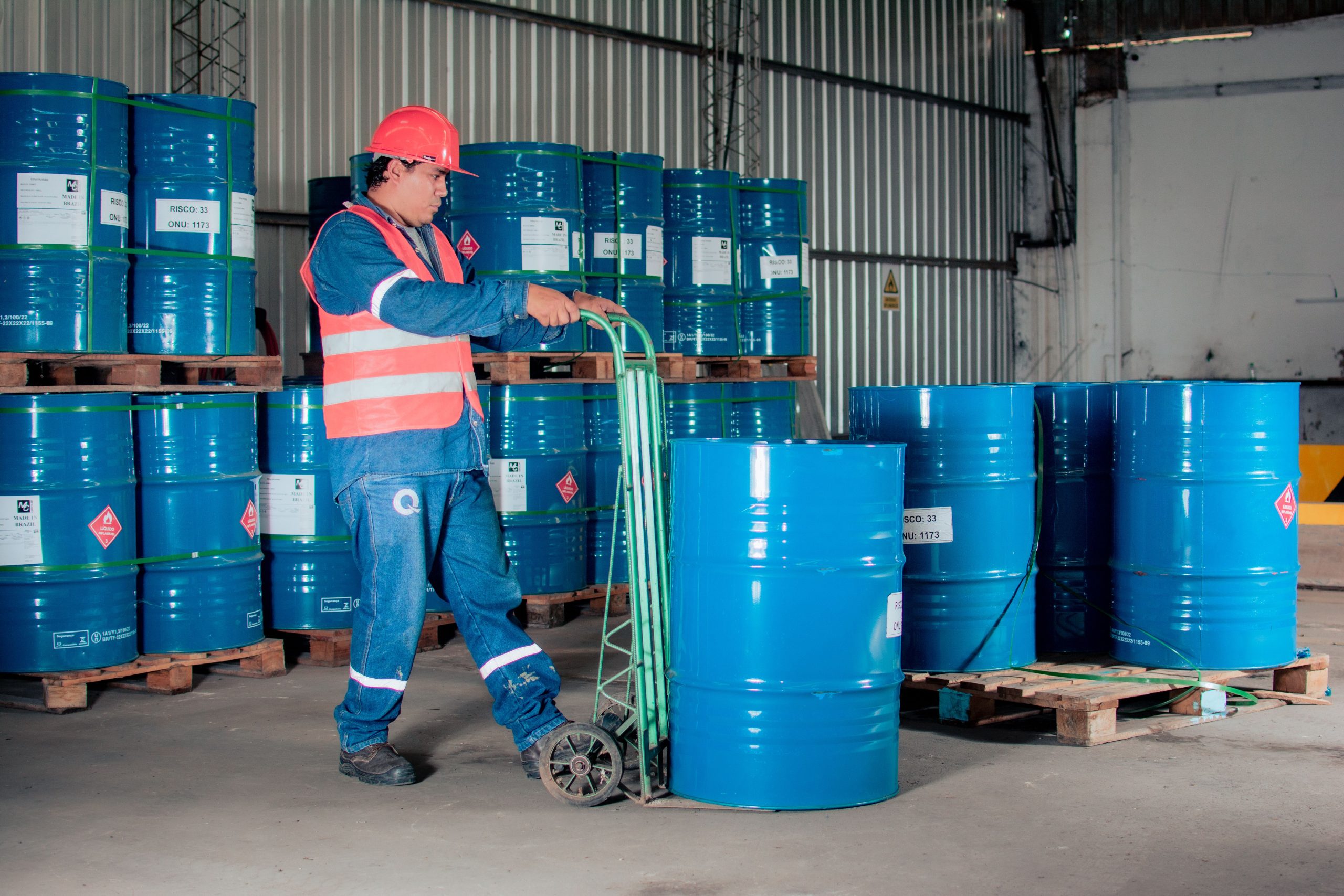
A drum of the same isopropanol blend your mix room has run for eleven years comes off the truck on a Tuesday morning. Receiving scans it, files the safety data sheet, and nobody thinks twice. Except this SDS is four pages longer than the last one, and Section 2 carries a hazard classification your written program has never mentioned. Down the hall, the transfer container that chemical gets poured into still wears the same handwritten label it wore in 2019.
Nothing about that morning is unusual right now. It is the predictable result of a compliance clock that started running for chemical manufacturers in May, and that hands the next deadline to you.
What Changed on May 19, 2026
OSHA published its update to the Hazard Communication Standard on May 20, 2024, aligning 29 CFR 1910.1200 primarily with the seventh revision of the Globally Harmonized System. The rule set a tiered compliance schedule: manufacturers first, employers second, substances before mixtures.
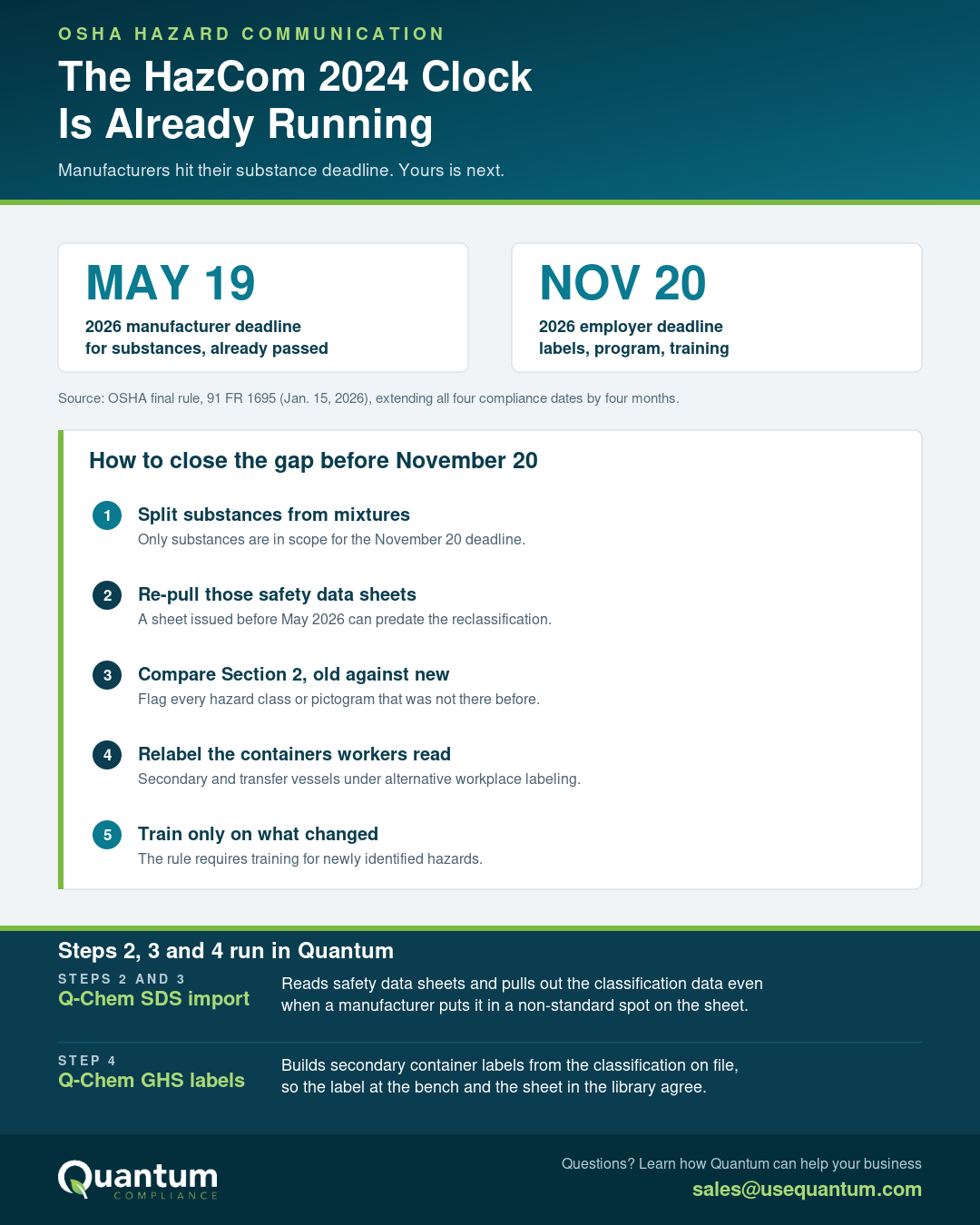
In January 2026, OSHA pushed every one of those dates back by four months. The agency said plainly why: it had not finished the guidance materials the regulated community had asked for, and the first deadline was days away. The extension notice moved the initial manufacturer deadline from January 19, 2026 to May 19, 2026, and shifted the rest of the schedule to match.
That first date has now passed. Chemical manufacturers, importers, and distributors evaluating substances were required to be in compliance with all modified provisions of the standard by May 19, 2026. Reclassified substances, rewritten Section 2 entries, and relabeled containers are in circulation and arriving at your dock today.
HazCom 2024 Compliance Dates, as Extended January 15, 2026
| Who | What | Deadline |
|---|---|---|
| Manufacturers, importers, distributors | Substances: all modified provisions | May 19, 2026 (passed) |
| All employers | Substances: workplace labels, written program, training | November 20, 2026 |
| Manufacturers, importers, distributors | Mixtures: all modified provisions | November 19, 2027 |
| All employers | Mixtures: workplace labels, written program, training | May 19, 2028 |
Source: OSHA, Hazard Communication Standard, 91 FR 1695 (Jan. 15, 2026)
The Classifications That Are New to Your Inventory
Two changes in the updated appendices are the ones most likely to surprise a facility that has been buying the same products for a decade. Appendix B.17 adds desensitized explosives as a hazard class, covering explosive substances that have been treated to suppress their explosive properties. Appendix B.3 is now titled Aerosols and Chemicals Under Pressure, and aerosols are classified into one of three categories rather than being addressed only when flammable.
A product that has sat on your shelf unchanged for years can carry a new classification simply because the criteria it is measured against changed. The chemical did not become more dangerous. Your documentation of it became more accurate.
The Deadline That Belongs to You: November 20, 2026
Paragraph (j)(2)(ii) of the standard is short, and it is worth reading in the original rather than in summary. For substances, all employers shall, as necessary, update any alternative workplace labeling used under paragraph (f)(6), update the hazard communication program required by paragraph (h)(1), and provide any additional employee training under paragraph (h)(3) for newly identified physical hazards, health hazards, or other hazards. The deadline is November 20, 2026.
Two things in that sentence do real work. “As necessary” means this is not a blanket requirement to redo everything; the obligation attaches where a classification actually changed. And “for substances” means this wave covers only part of your inventory. Most industrial chemical inventories are dominated by mixtures, which follow eighteen months later. Facilities that decide to handle all of it as one project in 2028 will be out of compliance for the intervening year and a half.
Working Backward From November 20
Separate single substances from mixtures. Only the substances are in scope for this deadline.
Check the revision date on each. A sheet issued before May 2026 may predate the reclassification.
Flag every hazard class, category, or pictogram that was not there before. That list is your scope.
Secondary containers, transfer vessels, and any alternative labeling system covered by (f)(6).
The rule requires training for newly identified hazards. Retraining everyone on all of HazCom buries the part that changed.
Why Old Labels Will Keep Arriving Anyway
Here is the carve-out that trips up receiving teams. Under paragraph (f)(11), for chemicals that have already been released for shipment and are awaiting future distribution, manufacturers and distributors have the option not to relabel those containers. “Released for shipment” means packaged and labeled in the form in which it will be sold.
So a container bearing a pre-2024 label can legitimately show up on your dock well after May 19, 2026, and it is not evidence of anyone’s noncompliance. What it does mean is that your receiving process cannot treat label format as a proxy for whether your file copy of the SDS is current. The revision date on the sheet is the signal. The label on the drum is not.
The Failure This Quietly Sets Up
Hazard Communication was the second most frequently cited OSHA standard across all industries in fiscal year 2025, and the most cited standard in general industry, according to OSHA’s own citation data. That has been true for years, and it is rarely because a facility ignored the standard outright. It is because the paperwork drifted out of sync with the shop floor.
Picture the operator at the mix room bench in November. The corporate SDS library has the updated sheet in it. The written program still describes the old classification. The label on the transfer container says what someone wrote on it seven years ago. If that operator handles the material the way they always have, and something goes wrong, the incident report will have a tidy box to check for human error. It would be the wrong box. Nothing in that person’s immediate information environment told them anything had changed. The system put them there.
Deadlines like this one are a chance to close that gap deliberately, in a planned window, instead of discovering it during an inspection or after an exposure.
How Q-Chem Can Help
The hard part of this deadline is not knowing the date. It is knowing which of your several thousand chemical records actually changed. Quantum’s Chemical Management module imports safety data sheets and extracts component and classification data even when a manufacturer places that information in a non-standard spot on the sheet, which is common enough during bulk imports that hand correction usually becomes the bottleneck. Fewer records falling through means fewer reclassified substances quietly retaining their old hazard profile in your inventory.
From those records, Q-Chem generates GHS secondary container labels that reflect the classification currently on file, so the label at the bench and the sheet in the SDS library are drawn from the same source rather than maintained separately. That is the specific gap November 20 is asking you to close.