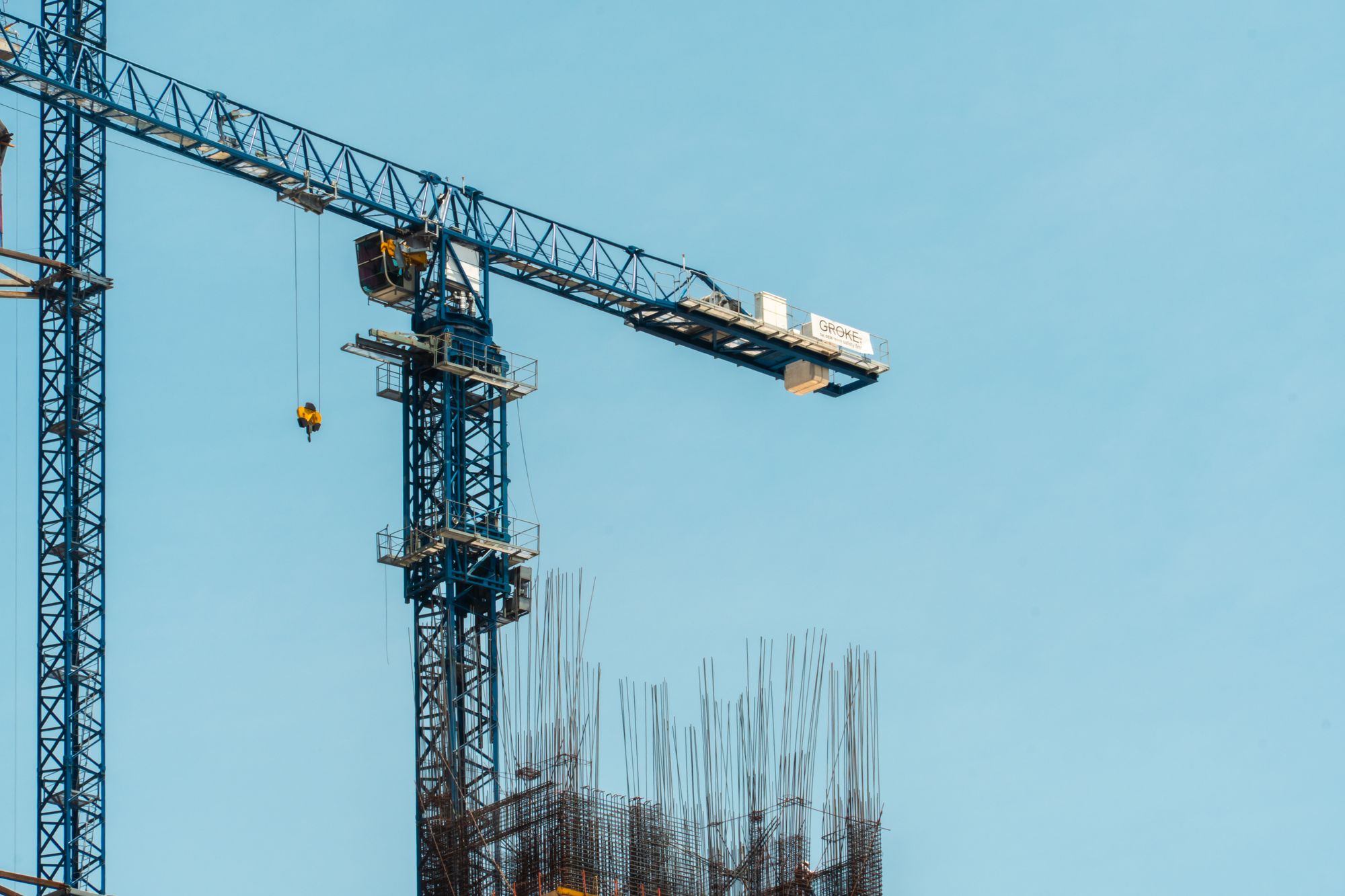
Picture a tower crane on a mid-rise job that has been swinging rebar bundles all morning when one load passes behind the elevator core. The signal person loses sight of it, the radio call gets buried under the noise of a concrete pump, and the operator holds the swing a few seconds longer on the last signal he understood. The bundle clears the deck, the crew finishes the pick, and nobody writes anything down.
Moments like that are common enough that a national survey now puts a number on them. In September the National Safety Council and the NCCCO Foundation released The State of Rigging and Signaling in Crane Operations, built on a March 2026 survey of 376 crane professionals, along with expert interviews and a review of existing research. Operators made up 71% of the respondents, and the rest were supervisors, riggers, safety professionals, trainers and signal persons.
98%
of surveyed crane professionals reported a communication challenge during lifts at least sometimes in the last 90 days
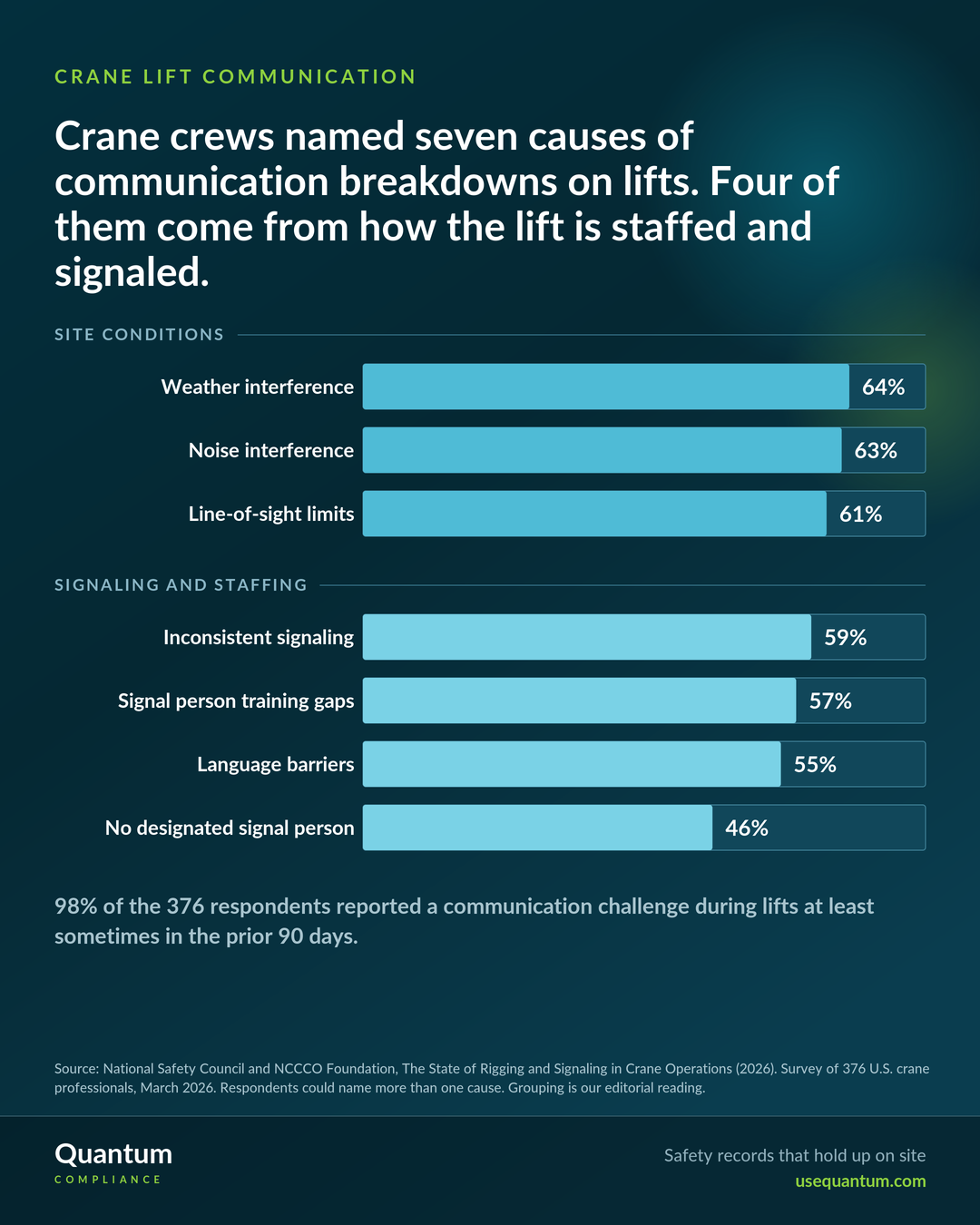
Where communication breaks down on a lift
The three most common causes respondents named are conditions any planner could see coming: weather, noise and limited line of sight. The next group sits inside the organization. Inconsistent signaling practices, gaps in signal person training, language barriers and the absence of a designated signal person were each reported by roughly half of respondents or more.
Most common causes of communication challenges during crane lifts
Share of 376 U.S. crane professionals surveyed in March 2026 who named each cause. Respondents could name more than one.
The consequences show up in the same data. Forty-seven percent of respondents said communication failures bring lifting operations to a full stop at least sometimes, 10% reported near misses, and 4% reported incidents involving injury or property damage.
On the rigging side, respondents named rigger knowledge and skill gaps (54%), inattention and distraction (49%), production pressure (48%) and poor supervision (47%) as contributors to unsafe practice. Seventy-seven percent said their organization does not formally compromise safety for production deadlines, yet 52% described rigging and signaling planning as last-minute, inconsistent or absent. Read together, the two figures suggest schedule pressure usually shows up as a plan that got squeezed out of the morning.
The report also cites Bureau of Labor Statistics fatality data showing cranes as a primary or secondary cause of 405 deaths from 2015 through 2024, with crane and tower operators accounting for only 29% of those deaths. Most of the workers killed were someone other than the crane operator.
What OSHA already requires for signals
For construction work, OSHA’s cranes and derricks standard, Subpart CC, already sets the communication rules. Overhead and other cranes used in general industry fall under separate standards, so check which rules apply to your site before borrowing anything below. Under 29 CFR 1926.1419, a signal person must be provided in any of three situations.
When a signal person is required under 29 CFR 1926.1419(a)
| Paragraph | Situation |
|---|---|
| (a)(1) | The point of operation (load travel or the area near or at load placement) is not in full view of the operator |
| (a)(2) | The equipment is traveling and the view in the direction of travel is obstructed |
| (a)(3) | The operator or the person handling the load determines one is necessary because of site-specific safety concerns |
Source: OSHA, 29 CFR 1926.1419, Signals: general requirements
The same section requires the Standard Method when hand signals are used, allowing non-standard hand signals only where the Standard Method is infeasible or does not cover the operation or attachment, and only after the signal person, operator and lift director (if there is one) agree on them before the operation. The signal type and the way it is transmitted, for example line of sight, video or radio, must be appropriate for the site conditions. If communication between the signal person and operator is interrupted at any point, the operator must safely stop operations requiring signals until it is restored and a proper signal is given and understood. Anyone who becomes aware of a safety problem must give the stop or emergency stop signal.
Qualification is covered in 29 CFR 1926.1428. Each signal person must be qualified before giving any signals, either through documentation from a third-party qualified evaluator or through an assessment by the employer’s own qualified evaluator, which is not portable to other employers. The documentation must be available at the site while the signal person is employed there and must list each type of signaling the person is qualified for, such as hand or radio. If a signal person’s later actions show they do not meet the requirements, the employer must stop them from signaling until they are retrained and reassessed.
What to do before the next pick
Most of the causes in the survey can be planned for before anyone is on the hook. Work through them in order, starting with the ones that change how the lift is set up.
- Plan communication when the lift is planned. Name the signal person, the signal type and the transmission method in the lift plan, and test them against the site: sight lines past the core or the steel, expected noise from other trades, and the weather forecast for the day.
- Default to the Standard Method and one voice. Assign a single designated signal person per lift, and hold the pre-lift talk where any non-standard signals are agreed. Where crews speak different languages, settle the words and gestures in that same talk.
- Make stopping the expected response. When the radio drops or the operator loses contact with the signal person, the operator stops. Supervisors should back those stops in front of the crew and treat them as the rule working, since production pressure is one of the most cited contributors in the report.
- Qualify signal persons by signal type and keep proof on site. Match each person’s documented qualification to the method the lift plan calls for, and pull anyone from signaling who needs retraining until they are reassessed.
- Record stopped lifts and near misses. Each halted pick tells you something about the plan. Some platforms now let a rigger report a near miss by scanning a QR code and entering only an employee ID, with no app download or password, so the report reaches you while the details are fresh. Review these alongside your incident records.
How Q-Training Can Help
Q-Training covers step four. You can set up a license category for each qualification you track, including separate entries for hand and radio signaling, and License Management shows each worker’s status as active, missing or expired, with automatic reminders before expiry. Certificates from third-party evaluators can be batch imported, and when a supervisor at the lift needs to confirm who is qualified, scanning the worker’s personal QR code shows their current training record without a login. When someone needs retraining, you assign it and the employee record shows when it was completed.
Lift plans, signal choices and the decision to stop stay with the people at the lift. Q-Training keeps signal person qualification records current and quick to pull up. See how it works on the Q-Training page, or explore the full Quantum EHS platform.