
It is second shift at a coatings plant, and a new alkaline cleaner has just gone into service in the wash bay. The supervisor wants the NFPA placard on the bay door updated before the night is over, so he pulls up the safety data sheet, scrolls to Section 2, and reads “Skin corrosion, Category 1B.” He writes a 1 in the blue health diamond and moves on to the next task.
To him it was a routine update. The SDS is the most authoritative chemical document in the building, and the number was printed right there in a box the diamond seemed made to hold. He’s also just taken a chemical in the most severe category of its hazard class and placed it near the bottom of the health scale, on the sign an arriving fire crew reads first.
Two Numbering Systems Built for Different Readers
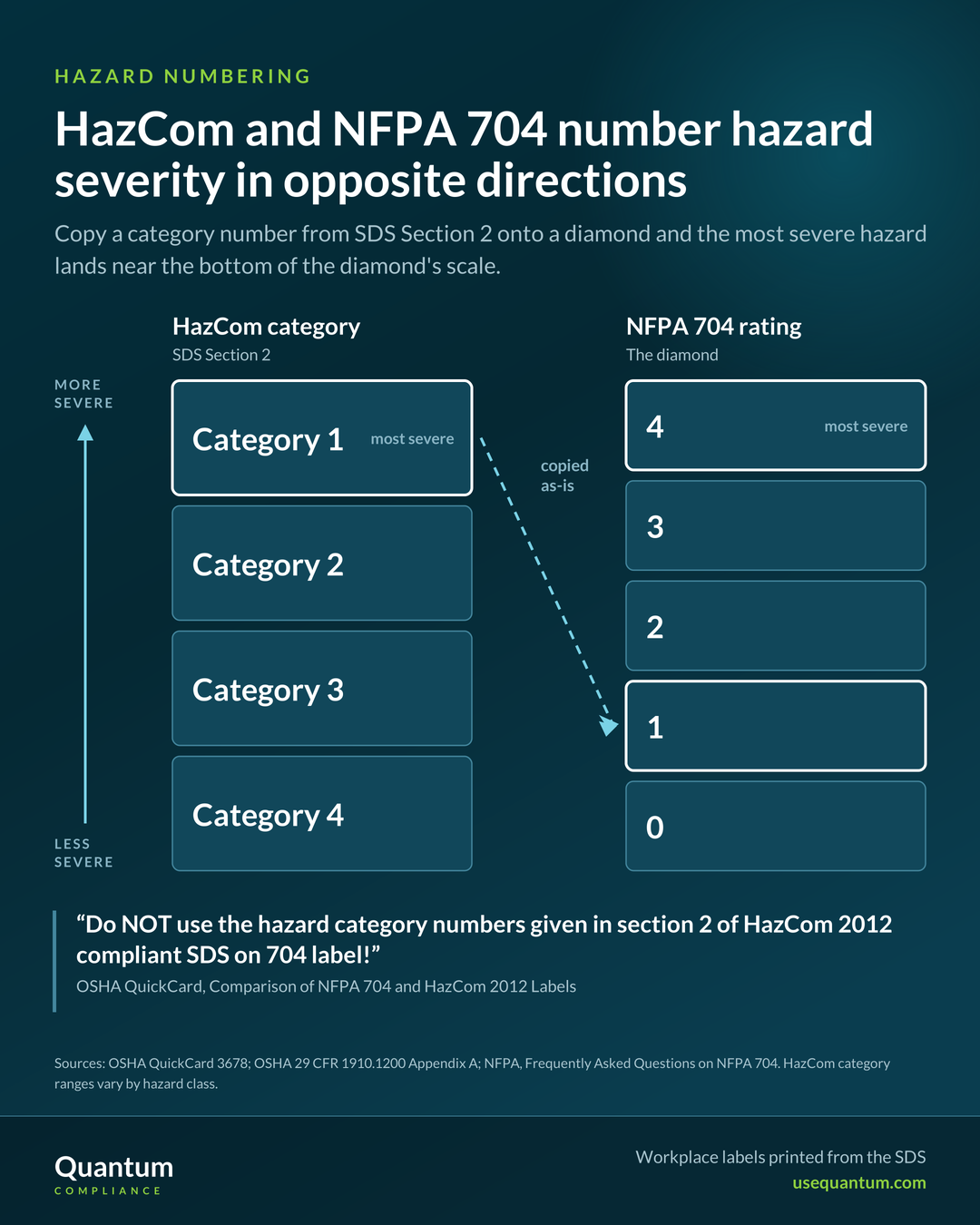
OSHA’s Hazard Communication Standard sorts chemicals into hazard classes and then into categories, using the criteria in Appendix A to 29 CFR 1910.1200. In most hazard classes Category 1 is the most severe, and the numbers climb as the hazard eases. Acute oral toxicity shows the pattern clearly. Category 1 is reserved for chemicals with an acute toxicity estimate of 5 mg/kg of body weight or less, while Category 4 covers everything above 300 and up to 2,000 mg/kg.
Acute Oral Toxicity: Upper Cutoff for Each HazCom Category
Acute toxicity estimate (ATE), oral route, in mg/kg of body weight. The lower the category number, the smaller the dose that qualifies.
Bars drawn to scale against the Category 4 cutoff. Source: OSHA, 29 CFR 1910.1200 Appendix A, Table A.1.1
NFPA 704 was written for a different reader. Its diamond rates health, flammability and instability on a scale that, in NFPA’s own frequently asked questions on NFPA 704, runs from zero, indicating a minimal hazard, to four, indicating a severe hazard. The ratings are meant to alert emergency response personnel to the short-term hazards of a material during a fire, spill or similar emergency. The HCS, by NFPA’s description, addresses workers exposed to materials primarily under normal conditions of use. On the 704 scale, the most severe rating is the highest number.
OSHA’s QuickCard comparing NFPA 704 and HazCom labels addresses this mistake directly. It explains that hazard category numbers are not required on labels, that they are required on SDSs in Section 2, and that they are used to classify hazards and determine what label information is required. Then it warns, with the word NOT in capitals, against using the Section 2 category numbers on a 704 label. NFPA’s FAQ carries the same warning and adds that the HCS numbers are not relative hazard ratings at all.
HazCom Hazard Categories and NFPA 704 Ratings, Side by Side
| HazCom category (SDS Section 2) | NFPA 704 rating (diamond) | |
|---|---|---|
| Most severe value | Category 1 | 4 |
| Range | Varies by hazard class; acute toxicity runs 1 to 4 | 0 to 4 |
| What the number does | Classifies the hazard to determine required label information | Rates the relative severity of the hazard |
| Primary reader | Workers, primarily under normal conditions of use | Emergency responders during a fire, spill or similar emergency |
| Required on container labels? | No, required on the SDS | Used on 704 placards and labels |
| Hazards covered | Acute and chronic | Acute (short-term) health hazards only |
Sources: OSHA QuickCard 3678, Comparison of NFPA 704 and HazCom 2012 Labels; NFPA, Frequently Asked Questions on NFPA 704
Why the Error Is So Easy to Make
The supervisor had two numbering systems in the same building, pointing in opposite directions, and a placard process that handed him the SDS as his only reference. That process never pointed him to NFPA 704’s criteria or warned him that the two 1s mean close to opposite things, so the error was set up long before he picked up the marker.
A wrong diamond can sit on a door for months. Workers may lean mostly on container labels and the SDS, while responders lean on the diamond, and they meet it during an emergency, when nobody has time to check it.
The SDS itself can carry both systems. In a 2013 interpretation letter, OSHA said responsible parties may include HMIS and NFPA ratings in Section 2, so long as they do not contradict or cast doubt on the HCS classification. A reader skimming Section 2 may find a category number and a rating number a few lines apart.
What HazCom Expects From Your Workplace Labels
Under 29 CFR 1910.1200(f)(6), and except as provided in (f)(7) and (f)(8), each workplace container of a hazardous chemical must be labeled, tagged or marked with either the full shipped-container elements in (f)(1)(i) through (v), or a product identifier plus words, pictures, symbols, or a combination that give at least general information about the hazards. The second option only works in conjunction with the other information immediately available to employees under your hazard communication program, which together must give them the specific physical and health hazard information. A diamond with no product identifier doesn’t meet (f)(6)(ii) on its own. A diamond on a bay door isn’t a container label either; where signs or placards stand in for labels on stationary process containers under (f)(7), they have to identify the containers they cover and convey the label information.
Paragraph (h)(3)(iv) requires training on the details of your program, including an explanation of the labels received on shipped containers and the workplace labeling system you use, and on the SDS, including the order of information. If diamonds are part of your workplace system, that explanation should cover how the diamond’s scale differs from the numbers in Section 2.
How to Keep the Two Scales Apart
Start with the controls that remove the chance to transcribe the wrong number, then add the checks and training that catch what is already posted.
Steps to Keep HazCom Categories Off Your NFPA Diamonds
Generate workplace labels directly from the SDS classification data, so every hazard element on the label traces back to the supplier’s document.
Assign 704 ratings against NFPA 704’s criteria, by someone technically competent and experienced with that standard, and record them as a separate determination. Never copy a Section 2 category number into the diamond.
A workplace label under (f)(6)(ii) leans on other information being immediately available, so make the full SDS reachable from the label itself.
List every chemical with a Category 1 classification and check its placards. A low number next to a Category 1 classification deserves a second look from whoever owns your 704 ratings.
Show a Category 1 entry from an SDS beside a 4 on a diamond and state the direction of each scale out loud.
The first three steps change how numbers get onto labels and placards in the first place, which is where the supervisor in the wash bay needed help. Audits and training come after because they catch errors that are already posted, and a placard filled in from the wrong document last spring will stay wrong until someone goes looking for it.
How Q-Chem Can Help
Q-Chem extracts hazard classes, pictograms and components from each SDS into structured data, and its GHS secondary labels print from those fields with no manual entry. Every secondary label carries the product identifier, pictogram, signal word and manufacturer information, adds hazard and precautionary statements where there is room, and includes a QR code that opens the full SDS with no login. That covers steps one and three. Because the chemical inventory is tracked across your facility locations and searchable by hazard or pictogram, you can pull every corrosive in your SDS library, for example, as a starting list for step four.
Q-Chem doesn’t assign NFPA 704 ratings. Rating a material under 704 is a judgment made against NFPA’s criteria, and it stays with the person on your team trained to make it. To see how your own inventory would look, contact sales@usequantum.com.