Picture the monthly walkthrough on a packaging floor. The area supervisor carries the clipboard, ticks forty boxes in twenty minutes, and signs the bottom. A week later a second-shift packer mentions, almost in passing, that the pallet wrapper’s foot pedal sticks on cold mornings and that everyone has learned to kick it loose. The crew had stopped seeing it as a hazard a long time ago.
That gap between what a checklist sees and what the people doing the job already know is the reason to run a hazard hunt. A hazard hunt is a structured walk of one area by the workers who use it, guided by a short list of hazard categories, with every finding written down and followed to a fix. The idea is an old one, and it lines up closely with what OSHA’s guidance recommends for workplace inspections.
What OSHA’s guidance asks for
OSHA’s Recommended Practices for Safety and Health Programs are voluntary guidance, so nobody gets cited for skipping a hazard hunt, and they do not change any obligation under an OSHA standard. They still describe in detail what a working hazard identification process looks like, and they explain why the clipboard walk drifts out of date: hazards can be introduced over time as workstations and processes change, equipment or tools become worn, maintenance is neglected, or housekeeping practices decline.
The inspection action item tells employers to have workers participate on the inspection team and to talk to them about the hazards they see or report. It also says to include all areas and activities in inspections, such as storage and warehousing, facility and equipment maintenance, purchasing and office functions, and the activities of on-site contractors, subcontractors, and temporary employees. The companion worker participation section adds, among other recommendations, that workers get the time and resources to take part and that they hear back routinely about action taken on their concerns. One of its examples is holding safety and health meetings during regular working hours.
Before the hunt: choose the area, the crew and the time
Pick one area small enough to walk properly in under an hour. A whole plant in one session is too much. Rotate through areas over the year, and put the examples OSHA lists, such as the maintenance shop, storage and warehousing, and the office, on the calendar early.
Build the crew from people who do the work in that area, on that shift, plus one person from outside it who will see it with fresh eyes. Include a contractor or temporary worker if they work there. Schedule it on paid time, during the shift, and tell supervisors in advance that their people will be off the line for it.
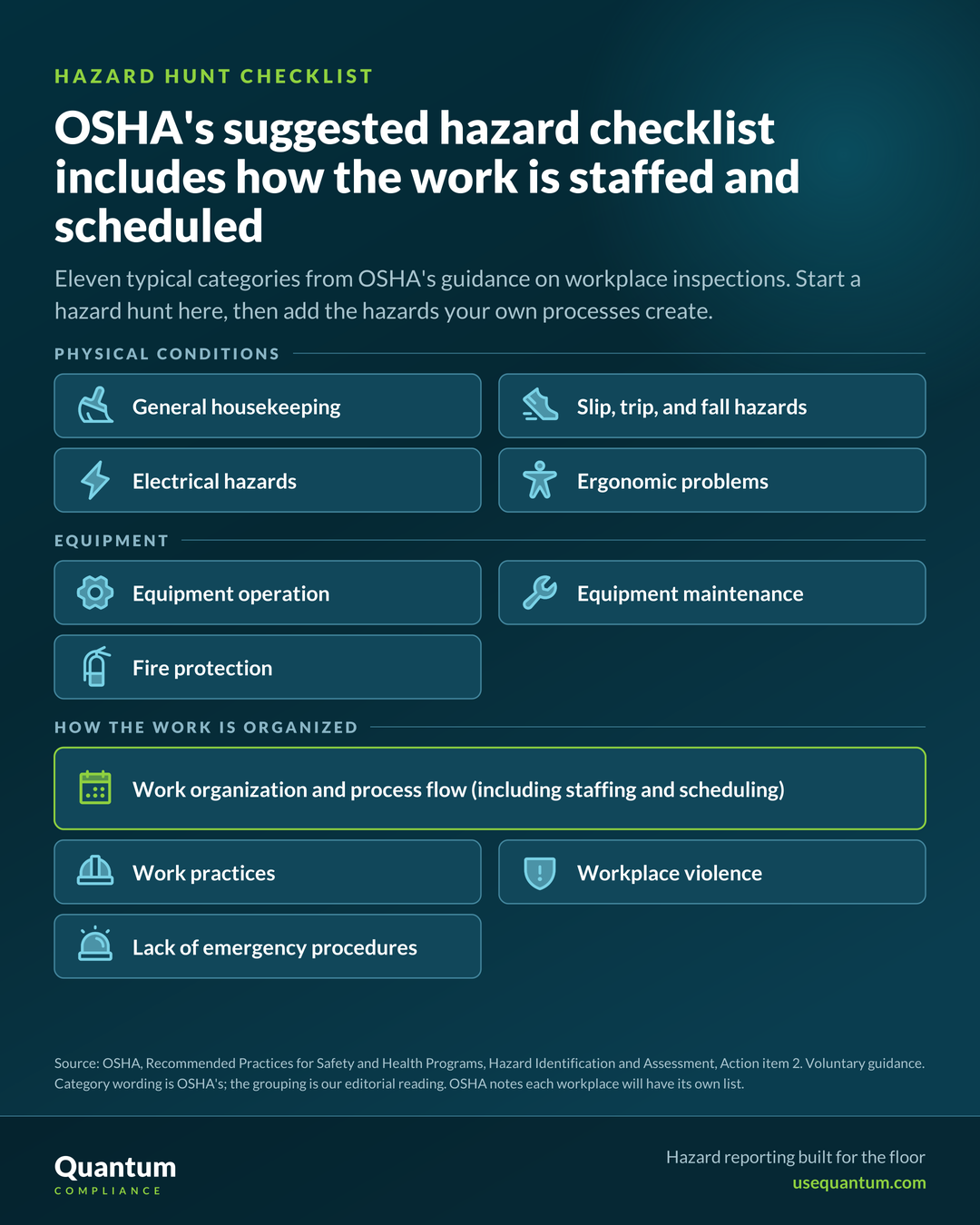
Bring a checklist built around hazard categories. OSHA lists the typical categories below and adds that each workplace will have its own list, so treat it as a starting point and add the hazards specific to your processes.
Typical hazard categories OSHA suggests for inspection checklists
| Physical conditions | Equipment | How the work is organized |
|---|---|---|
| General housekeeping | Equipment operation | Work organization and process flow, including staffing and scheduling |
| Slip, trip, and fall hazards | Equipment maintenance | Work practices |
| Electrical hazards | Fire protection | Workplace violence |
| Ergonomic problems | Lack of emergency procedures |
Source: OSHA, Recommended Practices for Safety and Health Programs, Hazard Identification and Assessment, Action item 2. Grouping into columns is ours. OSHA notes each workplace will have its own list.
The third column is where a worker-led hunt pays off. The crew can tell you that the line runs short-staffed every Friday, or that changeovers are always rushed because the next order is already late. Those are hazards built into how the work is set up, and the people living with them are the ones who can describe them.
Running the hunt, step by step
Steps to Run a Hazard Hunt
Let the crew lead the route and ask what they work around and what they have stopped noticing.
Housekeeping and tripping hazards can be corrected during the walk. Record them anyway.
Exact location, what the condition is, who is exposed, and a photo or short video.
Consider severity, likelihood and how many workers are exposed, and put an interim control on anything that cannot be fixed today.
Work down the hierarchy of controls before reaching for a sign or a toolbox talk.
Report back on every finding, including the ones you decided not to act on and why.
Steps are our synthesis; the hierarchy of controls in step 5 is general practice. Based on: OSHA, Hazard Identification and Assessment and OSHA, Worker Participation
OSHA’s guidance says some hazards, such as housekeeping and tripping hazards, can and should be fixed as they are found, and that fixing them on the spot emphasizes the importance of safety and health. Write those down too, because a hazard that keeps reappearing in the same spot may point to a storage or layout problem.
When it comes to ranking findings, OSHA frames prioritization around three factors: the severity of potential outcomes, the likelihood that an event or exposure will occur, and the number of workers who might be exposed. OSHA adds that employers have an ongoing obligation to control all serious recognized hazards and to protect workers, so a low-ranked finding still gets fixed.
Permanent fixes start with whether the hazard can be removed or engineered out. If the wrapper pedal sticks, repair or replace the pedal before anyone writes a reminder about it. When a finding needs a formal assessment before anyone commits budget, run it through your risk assessment process separately.
Where hazard hunts stall
Step six is the easiest one to let slide. The crew spends an hour pointing things out, a list goes to someone’s inbox, nothing visible happens for a month, and the crew notices. OSHA’s worker participation guidance names several barriers to participation, among them investigations that blame individuals for incidents, and incentive programs where reporting a concern could jeopardize a prize, reward or bonus. It also calls for frequent and regular feedback and suggests including an option for anonymous reporting to reduce fear of reprisal. Deal with those before the first hunt.
The second place they stall is trending. OSHA’s hazard identification guidance asks employers to group similar incidents and identify trends in injuries, illnesses, and hazards reported. When rushed changeovers come up in six findings across three hunts, the cause is likely in the production schedule, and you will see it only by reading across the records.
How Q-Hazard Can Help
Q-Hazard covers the record-keeping and follow-through in steps three through six. During the hunt, each crew member can report a finding from the floor by scanning a QR code or using the mobile app, with photos or video attached, and Smart Login means they sign in with an employee ID instead of a password, so every report is attributed to the person who made it. Severity, hazard type and contributing factors are captured at intake. Corrective actions carry owners and due dates and are verified before they close, and built-in email notification templates handle the routine report-back. Hazard and corrective action data export from the list views, as the full list, a filtered view or hand-picked rows, so findings from several hunts can be reviewed side by side for the trends described above. Because every report is tied to a named employee, plan a separate channel if you also want to offer anonymous reporting.
Choosing the area, building the crew, judging whether a fix is adequate, and spotting shared causes stay with you and your team. See how the Hazard Reporting app handles intake and routing, or contact sales@usequantum.com for a walkthrough.