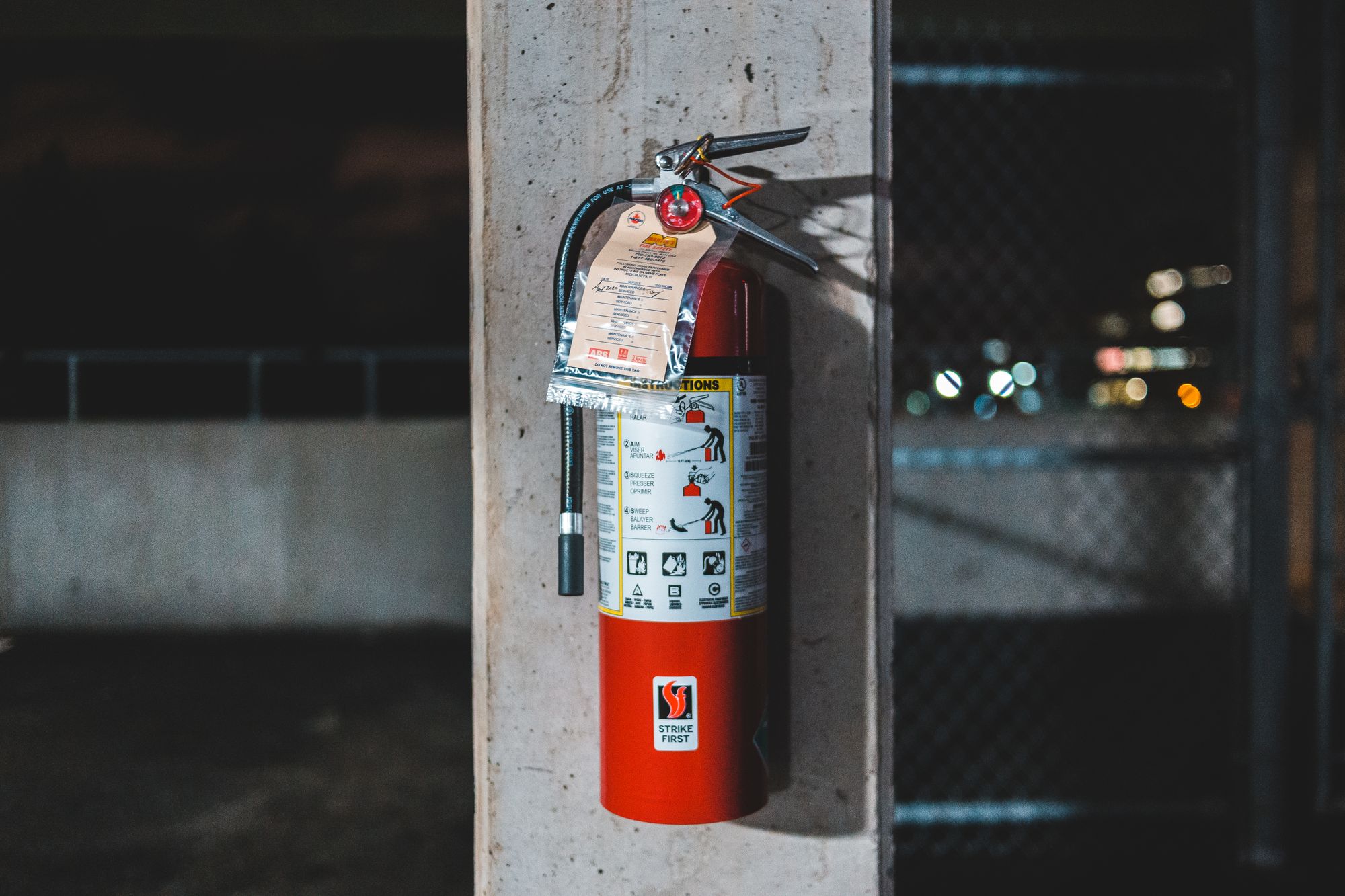
The compliance officer stops in the aisle between the racking and points at the extinguisher bracketed to a support column. She asks when it was last checked. The vendor tag carries an annual maintenance punch from last October, which is fine. Underneath it is a column of handwritten initials that runs January, February, March, and then stops. It is August. Nobody in the building can tell her whether those four months were checked and never written down, or never checked at all.
What 29 CFR 1910.157 actually asks for
Portable extinguishers run on more than one clock, and different paragraphs of the same standard set them. 1910.157(e)(1) puts inspection, maintenance and testing on the employer. Under (e)(2), portable extinguishers, or hose used in lieu of them under (d)(3), shall be visually inspected monthly. Under (e)(3) they get an annual maintenance check, stored pressure extinguishers do not require an internal examination at that check, and the employer records the annual maintenance date and retains that record for one year after the last entry or the life of the shell, whichever is less.
Paragraph (e)(4) requires that stored pressure dry chemical extinguishers which need a 12-year hydrostatic test be emptied and put through applicable maintenance procedures every six years, with non-refillable disposable containers exempt. Recharging or a hydrostatic test restarts that six-year clock from its date, so two identical cylinders on the same wall can fall due in different years. Whenever a unit leaves the wall for maintenance or recharging, (e)(5) requires alternate equivalent protection while it is gone.
Hydrostatic testing runs on Table L-1, with (f)(3) requiring an internal examination of the cylinder or shell before the test, in addition to the external visual examination. Paragraph (f)(2) sets those intervals and then carves out five conditions under which an extinguisher is not hydrostatically tested at all: repair by soldering, welding, brazing or patching compounds, damaged cylinder or shell threads, corrosion that has caused pitting, burning in a fire, or a calcium chloride agent used in a stainless steel shell. The certification record under (f)(16) includes the test date, the signature of the person who performed it, and the serial number or other identifier of the unit tested, and is kept until that unit is retested at the Table L-1 interval or taken out of service, whichever comes first.
Two scope points. Under (b)(1), an employer who has established and implemented a written fire safety policy requiring immediate and total evacuation on the sounding of a fire alarm signal, has an emergency action plan and fire prevention plan meeting 1910.38 and 1910.39, and has no extinguishers available in the workplace, is exempt from the section unless another Part 1910 standard requires one. Under (a), where extinguishers are present but not intended for employee use and both plans are in place, only paragraphs (e) and (f) apply.
WHAT 29 CFR 1910.157(e) AND (f) REQUIRE, AND WHAT EACH ONE OBLIGES YOU TO WRITE DOWN
| Requirement | How often | Record the standard names |
|---|---|---|
| Visual inspection of extinguishers, or hose used in lieu of them under (d)(3) (e)(2) |
Monthly | None named in the paragraph |
| Maintenance check. Stored pressure units need no internal examination here (e)(3) |
Annually | Record the annual maintenance date; retain one year after the last entry or the life of the shell, whichever is less; available to the Assistant Secretary on request |
| Empty and apply maintenance procedures, stored pressure dry chemical units requiring a 12-year hydrostatic test (e)(4) |
Every 6 years, restarting from any recharging or hydrostatic test | None named in the paragraph. Non-refillable disposable containers are exempt from the duty itself |
| Alternate equivalent protection while a unit is out for maintenance or recharging (e)(5) |
Whenever a unit leaves service | None named in the paragraph |
| Hydrostatic test, preceded by an internal examination under (f)(3) (f)(2), (f)(3), Table L-1, (f)(16) |
5 or 12 years for currently permitted types, set by agent and shell material. Paragraph (f)(2) lists five conditions under which a unit is not tested at all | Certification record that includes the test date, the signature of the person who performed it, and the serial number or other identifier; kept until retest or removal from service |
The check that carries no paperwork requirement
Read (e)(2) next to (e)(3) and the asymmetry shows. The monthly inspection paragraph is one sentence with no record language in it. The annual maintenance paragraph spells out a record, a retention period and a duty to produce it on request, and (f)(16) sets out what the hydrostatic certification includes. Where OSHA wants a record here, it says so.
Skipping the check is a separate matter. OSHA has been asked to stretch the interval and declined. In a 2006 letter of interpretation the agency said that absent a petition for rulemaking or an adequate showing in a variance application, it did not believe a change from the prescribed monthly frequency was justified at this time. The same letter notes that the monthly requirement is essentially consistent with NFPA 10, which many local fire codes adopt, so the authority having jurisdiction over your site may expect records that 1910.157 does not name.
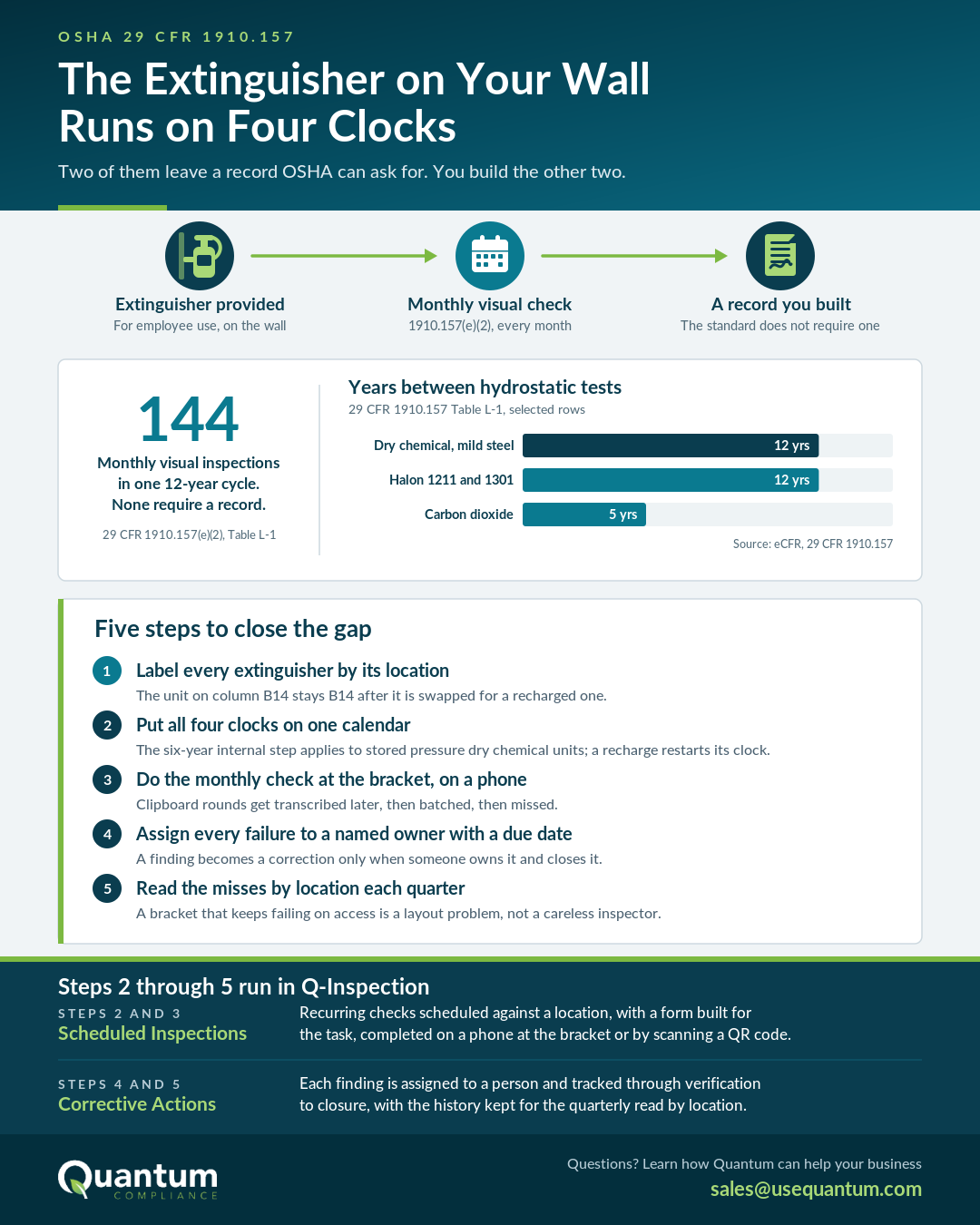
Run the arithmetic on a stored pressure dry chemical extinguisher with a mild steel shell, the common red ABC cylinder. Table L-1 puts it on a 12-year hydrostatic interval. Twelve years of monthly inspections is 144 checks, and 1910.157 obliges you to record none of them.
144
Monthly visual inspections across one 12-year hydrostatic cycle. The standard names a record for none of them.
An employer who keeps no monthly record cannot distinguish a missed check from one performed and never logged. When the initials stop in March, the only honest answer in August is that nobody knows. Building that record is left entirely to you.
The hydrostatic clock depends on what is inside the cylinder
A paper tag also hides the fact that identical looking extinguishers fall due in different years. Table L-1 sets the interval by extinguishing agent and shell material.
YEARS BETWEEN REQUIRED HYDROSTATIC TESTS
Intervals set by 29 CFR 1910.157 Table L-1, by extinguishing agent and shell material. Five of the sixteen rows are shown. The full table also covers cartridge operated water and antifreeze, wetting agent, foam and AFFF, loaded stream, soda acid, dry powder, and a second dry chemical row for cartridge or cylinder operated units with mild steel shells, which is also on 12 years.
Source: eCFR, 29 CFR 1910.157, Table L-1
The ABC dry chemical unit in the corridor and the carbon dioxide unit in the server room can hang thirty feet apart and come due seven years apart. Treat a site as one population and the short-interval units slip first.
How to build a check that does not drift
The order matters. The first three items change how the work is structured, which is where the leverage sits.
- Give every extinguisher a permanent identifier tied to its location. The unit on column B14 stays B14 after a swap for a recharged one, and the identifier outlives whoever walked the route.
- Put all four duties on one calendar, with the resets built in. Monthly visual, annual maintenance, the six-year empty-and-service step for stored pressure dry chemical units, and the Table L-1 hydrostatic test. Recharging restarts the six-year clock, so the calendar has to move a date.
- Move the monthly check to the extinguisher itself. A check completed at the bracket, on a phone, in under two minutes gets done while the inspector is standing there.
- Route every failed item to a named owner with a due date, the moment it is recorded. Assignment, tracking and verified closure are what turn a logged finding into a working extinguisher.
- Read the misses by location each quarter. A bracket that keeps failing on access is telling you the aisle got restacked, or that it was mounted where pallets now land.
That last point is where the design work sits. When an extinguisher is blocked, someone chose where to put the racking and someone else chose where to mount the bracket, probably years apart and without talking to each other. The person walking the round in month seven inherited both decisions, and only a layout change clears that bracket.
How Q-Inspection Can Help
Items two through five are scheduled field checks with findings attached, which is what Q-Inspection is built for. Recurring inspections are scheduled against a location, the form is specific to the task type rather than a generic checklist, and the check can be completed on a phone at the bracket, including by scanning a QR code. A non-compliant answer generates a corrective action assigned to a person and tracked through verification to closure, and the history stays available for the quarterly read on which locations keep failing.
Quantum does not perform the annual maintenance check or the hydrostatic test, which are physical services from a qualified servicer, and it will not label your hardware. Item one is a walk around the building with a label printer. For how the inspection record sits alongside the rest of your EHS data, see the Quantum EHS platform.