
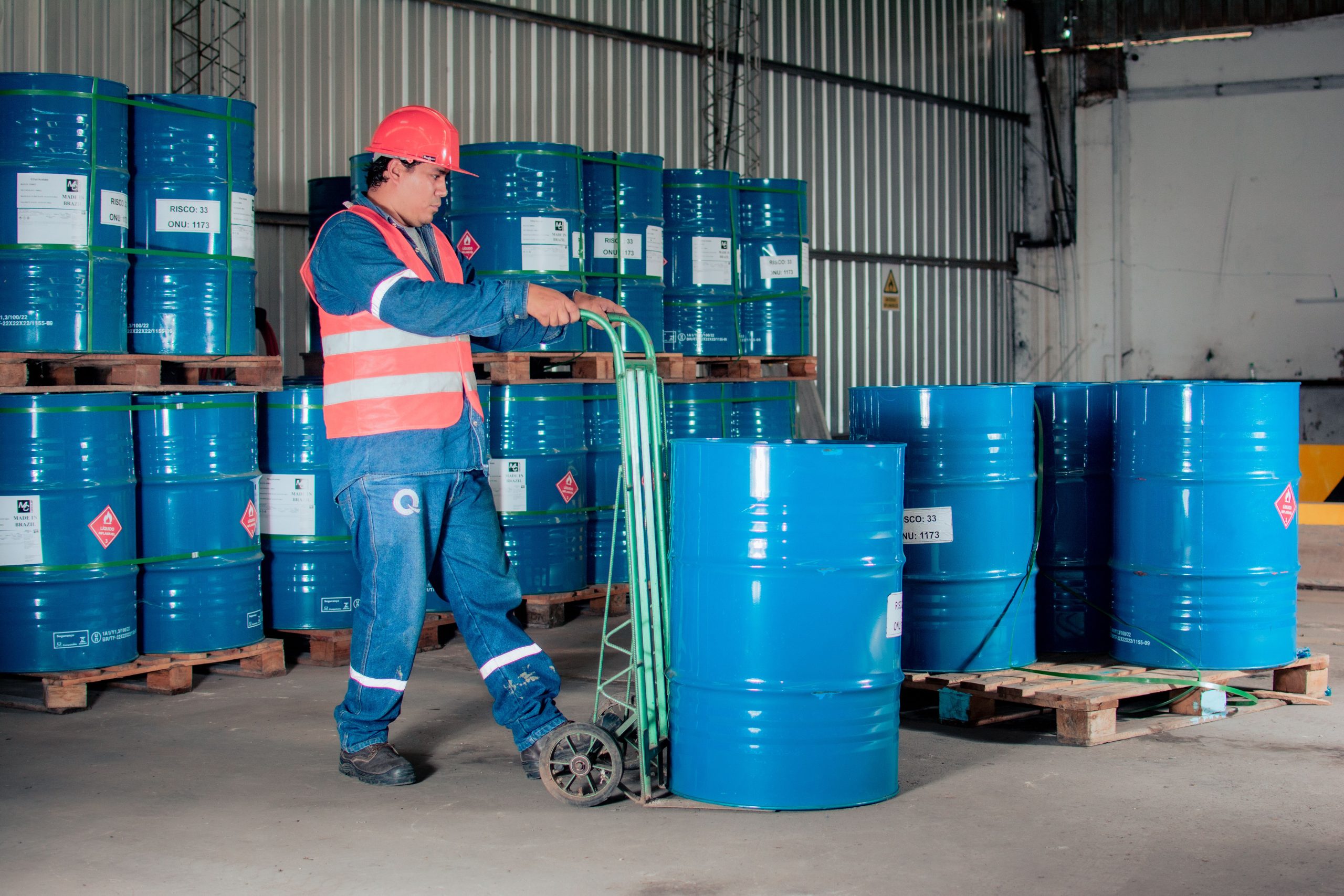
A drum of flammable solvent shows up at your receiving dock with a DOT diamond label on it: red background, flame icon, hazard class printed clean across the front. Your team signs for it, wheels it into the chemical storage room, and peels the DOT label off before it goes on the shelf. Nobody replaces it with anything. The thinking is simple: that label was for the truck, not the warehouse. Three weeks later the drum is half empty, sitting unlabeled next to forty other containers, and an OSHA compliance officer is asking why nothing on it identifies what’s inside.
That drum didn’t need a new label. It needed the old one to stay exactly where it was.
Two Labeling Systems, Two Different Jobs
Most EHS managers know GHS labels and DOT hazmat labels are different things. Fewer know exactly when each one applies, and that’s where the gap opens up. A joint guidance memorandum from the Department of Transportation’s Pipeline and Hazardous Materials Safety Administration (PHMSA) and OSHA lays out the boundary directly: DOT’s Hazardous Materials Regulations (49 CFR Parts 100-180) govern labeling during transportation, while OSHA’s Hazard Communication Standard (29 CFR 1910.1200) governs labeling in the workplace, both before and after that transportation happens.
Those are two separate regulatory clocks, and they don’t run out at the same time. A container can stop being DOT’s problem the moment it’s off the truck and still very much be OSHA’s problem for weeks afterward.
What OSHA Actually Requires You to Keep
The rule most receiving docks get wrong is 29 CFR 1910.1201, Retention of DOT markings, placards and labels. It doesn’t say “remove the DOT label once the chemical arrives.” It says the opposite. An employer who receives a package required to carry DOT markings, labels, or placards must retain them on the package until it’s sufficiently cleaned of residue and purged of vapors to remove any potential hazard. The same retention duty applies to freight containers, rail cars, and transport vehicles: the DOT markings stay until the hazardous material is sufficiently removed to prevent a hazard, not until the truck pulls away. And whatever is left on the container has to stay readily visible the whole time.
What To Do When a DOT-Labeled Container Arrives
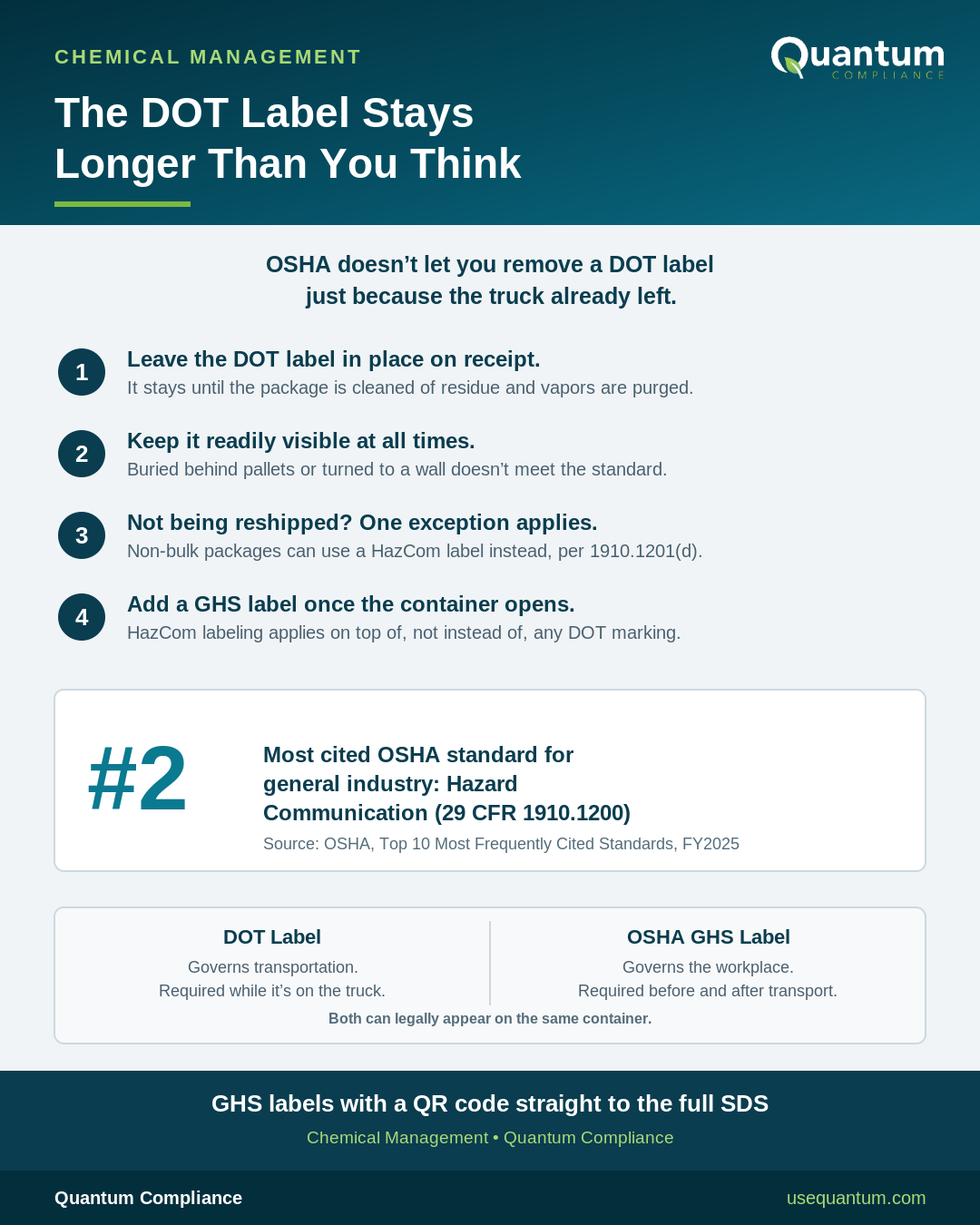
Do not remove or deface it on receipt. It stays until the package is cleaned of residue and purged of vapors, per 1910.1201(a).
Non-bulk packages that will not go back out the door can satisfy the requirement with a standard HazCom label instead, under 1910.1201(d).
Markings buried behind pallets, wrapped in shrink film, or turned toward a wall don’t meet the standard’s visibility requirement.
Once material is transferred, decanted, or the original packaging no longer reflects what’s inside, OSHA’s 1910.1200 labeling applies on top of, not instead of, whatever DOT marking remains.
The One Exception That Trips Teams Up
Section 1910.1201(d) is the part that gets misread into a blanket “swap the label” policy. It’s narrow: it applies only to non-bulk packages that will not be reshipped. If there’s any chance that drum, pail, or box leaves the facility again, whether for redistribution, return to a supplier, or transfer to another site, the DOT markings need to stay until the container is actually clean and empty. Treating every incoming shipment as exempt because “we’re not shipping it anywhere” is a judgment call your receiving staff usually isn’t positioned to make correctly, especially in facilities where surplus chemical gets moved between locations informally.
Can Both Labels Be on the Same Container?
Yes, and this is the detail that resolves a lot of confusion. The DOT’s Hazardous Materials Regulations generally prohibit a package from carrying any marking that could be confused with a required DOT label. But 49 CFR 172.401(c) carves out an exception for labeling that conforms to the UN Globally Harmonized System, including OSHA’s GHS-based HCS 2012 labels. In plain terms: an HCS-compliant GHS label and a DOT placard or label can legally sit on the same package at the same time. You are not choosing one system over the other. You’re often required to satisfy both, on the same surface, without either one canceling the other out.
#2
Hazard Communication (29 CFR 1910.1200) is the second most frequently cited OSHA standard for general industry, fiscal year 2025
When the Chemical Leaves Your Facility Again
The moment a container gets loaded for outbound transport, whether it’s surplus chemical going to another site, product returned to a supplier, or hazardous waste headed for disposal, DOT’s HMR requirements come back into force for that leg of the trip. That’s a separate compliance step from the workplace labeling you’ve already handled, and it’s where facilities that treat GHS and DOT as interchangeable tend to get caught. A workplace-compliant GHS label doesn’t automatically satisfy a shipping requirement, and vice versa.
This is also where legible, current labeling on the container pays off twice: once for the worker handling it on the floor, and again for whoever has to determine what’s inside before it goes back out the door. Some chemical management platforms now generate GHS labels with a QR code that links directly to the full safety data sheet, which matters most on secondary containers where there isn’t room to print every hazard statement, precautionary statement, and manufacturer detail at a readable size. A worker or shipping coordinator can scan it and pull up the complete SDS in seconds, no login, no searching a shared drive for the right file.
How Chemical Management Can Help
Quantum’s Chemical Management module generates GHS-compliant workplace labels directly from structured chemical data instead of manual entry, which matters when a container needs a HazCom label added on top of retained DOT markings and there’s no time to hunt down hazard statements by hand. Every secondary label the system produces carries a QR code linking straight to the full SDS, so a worker relabeling a transferred or partially used container can verify what’s inside without leaving the floor. For chemicals headed back out the door, whether to another facility or off-site disposal, that same structured record makes it faster to confirm what documentation needs to travel with the shipment before it becomes a receiving problem for someone else. You can see how the labeling and outbound waste labeling workflow fit together on Quantum’s site.