At 6:40 on a Tuesday the foreman gathers eleven people by the gang box, reads a one-page talk on trench cave-ins from a printed sheet, and passes a clipboard around. Eleven signatures come back. Three weeks later a laborer steps into an unshored cut to grab a dropped level. During the review he explains, through a coworker who translates, that he remembers the meeting but not what it was about. The talk had been read in English. His first language is Spanish, and nobody had asked.
The sign-in sheet says the crew was trained. OSHA treats that sheet as the start of the inquiry. This guide covers what the agency expects when training happens at the tailgate instead of a classroom, and how to run a toolbox talk that a mixed-language crew can follow and act on.
What OSHA Expects From a Toolbox Talk
In construction, 29 CFR 1926.21(b)(2) requires the employer to instruct each employee in the recognition and avoidance of unsafe conditions and in the regulations that apply to their work environment. If the morning toolbox talk is where your site delivers that instruction, it is training in the regulatory sense, whatever the agenda calls it.
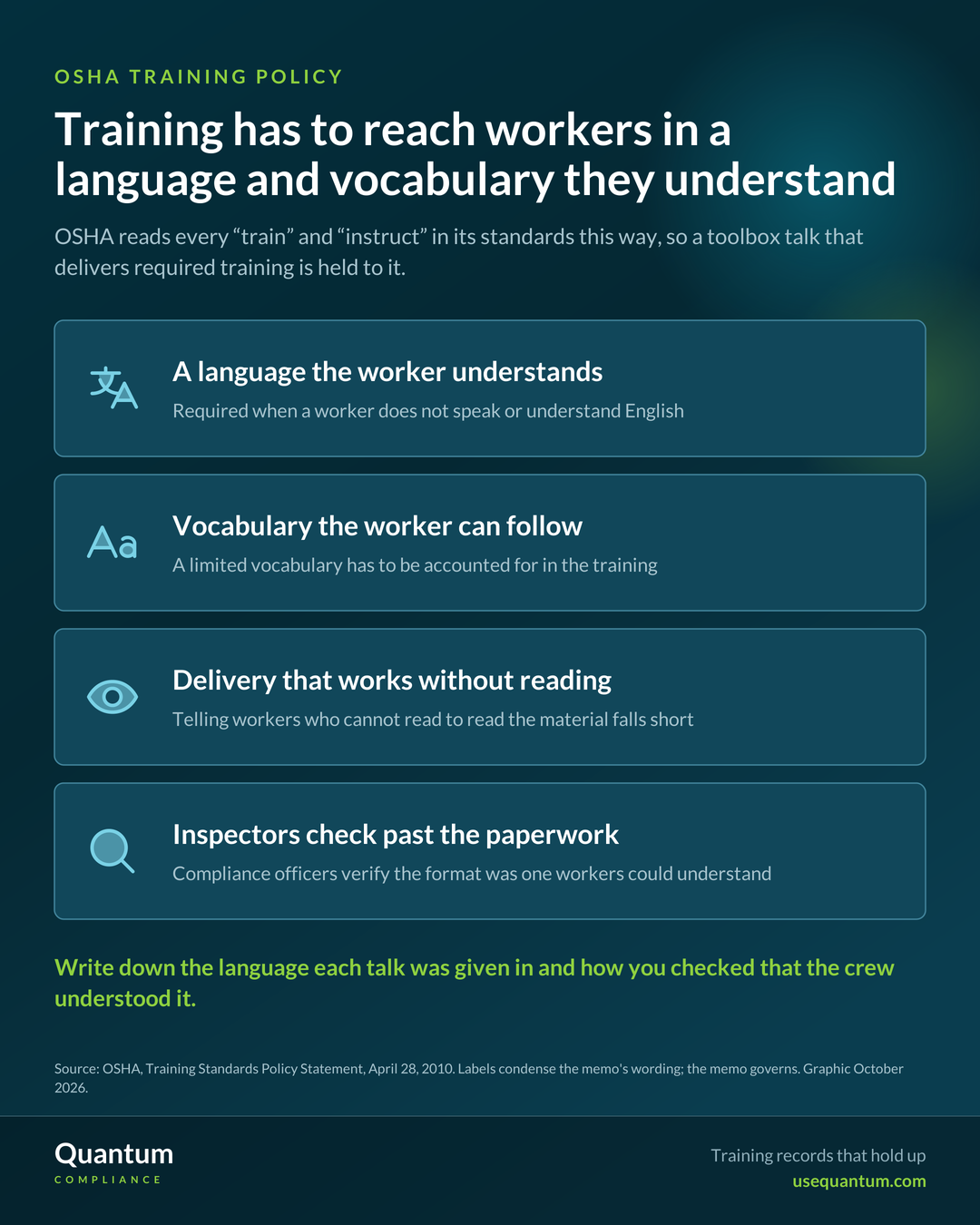
OSHA spelled out how that training has to be delivered in its April 28, 2010 Training Standards Policy Statement. The memo says an employer “must instruct its employees using both a language and vocabulary that the employees can understand.” It covers the agency’s agriculture, construction, general industry and maritime training requirements, and it reads every use of “train” or “instruct” in those standards to mean presenting information in a manner employees are capable of understanding. Three points from it shape how a toolbox talk should run:
- If a worker does not speak or understand English, the instruction has to be given in a language the worker understands. A limited vocabulary has to be accounted for as well.
- If workers cannot read, telling them to read the training material does not satisfy the obligation.
- Compliance officers are directed to look beyond basic paper documentation and verify that the training was provided in a format the workers could understand. If a reasonable person would conclude the training was not conveyed in a way workers could understand, the memo says the violation may be cited as serious where it meets the Field Operations Manual guidelines.
The memo also points to general industry standards that build a comprehension check into training, among them lockout/tagout, which requires that employees have acquired the knowledge and skills for safe use of energy controls, and bloodborne pathogens, which requires an opportunity for interactive questions and answers. A clipboard signature shows attendance and little else.
The Fatality Data Behind the Rule
BLS publishes no fatality data by language spoken, so no federal figure ties deaths directly to training that did not land. The closest it comes is its rates for Hispanic or Latino workers. Of the 1,229 who died on the job in 2024, 842 were born outside the United States, and the group’s fatality rate sits a full point above the rate for all workers.
Fatal Work Injury Rate, 2024
Fatalities per 100,000 full-time equivalent workers, United States, all industries
BLS attributes the gap to no single cause, and differences in the jobs people hold may account for some of it. When an inspector finds a training deficiency, the 2010 memo says to document the barriers to understanding, language being an obvious candidate on a mixed crew, and the daily toolbox talk is one of the few points in the week where a supervisor can check for it face to face.
How to Run a Toolbox Talk Your Crew Understands
The steps below run in order from the design of the talk to the record of it. A better sign-in form cannot rescue a talk the crew could not follow, so the early steps carry most of the weight.
Steps to Run a Toolbox Talk Your Crew Understands
Know which languages your crew speaks and reads. Ask workers directly instead of guessing from a name, and ask again whenever a new subcontractor or temp crew shows up.
Pick the one hazard the crew will face before lunch and explain it at the spot where they will face it.
Use a fluent presenter or prepared material in that language. If a bilingual crew member is interpreting, give them the content the day before so they are not translating technical terms on the spot.
Demonstrate the shoring, the lockout point or the harness check. A worker who cannot read a handout can still watch a task and repeat it.
Ask open questions in the worker’s language, such as what they would do if the trench wall starts to crack. A chorus of yes to “everyone understand?” tells you very little. Follow up one to one with anyone who hesitates.
Date, topic, presenter, the language the talk was delivered in, who interpreted, and how you checked understanding.
On step five, some platforms now let a worker scan a QR code posted at the job box and enter only an employee ID to answer a short follow-up quiz on their own phone. Workers need no app or password, and each answer is attributed to the right person automatically. Used after the talk, a quiz gives you a second, written check on the workers who stayed quiet.
Building a Record That Holds Up
OSHA sets no format for toolbox talk records, but the memo makes clear what a compliance officer will try to establish, and a typical sign-in sheet leaves most of it blank.
Typical Sign-In Sheet vs. a Record That Answers the Inspector
| Question | Typical sheet | Stronger record |
|---|---|---|
| Who attended | Names and signatures | Names, plus the language each worker received the talk in |
| What was covered | A topic title | The specific hazard and the control that was discussed |
| Whether it was understood | Usually nothing | How understanding was checked, and who needed follow-up |
| How it was delivered | Usually nothing | Presenter, and the interpreter if one was used |
The right column is our suggestion, built around what compliance officers are directed to verify, that workers could understand the training, in OSHA, Training Standards Policy Statement (April 28, 2010).
Adding a language column and a line for how understanding was checked is a small change to the form. It also changes how the foreman runs the meeting, because the form now asks a question he has to be able to answer.
How Q-Training Can Help
Q-Training covers step six and supports steps three and five. A toolbox talk can be logged as a live session with attendance recorded afterward, so the talk appears in each worker’s own training history alongside their on-demand courses, with the session date attached. Where a written check makes sense, a short on-demand lesson built around a quiz can follow the talk, and the off-the-shelf course library is available in English and Spanish for crews who need it.
The platform does not choose the hazard or judge whether a nod meant yes; that stays with the foreman. It keeps the evidence a compliance officer will ask about in one place, and a supervisor in the field can pull up any worker’s current training record by scanning that worker’s personal QR code, with no login. See how Quantum’s safety training software handles sessions and records, or explore the full Quantum EHS platform. Questions? Contact sales@usequantum.com.